Automate WhatsApp lead capture and replies with Whapi, Ollama and Sheets
Workflow preview


 Early Deal
DISCOUNT 20%

Overview
Receive WhatsApp messages via Whapi, generate AI replies with a local Ollama model, log conversations in Google Sheets, and auto-capture leads — all without touching a cloud LLM.
This n8n template builds a fully automated WhatsApp AI CRM using Whapi.cloud for messaging and Ollama for 100% local AI inference — no OpenAI costs, no data leaving your server.
How it works
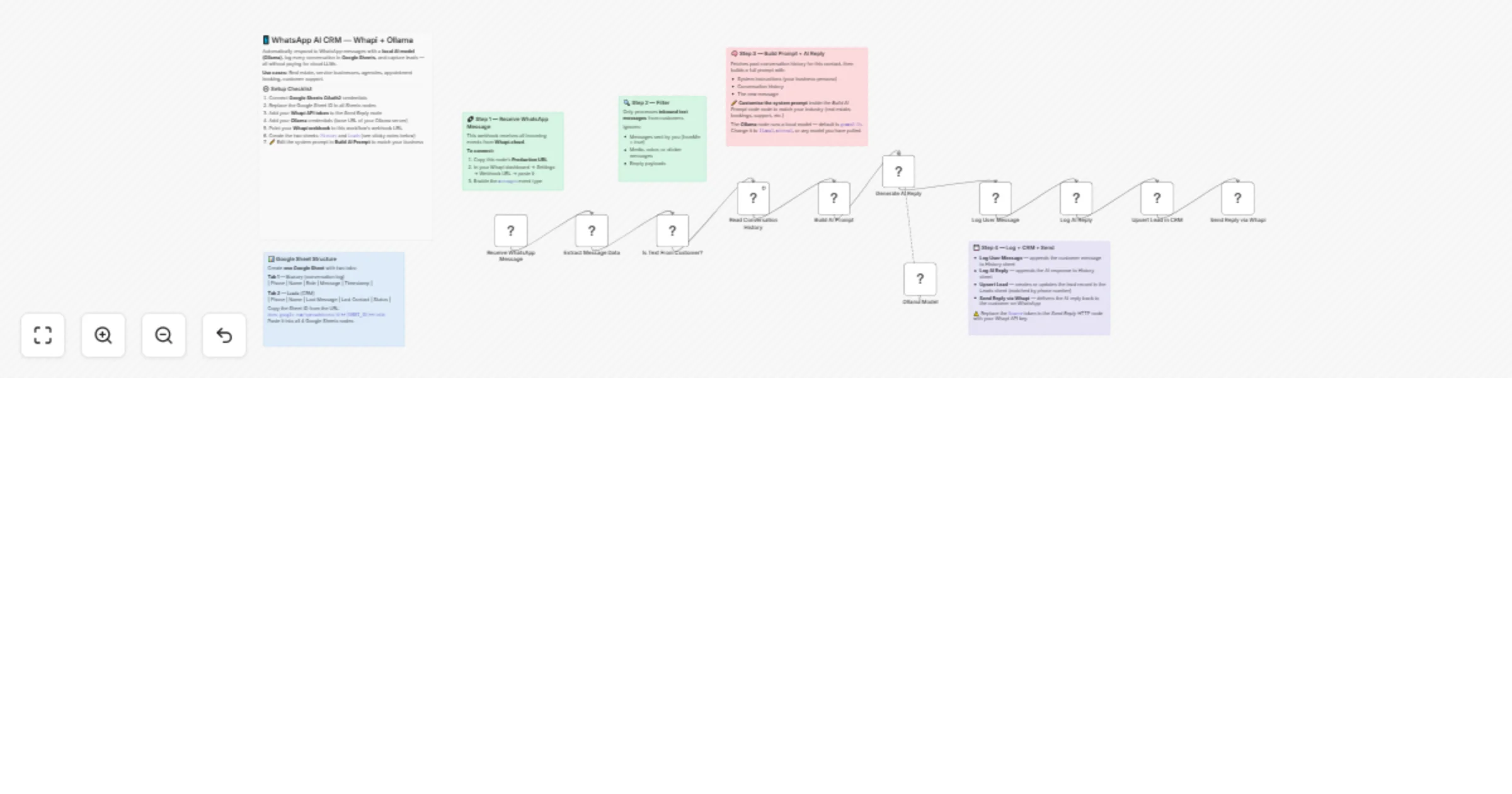
A Webhook node receives inbound WhatsApp messages from Whapi.cloud. A Code node extracts the sender's phone, name, message text, and filters out outbound/non-text messages. An IF node ensures only real inbound text messages from customers are processed. Google Sheets is used to fetch that customer's full conversation history, enabling memory across sessions. A Code node builds a full prompt — system instructions + conversation history + new message — passed to the AI model. Ollama (via LangChain LLM Chain node) generates a contextual reply using a local model (default: gemma3:1b). The user message and AI reply are each appended to Google Sheets as conversation history logs. A separate Google Sheets upsert captures or updates the lead record with phone and name. The AI reply is sent back to the customer via Whapi's HTTP API.
How to use
Set up a Whapi.cloud account and connect a WhatsApp number. Point the webhook to your n8n webhook URL. Create a Google Sheet with a History tab (columns: Phone, Name, Role, Message, Timestamp) and a Leads tab (columns: Phone, Name, CreatedAt). Add your Google Sheets credentials and replace YOUR_GOOGLE_SHEET_ID in the relevant nodes. Run Ollama locally or on your server. Pull the model: ollama pull gemma3:1b. Update the model name in the Ollama node if using a different model. Customise the system prompt inside the Build AI Prompt node to match your business (real estate, support, bookings, etc.). Activate the workflow and send a WhatsApp message to test.
Requirements
Whapi.cloud account (WhatsApp Business API) Ollama running locally or on a self-hosted server Google Sheets (with OAuth2 credentials connected in n8n)
Customising this workflow
Switch AI models: Swap gemma3:1b for any Ollama-supported model like llama3, mistral, or phi3 depending on your hardware. Change the industry: Edit the system prompt in Build AI Prompt to serve any business — bookings, customer support, sales qualification, etc. Upgrade the CRM: Replace Google Sheets with Airtable, Notion, or a real CRM (HubSpot, Pipedrive) by swapping out the Sheets nodes. Add handoff logic: Insert a condition to escalate to a human agent if the message contains keywords like "speak to someone" or "human". Multi-language: The system prompt already instructs the AI to reply in the customer's language — no extra setup needed.
Who is this for
It's designed for service businesses (real estate, consultants, agencies) that want to respond to inbound WhatsApp leads instantly, log conversations, and build a simple CRM — all from a single workflow.