Automate vulnerability triage from Snyk with Jira, Slack & Airtable integration
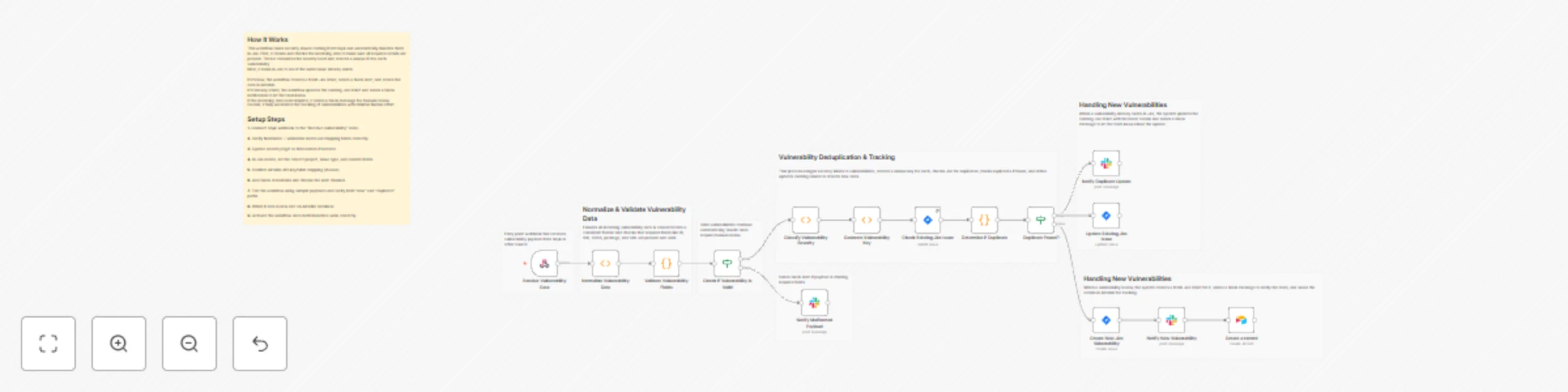
Workflow preview


 Early Deal
DISCOUNT 20%

Important notice
This workflow is provided as-is. Please review and test before using in production.
Overview
Snyk Vulnerability Automation Workflow with Webhook, Jira, Slack & Airtable
This workflow receives vulnerability data(e.g., Snyk, Dependabot or any security scanner) from Snyk through a webhook, standardizes and validates the payload, checks Jira for duplicates using a unique vulnerability key, and either updates an existing Jira issue or creates a new one. It also sends real-time alerts to Slack and stores every new vulnerability in Airtable for reporting and auditing. The workflow ensures fast triage, prevents duplicate Jira tickets and centralizes all data for easy tracking.
Quick Start – Implementation Steps
- Add the n8n Webhook URL to Snyk.
- Configure Jira, Slack and Airtable credentials in n8n.
- Adjust severity rules or Jira fields if required.
- Activate the workflow — vulnerability triage becomes fully automated.
What It Does
This workflow automates how your team processes vulnerabilities reported by Snyk. When a new vulnerability arrives, the system first normalizes the payload into a clean, consistent format. It then validates required fields such as the vulnerability ID, CVSS score, title and URL. If anything is missing, the workflow instantly sends a Slack alert so the team can review.
If the payload is valid, the workflow assigns a severity level and generates a unique “vulnerability key.” This key is used to search Jira for existing issues. If a match is found, the workflow updates the existing Jira ticket and notifies the team. If no match exists, the workflow creates a brand-new Jira issue, sends a Slack alert and also writes the data into Airtable for centralized tracking and analytics.
This ensures accurate documentation, avoids duplicates and gives teams visibility through both Jira and Airtable.
Who’s It For
This workflow is ideal for:
- DevOps and platform engineering teams
- Security engineers
- QA and development teams
- Companies using Snyk for vulnerability scanning
- Teams needing automated Jira creation and Airtable reporting
Requirements to Use This Workflow
To fully use this workflow, you need:
- An n8n instance (cloud or self-hosted)
- A Snyk webhook configured to send vulnerability notifications
- A Jira Software Cloud account
- A Slack workspace with bot permissions
- An Airtable base and personal access token
- Basic understanding of JSON fields
How It Works
- Receive Vulnerability – Snyk posts data to an n8n webhook.
- Normalize Payload – Converts inconsistent Snyk formats into a standard structure.
- Validate Required Fields – Missing fields trigger a Slack alert.
- Assign Severity – CVSS score is mapped to Low/Medium/High/Critical.
- Generate Vulnerability Key – Used for deduplication (e.g., vuln-SNYK-12345).
- Check Jira for Matches – Searches by label to detect duplicates.
- Duplicate Handling – Updates existing Jira issue and sends Slack notification.
- Create New Issue – If no duplicate exists, creates a new Jira ticket.
- Store in Airtable – Adds a new vulnerability row for reporting and history.
- Slack Alerts – Notifies the team of new or updated vulnerabilities.
Setup Steps
- Import the workflow JSON file into n8n.
- Configure credentials:
- Jira
- Slack
- Airtable
- Add the generated webhook URL inside your Snyk project settings.
- Update Jira project ID, issue type, or description fields as needed.
- Map Airtable fields (Title, CVSS, Severity, URL, Key, etc.).
- Update Slack channel IDs.
- Activate the workflow.
How To Customize Nodes
Customize Severity Rules
Modify the node that maps CVSS score ranges:
- Change thresholds
- Add custom severity levels
- Map severity to Jira priority
Customize Jira Fields
Inside the Create or Update Jira Issue nodes, you can modify:
- Project ID
- Issue type
- Labels
- Description template
- Assigned user
Customize Slack Messages
Adjust Slack text blocks to:
- Change formatting
- Add emojis or styling
- Mention specific users or teams
- Send different messages based on severity
Customize Airtable Storage
Update the Airtable node to:
- Add new columns
- Save timestamps
- Link vulnerabilities to other Airtable tables
- Store more metadata for reporting
Add-Ons (Optional Enhancements)
You can extend this workflow with:
- Auto-close Jira tickets when Snyk marks vulnerabilities as “fixed”.
- Severity-based Slack routing (e.g., Critical → #security-alerts).
- Email notifications for high-risk vulnerabilities.
- Google Sheets or Notion logging for long-term tracking.
- Weekly summary report generated using OpenAI.
- Mapping vulnerabilities to microservices or repositories.
- Automated dashboards using Airtable Interfaces.
Use Case Examples
- Automatic Vulnerability Triage – Instantly logs new Snyk findings into Jira.
- Duplicate Prevention – Ensures every vulnerability is tracked only once.
- Slack Alerts – Real-time notifications for new or updated issues.
- Airtable Reporting – Creates a central, filterable database for analysis.
- Security Team Automation – Reduces manual reviews and saves time.
Troubleshooting Guide
| Issue | Possible Cause | Solution |
|---|---|---|
| Slack alert not sent | Wrong API credentials or channel ID | Re-check Slack configuration |
| Jira issue not created | Incorrect project ID / issue type | Update Jira node details |
| Duplicate detection not working | Vulnerability key or label mismatch | Confirm key generation and JQL settings |
| Airtable row not added | Wrong base or field mapping | Reconfigure Airtable node |
| Webhook not triggered | Snyk not pointing to correct URL | Re-add the n8n webhook in Snyk |
| Severity not correct | CVSS parsing error | Check normalization and mapping node |
Need Help?
If you need help setting up this workflow, customizing the logic, integrating new nodes or adding advanced reporting, feel free to reach out to our n8n automation development team at WeblineIndia. We can help automate with advanced security processes, build dashboards, integrate additional tools or expand the workflow as per your business needs.