Automate commercial real estate monitoring with ScrapeGraphAI, Notion and Mailchimp
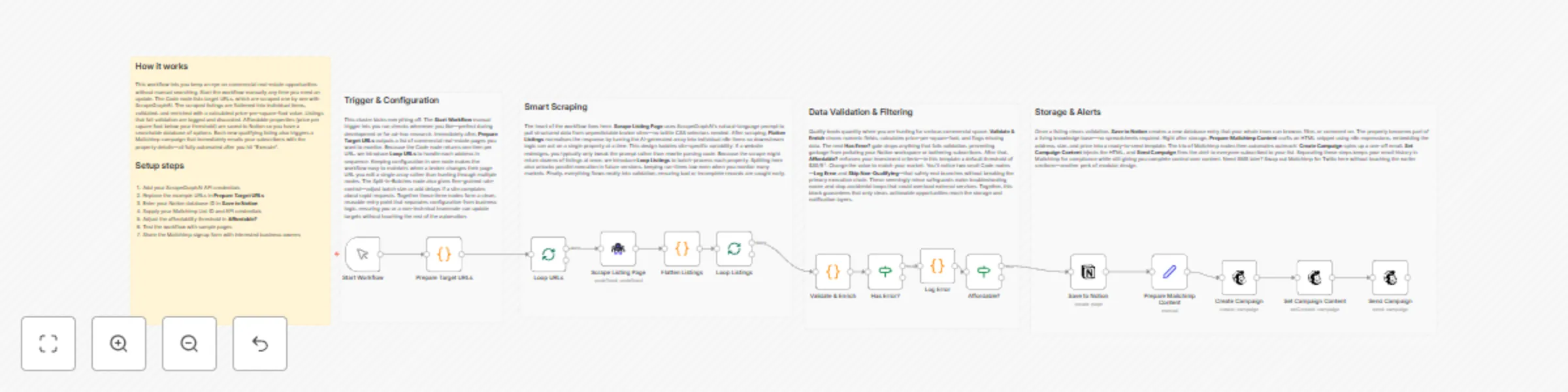
Workflow preview


 Early Deal
DISCOUNT 20%

Important notice
This workflow is provided as-is. Please review and test before using in production.
Overview
Property Listing Aggregator with Mailchimp and Notion
⚠️ COMMUNITY TEMPLATE DISCLAIMER: This is a community-contributed template that uses ScrapeGraphAI (a community node). Please ensure you have the ScrapeGraphAI community node installed in your n8n instance before using this template.
This workflow scrapes multiple commercial-real-estate websites, consolidates new property listings into Notion, and emails weekly availability updates or immediate space alerts to a Mailchimp audience. It automates the end-to-end process so business owners can stay on top of the latest spaces without manual searching.
Pre-conditions/Requirements
Prerequisites
- n8n instance (self-hosted or n8n.cloud)
- ScrapeGraphAI community node installed
- Active Notion workspace with permission to create/read databases
- Mailchimp account with at least one Audience list
- Basic understanding of JSON; ability to add API credentials in n8n
Required Credentials
- ScrapeGraphAI API Key – Enables web scraping functionality
- Notion OAuth2 / Integration Token – Writes data into Notion database
- Mailchimp API Key – Sends campaigns and individual emails
- (Optional) Proxy credentials – If target real-estate sites block your IP
Specific Setup Requirements
| Resource | Requirement | Example |
|---|---|---|
| Notion | Database with property fields (Address, Price, SqFt, URL, Availability) | Database ID: abcd1234efgh |
| Mailchimp | Audience list where alerts are sent | Audience ID: f3a2b6c7d8 |
| ScrapeGraphAI | YAML/JSON config per site | Stored inside the ScrapeGraphAI node |
How it works
This workflow scrapes multiple commercial-real-estate websites, consolidates new property listings into Notion, and emails weekly availability updates or immediate space alerts to a Mailchimp audience. It automates the end-to-end process so business owners can stay on top of the latest spaces without manual searching.
Key Steps:
- Manual Trigger / CRON: Starts the workflow weekly or on-demand.
- Code (Site List Builder): Generates an array of target URLs for ScrapeGraphAI.
- Split In Batches: Processes URLs in manageable groups to avoid rate limits.
- ScrapeGraphAI: Extracts property details from each site.
- IF (New vs Existing): Checks whether the listing already exists in Notion.
- Notion: Inserts new listings or updates existing records.
- Set: Formats email content (HTML & plaintext).
- Mailchimp: Sends a campaign or automated alert to subscribers.
- Sticky Notes: Provide documentation and future-enhancement pointers.
Set up steps
Setup Time: 15-25 minutes
- Install Community Node
Navigate to Settings → Community Nodes and install “ScrapeGraphAI”. - Create Notion Integration
- Go to Notion Settings → Integrations → Develop your own integration.
- Copy the integration token and share your target database with the integration.
- Add Mailchimp API Key
- In Mailchimp: Account → Extras → API keys.
- Copy an existing key or create a new one, then add it to n8n credentials.
- Build Scrape Config
In the ScrapeGraphAI node, paste a YAML/JSON selector config for each website (address, price, sqft, url, availability). - Configure the URL List
Open the first Code node. Replace the placeholder array with your target listing URLs. - Map Notion Fields
Open the Notion node and map scraped fields to your database properties. Save. - Design Email Template
In the Set node, tweak the HTML and plaintext blocks to match your brand. - Test the Workflow
Trigger manually, check that Notion rows are created and Mailchimp sends the message. - Schedule
Add a CRON node (weekly) or leave the Manual Trigger for ad-hoc runs.
Node Descriptions
Core Workflow Nodes:
- Manual Trigger / CRON – Kicks off the workflow either on demand or on a schedule.
- Code (Site List Builder) – Holds an array of commercial real-estate URLs and outputs one item per URL.
- Split In Batches – Prevents hitting anti-bot limits by processing URLs in groups (default: 5).
- ScrapeGraphAI – Crawls each URL, parses DOM with CSS/XPath selectors, returns structured JSON.
- IF (New Listing?) – Compares scraped listing IDs against existing Notion database rows.
- Notion – Creates or updates pages representing property listings.
- Set (Email Composer) – Builds dynamic email subject, body, and merge tags for Mailchimp.
- Mailchimp – Uses the Send Campaign endpoint to email your audience.
- Sticky Note – Contains inline documentation and customization reminders.
Data Flow:
- Manual Trigger/CRON → Code (URLs) → Split In Batches → ScrapeGraphAI → IF (New?)
- True path → Notion (Create) → Set (Email) → Mailchimp
- False path → (skip)
Customization Examples
Filter Listings by Maximum Budget
// Inside the IF node (custom expression)
{{$json["price"] <= 3500}}
Change Email Frequency to Daily Digests
{
  "nodes": [
    {
      "name": "Daily CRON",
      "type": "n8n-nodes-base.cron",
      "parameters": {
        "triggerTimes": [
          {
            "hour": 8,
            "minute": 0
          }
        ]
      }
    }
  ]
}
Data Output Format
The workflow outputs structured JSON data:
{
  "address": "123 Market St, Suite 400",
  "price": 3200,
  "sqft": 950,
  "url": "https://examplebroker.com/listing/123",
  "availability": "Immediate",
  "new": true
}
Troubleshooting
Common Issues
- Scraper returns empty objects – Verify selectors in ScrapeGraphAI config; inspect the site’s HTML for changes.
- Duplicate entries in Notion – Ensure the “IF” node checks a unique ID (e.g., listing URL) before creating a page.
Performance Tips
- Reduce batch size or add delays in ScrapeGraphAI to avoid site blocking.
- Cache previously scraped URLs in an external file or database for faster runs.
Pro Tips:
- Rotate proxies in ScrapeGraphAI for heavily protected sites.
- Use Notion rollups to calculate total available square footage automatically.
- Leverage Mailchimp merge tags (
*|FNAME|*) in the Set node for personalized alerts.