
Auto-update Notion CRM and send email from Google Form submissions

Workflow preview
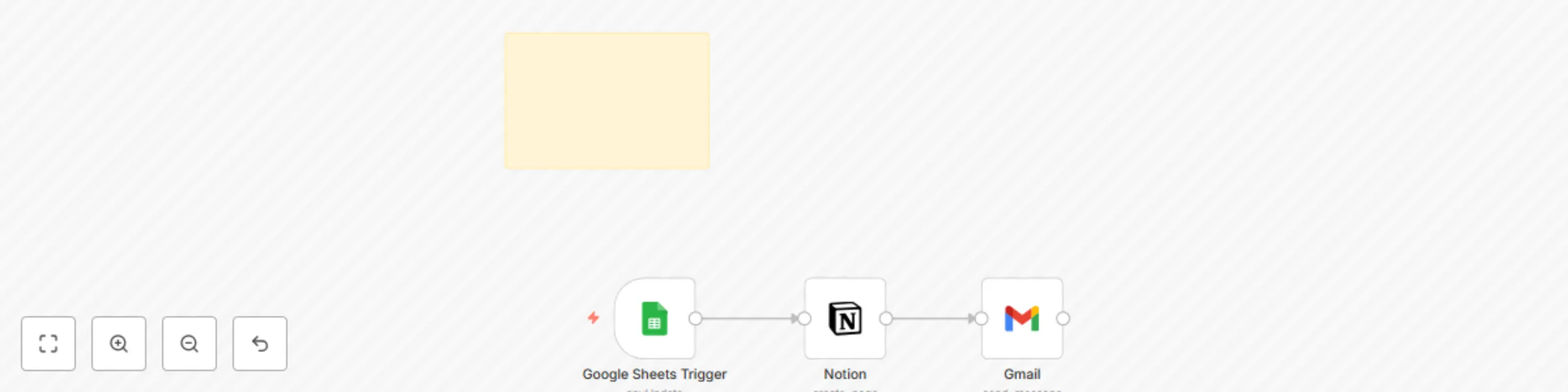
Workflow preview
100%
Auto-update Notion CRM and send email from Google Form submissions preview
Open on n8n.io

Important notice

This workflow is provided as-is. Please review and test before using in production.

1. Workflow Overview

![This automation captures new Google Form responses, maps them into a Notion CRM database, and sends a Gmail confirmation to the submitter. Ideal for lead capture, onboarding, or internal team coo...

Best for

  • Lead Generation automation workflows
  • beginner n8n builders looking for reusable templates

Tools used

n8n-nodes-base.googlesheetstrigger, n8n-nodes-base.notion, n8n-nodes-base.gmail, n8n-nodes-base.stickynote

Source and attribution

This workflow is cataloged by N8N Workflows and links back to its original n8n.io source page by Harsh Sharma.

Original n8n.io source

1.1 Workflow description

Title
Auto-update Notion CRM and send email from Google Form submissions
Workflow name
Auto-update Notion CRM and send email from Google Form submissions

Who is this for?

This is for marketers, educators, HR teams, startups, and freelancers who use Google Forms to collect information and want to automatically send it to Notion while emailing the respondent.


What problem does it solve?

Manual data entry from Google Forms into CRMs is time-consuming. This template eliminates that, ensuring leads are captured in your Notion database in real time and respondents are notified instantly — improving speed and accuracy.


What this workflow does?

  • Node 1 – Google Sheets Trigger: Listens for new rows in the spreadsheet connected to your Google Form.
  • Node 2 – Notion: Creates a new entry in your CRM-style Notion database.
  • Node 3 – Gmail: Sends a confirmation email to the person who filled the form.

🛠 Setup Guide

1. Prepare Google Form and Sheets

  • Create your Google Form.
  • Connect it to a Google Sheet (Responses tab > "Link to Sheets").

2. n8n - Google Sheets Trigger Setup

  • Add Google Sheets Trigger node.
  • Authentication: Use OAuth2 (preferred).
  • Select your spreadsheet and worksheet.
  • Trigger type: On new row (not "updated").

3. n8n - Notion Node

  • Add Notion node (action: "Create Page").

  • Connect your Notion integration:

    • In Notion, create a new integration and copy the token.
    • Share your CRM database with that integration.
  • In the node, map form responses to your database properties:

    • e.g., Name → Title, Email → Email, etc.
    • Use {{$json["Full Name"]}} for mapped fields.
  • Common error: Check Notion property types (email must be set to type: email).

4. n8n - Gmail Node (Optional Auto Reply)

  • Add Gmail node (action: "Send Email").

  • Auth: OAuth2 with your Gmail account.

  • To: {{$json["Email Address"]}}

  • Subject: "Thanks for contacting us!"

  • Body:

    Hi {{$json["Full Name"]}},
    Thanks for reaching out via the form. We’ve received your info and will follow up soon!
    

🧩 How to Customize

  • Replace Gmail with Outlook or SendGrid if needed.
  • Map more fields into Notion like phone, tags, etc.
  • Add Slack or Discord notifications for internal alerts.

🧾 SEO Optimized Title Suggestions

  • Auto-sync Google Forms with Notion CRM and send a confirmation email
  • Add Google Form leads to Notion and auto-send thank-you email via Gmail

📎 Required Permissions / Dependencies

  • Google Sheets and Gmail authenticated in n8n
  • Notion integration shared with your CRM database
  • Enable “Impersonate User” if using Google Service Account

1.2 Logical Blocks

This catalog entry is organized from the workflow JSON. The node-level section below shows the executable blocks available for review before importing the template.

2. Block-by-Block Analysis

Block 1 - Google Sheets Trigger

Type / Role
n8n-nodes-base.googleSheetsTrigger - googleSheetsTrigger
Config choices
Version 1

Block 2 - Notion

Type / Role
n8n-nodes-base.notion - notion
Config choices
Version 2.2

Block 3 - Gmail

Type / Role
n8n-nodes-base.gmail - gmail
Config choices
Version 2.1

Block 4 - Sticky Note

Type / Role
n8n-nodes-base.stickyNote - stickyNote
Config choices
Version 1

3. Summary Table

Workflow Auto-update Notion CRM and send email from Google Form submissions
Complexity beginner
Nodes 4
Categories Lead Generation
Author Harsh Sharma
Published 11 May 2025

4. Reproducing the Workflow from Scratch

  1. 1. Download the workflow JSON

    Use the JSON export at /data/workflows/3985/3985.json as the source template for this automation.

  2. 2. Import the template into n8n

    Open n8n, import the downloaded JSON, and review each node before activating the workflow.

  3. 3. Configure credentials and variables

    Replace placeholder credentials, API keys, webhook URLs, account IDs, and environment-specific values with your own settings.

  4. 4. Test with sample data

    Run the workflow manually or in a staging workspace, inspect node output, and confirm downstream systems receive the expected data.

  5. 5. Activate and monitor

    Enable the workflow only after testing, then monitor executions, errors, and rate limits during the first production runs.

5. General Notes & Resources

Review imported nodes carefully before activation. This catalog entry is intended to help you inspect the workflow structure, understand required services, and find related templates faster.

Node names, credentials, schedules, webhook paths, and external service limits may need adjustment for your workspace.

Frequently asked questions

What does Auto-update Notion CRM and send email from Google Form submissions do?

![This automation captures new Google Form responses, maps them into a Notion CRM database, and sends a Gmail confirmation to the submitter. Ideal for lead capture, onboarding, or internal team coo...

What do I need before importing this workflow?

Review the workflow JSON, configure any required credentials in n8n, and test the automation in a safe workspace before using it in production.

Can I customize this workflow?

Yes. Use the block-by-block analysis and the downloadable JSON to inspect each node, then adjust credentials, prompts, schedules, filters, or destinations for your Lead Generation use case.



