
Auto-post LinkedIn updates from spreadsheet topics using GPT-4o

Workflow preview
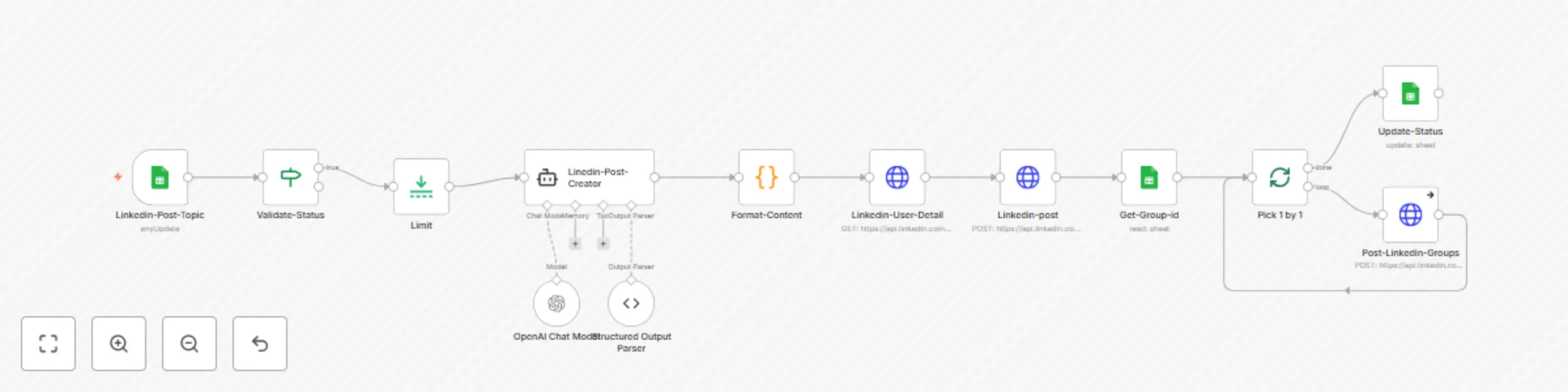
Workflow preview
100%
Auto-post LinkedIn updates from spreadsheet topics using GPT-4o preview
Open on n8n.io

Important notice

This workflow is provided as-is. Please review and test before using in production.

1. Workflow Overview

How it works: This workflow automates the entire LinkedIn content distribution process — from AI powered post creation to auto posting on both personal LinkedIn profiles and LinkedIn groups, using ...

Best for

  • Social Media automation workflows
  • Multimodal AI automation workflows
  • intermediate n8n builders looking for reusable templates

Tools used

n8n-nodes-base.limit, @n8n/n8n-nodes-langchain.outputparserstructured, @n8n/n8n-nodes-langchain.lmchatopenai, n8n-nodes-base.googlesheetstrigger, n8n-nodes-base.if, @n8n/n8n-nodes-langchain.agent, n8n-nodes-base.code, n8n-nodes-base.httprequest

Source and attribution

This workflow is cataloged by N8N Workflows and links back to its original n8n.io source page by Amit Mehta.

Original n8n.io source

1.1 Workflow description

Title
Auto-post LinkedIn updates from spreadsheet topics using GPT-4o
Workflow name
Auto-post LinkedIn updates from spreadsheet topics using GPT-4o

How it works:

This workflow automates the entire LinkedIn content distribution process — from AI-powered post creation to auto-posting on both personal LinkedIn profiles and LinkedIn groups, using GPT-4o and Google Sheets as the content source and control panel.

  1. Auto-generates professional LinkedIn posts from spreadsheet topics using GPT-4o.
  2. Posts to your LinkedIn profile and multiple groups.
  3. Updates status to avoid duplicate posting.
  4. Fully customizable and reusable with your spreadsheet.

Set up Steps

  1. Create and Upload the Spreadsheet

    1. Name it: Linkedin Post
    2. Sheet1 (for post topics): Columns: ID | Linkedin Post Title | Status
    3. Add post titles under Linkedin Post Title
    4. Set Status to Pending
    5. Create new sheet name as "Groups" (for group distribution): Column: GroupIds
    6. Add LinkedIn Group IDs, one per row
  2. Connect Google Sheets Nodes

    1. Connect your Google account to these nodes:
      1. Linkedin Post topic (Reads post topics)
      2. Get group id (Reads LinkedIn groups)
      3. Update Status (Writes back the status after posting)
  3. Configure GPT-4o (OpenAI)

    1. Add your OpenAI API key in the Linkedin Post creator node
    2. This node will generate high-quality content from your topic titles
  4. Connect LinkedIn Account

    1. Add your LinkedIn credentials in the Linkedin user detail node
    2. Ensure appropriate permissions to post on profile and groups
  5. Activate the Workflow : Once live, the workflow will:

    1. Monitor the Google Sheet for Pending posts.
    2. Generate content via GPT-4o.
    3. Post to:
      1. Your LinkedIn Profile
      2. Each LinkedIn Group listed in the Groups sheet
    4. Update the post Status to Posted

Customization Tips

Want to personalize this template?

  1. Change AI tone or style in the OpenAI node prompt
  2. Add a scheduler node if you'd like to post at fixed intervals
  3. Use a Slack or Telegram approval step before posting
  4. Integrate analytics tools to track post performance

Suggested Sticky Notes for Workflow

Node or Section Sticky Note Content
Linkedin Post topic Reads the topic titles and statuses from Sheet1
OpenAI (GPT-4o) Generates content using topic title — you can modify the tone/prompt here
Linkedin user detail Your personal LinkedIn credentials — required to post
Group loop Iterates through LinkedIn Group IDs and posts the content
Update Status Updates spreadsheet so the topic isn't re-posted

1.2 Logical Blocks

This catalog entry is organized from the workflow JSON. The node-level section below shows the executable blocks available for review before importing the template.

2. Block-by-Block Analysis

Block 1 - Limit

Type / Role
n8n-nodes-base.limit - limit
Config choices
Version 1

Block 2 - Structured Output Parser

Type / Role
@n8n/n8n-nodes-langchain.outputParserStructured - outputParserStructured
Config choices
Version 1.2

Block 3 - OpenAI Chat Model

Type / Role
@n8n/n8n-nodes-langchain.lmChatOpenAi - lmChatOpenAi
Config choices
Version 1.2

Block 4 - Linkedin-Post-Topic

Type / Role
n8n-nodes-base.googleSheetsTrigger - googleSheetsTrigger
Config choices
Version 1

Block 5 - Validate-Status

Type / Role
n8n-nodes-base.if - if
Config choices
Version 2.2

Block 6 - Linedin-Post-Creator

Type / Role
@n8n/n8n-nodes-langchain.agent - agent
Config choices
Version 1.9

Block 7 - Format-Content

Type / Role
n8n-nodes-base.code - code
Config choices
Version 2

Block 8 - Linkedin-User-Detail

Type / Role
n8n-nodes-base.httpRequest - httpRequest
Config choices
Version 4.2

Block 9 - Linkedin-post

Type / Role
n8n-nodes-base.httpRequest - httpRequest
Config choices
Version 4.2

Block 10 - Get-Group-id

Type / Role
n8n-nodes-base.googleSheets - googleSheets
Config choices
Version 4.5

Block 11 - Pick 1 by 1

Type / Role
n8n-nodes-base.splitInBatches - splitInBatches
Config choices
Version 3

Block 12 - Post-Linkedin-Groups

Type / Role
n8n-nodes-base.httpRequest - httpRequest
Config choices
Version 4.2

Block 13 - Update-Status

Type / Role
n8n-nodes-base.googleSheets - googleSheets
Config choices
Version 4.5

3. Summary Table

Workflow Auto-post LinkedIn updates from spreadsheet topics using GPT-4o
Complexity intermediate
Nodes 13
Categories Social Media, Multimodal AI
Author Amit Mehta
Published 23 May 2025

4. Reproducing the Workflow from Scratch

  1. 1. Download the workflow JSON

    Use the JSON export at /data/workflows/4344/4344.json as the source template for this automation.

  2. 2. Import the template into n8n

    Open n8n, import the downloaded JSON, and review each node before activating the workflow.

  3. 3. Configure credentials and variables

    Replace placeholder credentials, API keys, webhook URLs, account IDs, and environment-specific values with your own settings.

  4. 4. Test with sample data

    Run the workflow manually or in a staging workspace, inspect node output, and confirm downstream systems receive the expected data.

  5. 5. Activate and monitor

    Enable the workflow only after testing, then monitor executions, errors, and rate limits during the first production runs.

5. General Notes & Resources

Review imported nodes carefully before activation. This catalog entry is intended to help you inspect the workflow structure, understand required services, and find related templates faster.

Node names, credentials, schedules, webhook paths, and external service limits may need adjustment for your workspace.

Frequently asked questions

What does Auto-post LinkedIn updates from spreadsheet topics using GPT-4o do?

How it works: This workflow automates the entire LinkedIn content distribution process — from AI powered post creation to auto posting on both personal LinkedIn profiles and LinkedIn groups, using ...

What do I need before importing this workflow?

Review the workflow JSON, configure any required credentials in n8n, and test the automation in a safe workspace before using it in production.

Can I customize this workflow?

Yes. Use the block-by-block analysis and the downloadable JSON to inspect each node, then adjust credentials, prompts, schedules, filters, or destinations for your Social Media, Multimodal AI use case.



