
Auto-generate platform-optimized social media posts from WordPress with Claude & Postiz

Workflow preview
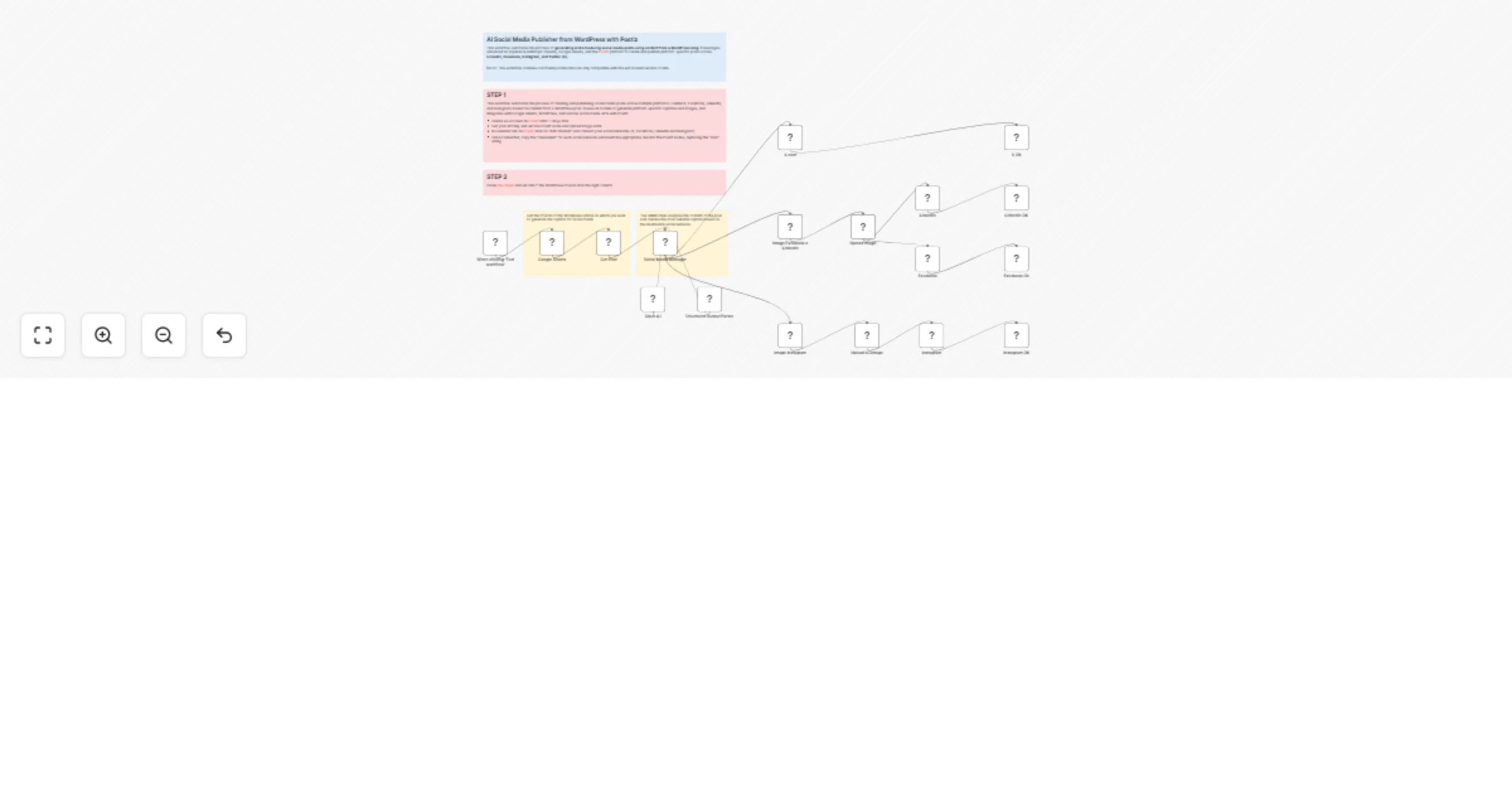
Workflow preview
100%
Auto-generate platform-optimized social media posts from WordPress with Claude & Postiz preview
Open on n8n.io

Important notice

This workflow is provided as-is. Please review and test before using in production.

1. Workflow Overview

This workflow automates the process of generating and scheduling social media posts using content from a WordPress blog . It leverages advanced AI (OpenAI & Anthropic Claude), Google Sheets, and th...

Best for

  • Social Media automation workflows
  • Multimodal AI automation workflows
  • advanced n8n builders looking for reusable templates

Tools used

n8n-nodes-base.manualtrigger, n8n-nodes-base.googlesheets, @n8n/n8n-nodes-langchain.outputparserstructured, @n8n/n8n-nodes-langchain.openai, @n8n/n8n-nodes-langchain.chainllm, n8n-nodes-base.stickynote, n8n-nodes-base.wordpress, n8n-nodes-postiz.postiz

Source and attribution

This workflow is cataloged by N8N Workflows and links back to its original n8n.io source page by Davide.

Original n8n.io source

1.1 Workflow description

Title
Auto-generate platform-optimized social media posts from WordPress with Claude & Postiz
Workflow name
Auto-generate platform-optimized social media posts from WordPress with Claude & Postiz

This workflow automates the process of generating and scheduling social media posts using content from a WordPress blog. It leverages advanced AI (OpenAI & Anthropic Claude), Google Sheets, and the Postiz platform to create and publish platform-specific posts across LinkedIn, Facebook, Instagram, and Twitter (X).

This system streamlines cross-platform social media publishing, ensuring consistent branding and AI-optimized content.


Key Features

  1. Content Source: WordPress

    • Automatically fetches the content of a WordPress post by its Post ID.
  2. Content Transformation via AI

    • Uses Anthropic Claude and OpenAI to generate unique, optimized captions for each platform:

      • LinkedIn: professional and insight-driven
      • Instagram: creative with emojis and storytelling
      • Facebook: community-oriented and friendly
      • Twitter (X): concise, hashtag-optimized
  3. Visual Generation (Optional)

    • Uses OpenAI's DALL·E (via OpenRouter) to generate custom images based on the AI-generated Instagram and Facebook/LinkedIn captions.
  4. Post Management with Google Sheets

    • Uses a Google Sheet as the control panel:

      • Simply input the WordPress Post ID
      • Marks each post as “done” by updating corresponding columns (TWITTER, FACEBOOK, INSTAGRAM, LINKEDIN)
  5. Publishing via Postiz

    • Uses the Postiz API to schedule or immediately publish posts to your connected social accounts.
    • Handles image uploads and scheduling time for each platform.

Benefits

  • 💡 Intelligent automation: Saves time by removing manual copywriting and platform formatting.
  • 🎯 Platform optimization: Ensures posts are tailored to each platform’s audience and algorithm.
  • 🛠️ No-code friendly: Simple setup via Google Sheets + Postiz + WordPress.
  • 🔁 Repeatable & Scalable: Ideal for agencies or content creators managing multiple posts per week.
  • 🧪 +20 Social Media Platforms: Easy to start with social integrations.

How It Works

  1. Input & Data Fetching:

    • The workflow starts with a manual trigger (e.g., "Test workflow") or scheduled execution.
    • It retrieves a WordPress post ID from a Google Sheets document, then fetches the full post content (title and body) via the WordPress API.
  2. AI-Powered Content Generation:

    • The "Social Media Manager" node (powered by Claude Opus 4.1) analyzes the post and generates platform-optimized captions for:
      • Twitter/X: Concise, hashtag-rich text (≤150 chars).
      • Facebook/LinkedIn: Professional yet engaging copy with CTAs.
      • Instagram: Visual-focused captions with emojis and hashtags.
    • AI-generated images are created for Instagram (square) and Facebook/LinkedIn (landscape) using OpenAI’s image model.
  3. Publishing Automation:

    • Captions and images are uploaded to Postiz, a social media scheduler.
    • Postiz publishes the content to connected platforms (Twitter, Facebook, LinkedIn, Instagram) at the specified time.
    • Google Sheets is updated with status markers (e.g., "x" in columns like TWITTER, FACEBOOK) to track published posts.

Set Up Steps

  1. Prerequisites:

    • Postiz Account: Sign up for Postiz (free trial available).
    • API Keys: Configure Postiz API credentials in the "Postiz" and "Upload Image" nodes.
    • Social Channels: Link your social accounts in Postiz’s dashboard and note their integrationId values (replace "XXX" in Postiz nodes).
  2. Google Sheets Setup:

    • Clone the template Sheet and add WordPress post IDs to the "POST ID" column.
  3. Configure Nodes:

    • WordPress: Add credentials for your WordPress site in the "Get Post" node.
    • AI Models: Ensure API keys for Claude (Anthropic) and OpenAI (for images) are valid.
    • Postiz Nodes: Replace placeholder integrationId values with your actual Postiz channel IDs.
  4. Test & Deploy:

    • Trigger the workflow manually to verify captions, images, and Postiz scheduling.
    • Activate the workflow for automation (e.g., run daily to publish new WordPress posts).

Note: This workflow requires self-hosted n8n due to community nodes (Postiz, LangChain).


Need help customizing?

Contact me for consulting and support or add me on Linkedin.

1.2 Logical Blocks

This catalog entry is organized from the workflow JSON. The node-level section below shows the executable blocks available for review before importing the template.

2. Block-by-Block Analysis

Block 1 - When clicking ‘Test workflow’

Type / Role
n8n-nodes-base.manualTrigger - manualTrigger
Config choices
Version 1

Block 2 - Google Sheets

Type / Role
n8n-nodes-base.googleSheets - googleSheets
Config choices
Version 4.5

Block 3 - Structured Output Parser

Type / Role
@n8n/n8n-nodes-langchain.outputParserStructured - outputParserStructured
Config choices
Version 1.2

Block 4 - Image Instagram

Type / Role
@n8n/n8n-nodes-langchain.openAi - openAi
Config choices
Version 1.8

Block 5 - Image Facebook e Linkedin

Type / Role
@n8n/n8n-nodes-langchain.openAi - openAi
Config choices
Version 1.8

Block 6 - Social Media Manager

Type / Role
@n8n/n8n-nodes-langchain.chainLlm - chainLlm
Config choices
Version 1.5

Block 7 - Sticky Note

Type / Role
n8n-nodes-base.stickyNote - stickyNote
Config choices
Version 1

Block 8 - Linkedin OK

Type / Role
n8n-nodes-base.googleSheets - googleSheets
Config choices
Version 4.5

Block 9 - Facebook Ok

Type / Role
n8n-nodes-base.googleSheets - googleSheets
Config choices
Version 4.5

Block 10 - Instagram OK

Type / Role
n8n-nodes-base.googleSheets - googleSheets
Config choices
Version 4.5

Block 11 - Get Post

Type / Role
n8n-nodes-base.wordpress - wordpress
Config choices
Version 1

Block 12 - Sticky Note1

Type / Role
n8n-nodes-base.stickyNote - stickyNote
Config choices
Version 1

Block 13 - X OK

Type / Role
n8n-nodes-base.googleSheets - googleSheets
Config choices
Version 4.5

Block 14 - Sticky Note2

Type / Role
n8n-nodes-base.stickyNote - stickyNote
Config choices
Version 1

Block 15 - Sticky Note3

Type / Role
n8n-nodes-base.stickyNote - stickyNote
Config choices
Version 1

Block 16 - Facebook

Type / Role
n8n-nodes-postiz.postiz - postiz
Config choices
Version 1

Block 17 - Linkedin

Type / Role
n8n-nodes-postiz.postiz - postiz
Config choices
Version 1

Block 18 - Instagram

Type / Role
n8n-nodes-postiz.postiz - postiz
Config choices
Version 1

Block 19 - Upload image

Type / Role
n8n-nodes-base.httpRequest - httpRequest
Config choices
Version 4.2

Block 20 - Upload IG Image

Type / Role
n8n-nodes-base.httpRequest - httpRequest
Config choices
Version 4.2

Block 21 - X.com

Type / Role
n8n-nodes-postiz.postiz - postiz
Config choices
Version 1

Block 22 - Sticky Note4

Type / Role
n8n-nodes-base.stickyNote - stickyNote
Config choices
Version 1

Block 23 - Opus 4.1

Type / Role
@n8n/n8n-nodes-langchain.lmChatAnthropic - lmChatAnthropic
Config choices
Version 1.3

3. Summary Table

Workflow Auto-generate platform-optimized social media posts from WordPress with Claude & Postiz
Complexity advanced
Nodes 23
Categories Social Media, Multimodal AI
Author Davide
Published 06 Aug 2025

4. Reproducing the Workflow from Scratch

  1. 1. Download the workflow JSON

    Use the JSON export at /data/workflows/7046/7046.json as the source template for this automation.

  2. 2. Import the template into n8n

    Open n8n, import the downloaded JSON, and review each node before activating the workflow.

  3. 3. Configure credentials and variables

    Replace placeholder credentials, API keys, webhook URLs, account IDs, and environment-specific values with your own settings.

  4. 4. Test with sample data

    Run the workflow manually or in a staging workspace, inspect node output, and confirm downstream systems receive the expected data.

  5. 5. Activate and monitor

    Enable the workflow only after testing, then monitor executions, errors, and rate limits during the first production runs.

5. General Notes & Resources

Review imported nodes carefully before activation. This catalog entry is intended to help you inspect the workflow structure, understand required services, and find related templates faster.

Node names, credentials, schedules, webhook paths, and external service limits may need adjustment for your workspace.

Frequently asked questions

What does Auto-generate platform-optimized social media posts from WordPress with Claude & Postiz do?

This workflow automates the process of generating and scheduling social media posts using content from a WordPress blog . It leverages advanced AI (OpenAI & Anthropic Claude), Google Sheets, and th...

What do I need before importing this workflow?

Review the workflow JSON, configure any required credentials in n8n, and test the automation in a safe workspace before using it in production.

Can I customize this workflow?

Yes. Use the block-by-block analysis and the downloadable JSON to inspect each node, then adjust credentials, prompts, schedules, filters, or destinations for your Social Media, Multimodal AI use case.



