Auto-classify security incidents with GPT-4 and Google Sheets for SOC teams
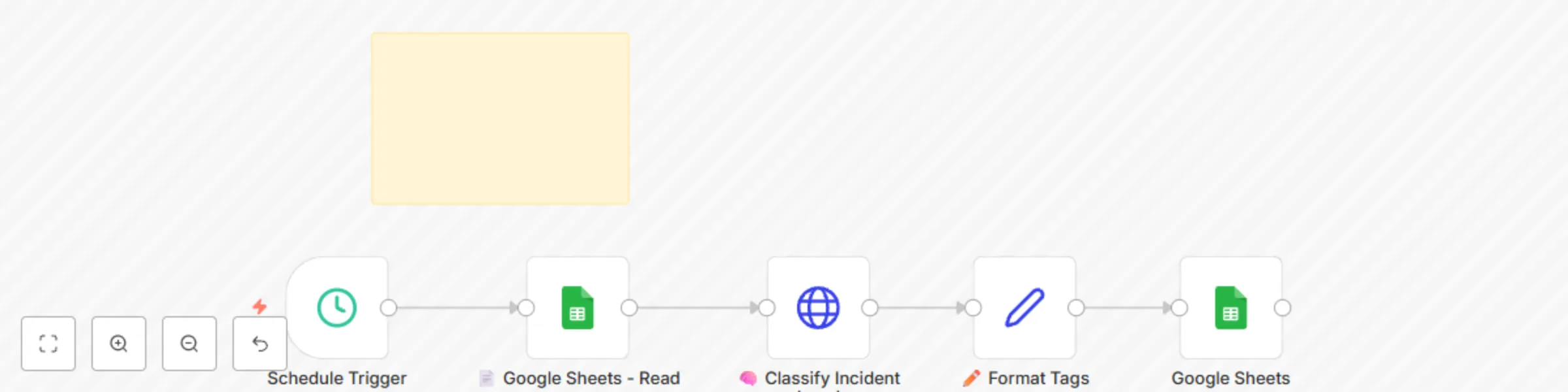
Workflow preview


 Early Deal
DISCOUNT 20%

Important notice
This workflow is provided as-is. Please review and test before using in production.
Overview
👤 Who it’s for
Blue Team leads, SOC analysts, and IT responders looking to automatically classify security alerts using AI-driven logic and asset-based risk signals.
Ideal for teams already scoring threats via CyberScan or BlueOps Module 3, and needing to prioritize next steps across Monitor / Investigate / Isolate / Escalate playbooks.
⚙️ How it works / What it does
Reads recent endpoint alerts from Google Sheets
Sends alert data (hostname, IP, risk score) to OpenAI GPT model
GPT returns structured JSON with:
severity tag (Low / Medium / High / Critical)
action recommendation (Monitor / Investigate / Isolate / Escalate)
Logs the full result to a centralized incident sheet
Can be expanded to trigger automated EDR actions or email alerts
🛠️ How to set up
Insert OpenAI API Key Replace placeholder with your actual OpenAI secret in the HTTP Request node
Connect Sheets Use your OAuth2 credentials to access the alerts input + classified log sheet
Tune GPT Prompt Adjust language or risk thresholds inside the 🧠 Classify Incident (GPT) node
Automation Add a Cron node or Webhook to run every X minutes/hours
📋 Requirements
OpenAI API key (GPT-4 or GPT-3.5 supported)
Google Sheets (or similar DB with alerts)
n8n credentials for Sheets access
Optional: Connected playbook actions or EDR endpoint logic
🧩 How to customize the workflow
Swap GPT with Claude, Gemini, or local LLM via API
Replace Google Sheets with Supabase or Airtable
Add a playbook router for Notify / Isolate logic
Integrate email or ticketing notification step
📦 This is a production-grade, AI-powered classification engine.
All inputs and tags are configurable. Safe placeholders are marked clearly.
📘 This module is part of the CYBERPULSEBlueOps Pro automation suite.
Explore the full set at 👉 cyberpulsesolutions.com/blueops