
Audit Confluence space permissions and public links for compliance

Workflow preview
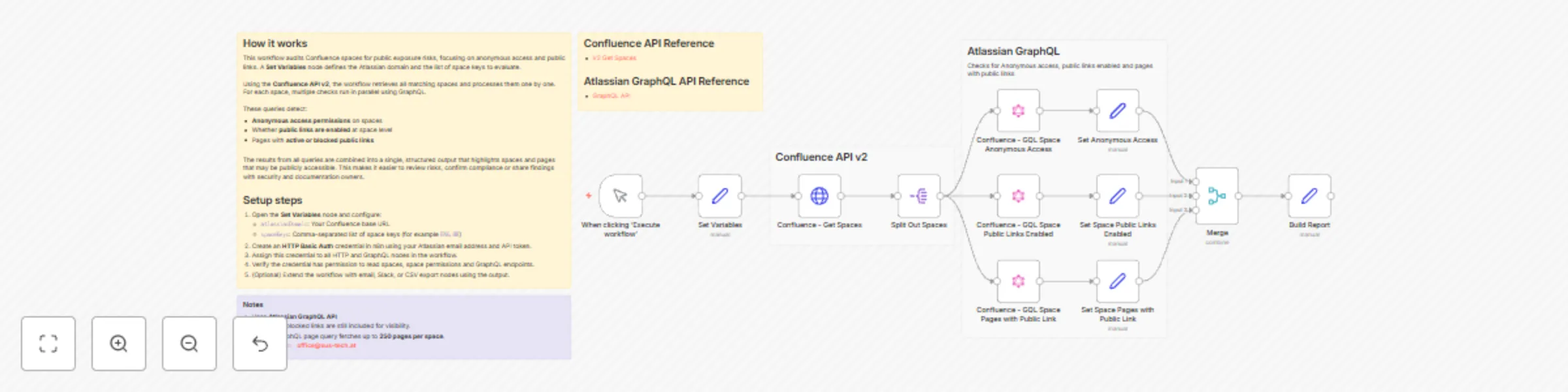
Workflow preview
100%
Audit Confluence space permissions and public links for compliance preview
Open on n8n.io

Important notice

This workflow is provided as-is. Please review and test before using in production.

1. Workflow Overview

Audit permissions in Confluence to ensure compliance This workflow scans selected Confluence spaces for public exposure risks , helping teams identify unintended access and potential data leakage. ...

Best for

  • SecOps automation workflows
  • advanced n8n builders looking for reusable templates

Tools used

n8n-nodes-base.manualtrigger, n8n-nodes-base.set, n8n-nodes-base.graphql, n8n-nodes-base.splitout, n8n-nodes-base.stickynote, n8n-nodes-base.merge, n8n-nodes-base.httprequest

Source and attribution

This workflow is cataloged by N8N Workflows and links back to its original n8n.io source page by Alexander Schnabl.

Original n8n.io source

1.1 Workflow description

Title
Audit Confluence space permissions and public links for compliance
Workflow name
Audit Confluence space permissions and public links for compliance

Audit permissions in Confluence to ensure compliance

This workflow scans selected Confluence spaces for public exposure risks, helping teams identify unintended access and potential data leakage.

What it does

  • Detects public exposure risks in Confluence spaces, including:
    • Anonymous access permissions at space level
    • Whether public links are enabled
    • Pages with active or blocked public links
  • Uses Confluence REST API v2 together with the Atlassian GraphQL API.
  • Produces a consolidated per-space report containing:
    • Anonymous access permissions
    • Public link status
    • Pages with public links (title, status, URL, enabled-by user)
  • Ideal for security audits, compliance reviews, and data leakage prevention.

How it works

  • The workflow starts via a Manual Trigger.
  • A Set Variables node defines:
    • atlassianDomain
    • spaceKeys (comma-separated)
  • Get Spaces (v2) retrieves matching spaces and splits them into individual items.
  • For each space, three GraphQL queries run in parallel:
    • Retrieve anonymous access permissions
    • Check public link feature status at space level
    • Fetch pages with public links (ON / BLOCKED)
  • Results from all three queries are merged and normalized into a single per-space report.

Setup

  • Configure the Set Variables node:
    • atlassianDomain → your Confluence base URL
    • spaceKeys → comma-separated list (e.g. ENG, HR)
  • Create an HTTP Basic Auth credential for Atlassian:
    • Email + API token
    • Assign it to all HTTP and GraphQL nodes
  • Ensure the credential has permission to:
    • Read spaces
    • Read space permissions
    • Access GraphQL endpoints
  • Execute the workflow manually to generate the report.

Notes

  • Uses the Atlassian GraphQL API, which exposes permission and public-link data not fully available via REST.
  • Pages with blocked public links are included for visibility.
  • The GraphQL page query fetches up to 250 pages per space.

1.2 Logical Blocks

This catalog entry is organized from the workflow JSON. The node-level section below shows the executable blocks available for review before importing the template.

2. Block-by-Block Analysis

Block 1 - When clicking ‘Execute workflow’

Type / Role
n8n-nodes-base.manualTrigger - manualTrigger
Config choices
Version 1

Block 2 - Set Variables

Type / Role
n8n-nodes-base.set - set
Config choices
Version 3.4

Block 3 - Confluence - GQL Space Anonymous Access

Type / Role
n8n-nodes-base.graphql - graphql
Config choices
Version 1.1

Block 4 - Split Out Spaces

Type / Role
n8n-nodes-base.splitOut - splitOut
Config choices
Version 1

Block 5 - Sticky Note2

Type / Role
n8n-nodes-base.stickyNote - stickyNote
Config choices
Version 1

Block 6 - Confluence - GQL Space Public Links Enabled

Type / Role
n8n-nodes-base.graphql - graphql
Config choices
Version 1.1

Block 7 - Confluence - GQL Space Pages with Public Link

Type / Role
n8n-nodes-base.graphql - graphql
Config choices
Version 1.1

Block 8 - Merge

Type / Role
n8n-nodes-base.merge - merge
Config choices
Version 3.2

Block 9 - Set Anonymous Access

Type / Role
n8n-nodes-base.set - set
Config choices
Version 3.4

Block 10 - Set Space Public Links Enabled

Type / Role
n8n-nodes-base.set - set
Config choices
Version 3.4

Block 11 - Set Space Pages with Public Link

Type / Role
n8n-nodes-base.set - set
Config choices
Version 3.4

Block 12 - Confluence - Get Spaces

Type / Role
n8n-nodes-base.httpRequest - httpRequest
Config choices
Version 4.3

Block 13 - Build Report

Type / Role
n8n-nodes-base.set - set
Config choices
Version 3.4

Block 14 - Sticky Note

Type / Role
n8n-nodes-base.stickyNote - stickyNote
Config choices
Version 1

Block 15 - Sticky Note6

Type / Role
n8n-nodes-base.stickyNote - stickyNote
Config choices
Version 1

Block 16 - Sticky Note1

Type / Role
n8n-nodes-base.stickyNote - stickyNote
Config choices
Version 1

Block 17 - Sticky Note3

Type / Role
n8n-nodes-base.stickyNote - stickyNote
Config choices
Version 1

3. Summary Table

Workflow Audit Confluence space permissions and public links for compliance
Complexity advanced
Nodes 17
Categories SecOps
Author Alexander Schnabl
Published 28 Dec 2025

4. Reproducing the Workflow from Scratch

  1. 1. Download the workflow JSON

    Use the JSON export at /data/workflows/12239/12239.json as the source template for this automation.

  2. 2. Import the template into n8n

    Open n8n, import the downloaded JSON, and review each node before activating the workflow.

  3. 3. Configure credentials and variables

    Replace placeholder credentials, API keys, webhook URLs, account IDs, and environment-specific values with your own settings.

  4. 4. Test with sample data

    Run the workflow manually or in a staging workspace, inspect node output, and confirm downstream systems receive the expected data.

  5. 5. Activate and monitor

    Enable the workflow only after testing, then monitor executions, errors, and rate limits during the first production runs.

5. General Notes & Resources

Review imported nodes carefully before activation. This catalog entry is intended to help you inspect the workflow structure, understand required services, and find related templates faster.

Node names, credentials, schedules, webhook paths, and external service limits may need adjustment for your workspace.

Frequently asked questions

What does Audit Confluence space permissions and public links for compliance do?

Audit permissions in Confluence to ensure compliance This workflow scans selected Confluence spaces for public exposure risks , helping teams identify unintended access and potential data leakage. ...

What do I need before importing this workflow?

Review the workflow JSON, configure any required credentials in n8n, and test the automation in a safe workspace before using it in production.

Can I customize this workflow?

Yes. Use the block-by-block analysis and the downloadable JSON to inspect each node, then adjust credentials, prompts, schedules, filters, or destinations for your SecOps use case.



