AI-powered RAG Q&A chatbot with OpenAI, Google Sheets, Glide & Supabase
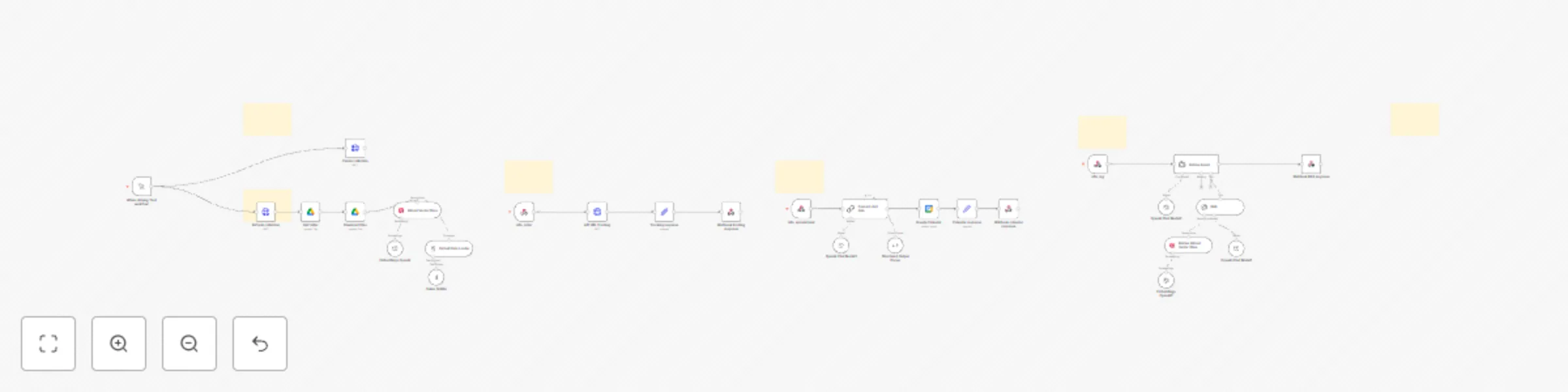
Workflow preview


 Early Deal
DISCOUNT 20%

Important notice
This workflow is provided as-is. Please review and test before using in production.
Overview
Automate AI-Powered RAG System with Contextual Q&A, Google Sheets Integration, and Glide Frontend—Powered by n8n, OpenAI, Supabase, and Google Apps Script.
Tools & Services Used
Glide (Frontend for user interactions)
Google Sheets (Stores questions and answers)
Google Apps Script (Forms + media upload handling)
OpenAI (Embeddings + GPT-4 to rank and generate answers)
Supabase (Optional for image hosting)
n8n (Automation logic and backend glue)
Workflow Overview
This automation performs the following steps:
Trigger: Webhook receives a user question from a Glide frontend.
Fetch Data: Retrieves Q&A entries (and optionally, image URLs) from a connected Google Sheet.
Rank Relevance:
OpenAI Embeddings rank the relevance of stored questions to the new input.
Top matches are passed to a GPT-4 prompt for answer generation.
Generate Answer:
GPT-4 creates a contextual answer using the best match.
Optional: Includes media URL if attached to the matched answer.
Response: Sends the formatted answer back to Glide frontend (text + optional image).
Prerequisites
Active accounts and API keys for:
OpenAI (API key with GPT-4 and embedding access)
Google Sheets (linked via Service Account or OAuth2 credentials)
Glide App (with a form to submit questions)
Supabase (optional, if hosting user-uploaded media)
n8n Self-hosted (for community nodes and webhook access)
How to Use This Template
Step 1: Import the Template
Upload the provided JSON into your self-hosted n8n instance.
Requires installation of the Community Node: @n8n/n8n-nodes-openai-embeddings
Step 2: Configure Credentials
Webhook Trigger: Replace the Glide webhook URL with your actual endpoint from your app.
Google Sheets Node: Set the spreadsheet ID and worksheet name to fetch your Q&A dataset.
OpenAI Nodes:
Insert your OpenAI API key.
Confirm that both text-embedding-ada-002 (or similar) and gpt-4 are available.
Supabase or Apps Script (Optional): Ensure image links are correctly formed in the Sheet.
Step 3: Customize Prompts and Thresholds
Update the OpenAI ranking prompt or similarity threshold in the Function or Code node.
Tailor GPT-4 prompts to return concise or detailed answers based on your use case.
Initial Test Run
Simulate a Question: Trigger the Glide form with a sample question.
Check n8n logs for:
Matching score/ranking success
Correct retrieval from Sheets
GPT-4 answer generation
Image URL handling (if enabled)
Production Prep
Add error-handling nodes for cases when Sheets are empty or GPT-4 fails.
Set up logging via Google Sheets, Supabase, or external database.
Rate-limit or debounce requests from Glide if needed.
Use Cases
Customer Support Portals: Offer instant Q&A with your business data.
Internal Knowledgebase: Employees can query training manuals and SOPs.
AI Concierge: Combine structured answers with friendly tone for guest interactions.
Disclaimer
Validate Glide form inputs before full deployment.
Ensure your OpenAI and Google Sheets usage stays within quota limits.