AI automate UX feedback: Sentiment & emotion analysis in Google Sheets + OpenAI
Workflow preview


 Early Deal
DISCOUNT 20%

Important notice
This workflow is provided as-is. Please review and test before using in production.
Overview
Who's it for
Product managers, customer success teams, and UX researchers who collect feedback in Google Sheets and want to automatically categorize and analyze it with sentiment and emotions insights. Ideal for teams processing dozens or hundreds of customer comments daily.
What it does
This workflow automatically tags and analyzes customer feedback stored in Google Sheets using OpenAI's GPT-4. It reads unprocessed feedback entries, sends them in batches to OpenAI for intelligent tagging and sentiment analysis, then writes the results back to your sheet—complete with up to 3 relevant tags per feedback, sentiment scores (Very Negative to Very Positive), and emotional analysis.
The workflow uses batch processing to optimize API costs: instead of sending 10 separate requests, it sends one request with all 10 feedbacks, reducing API calls by ~90%.
How it works
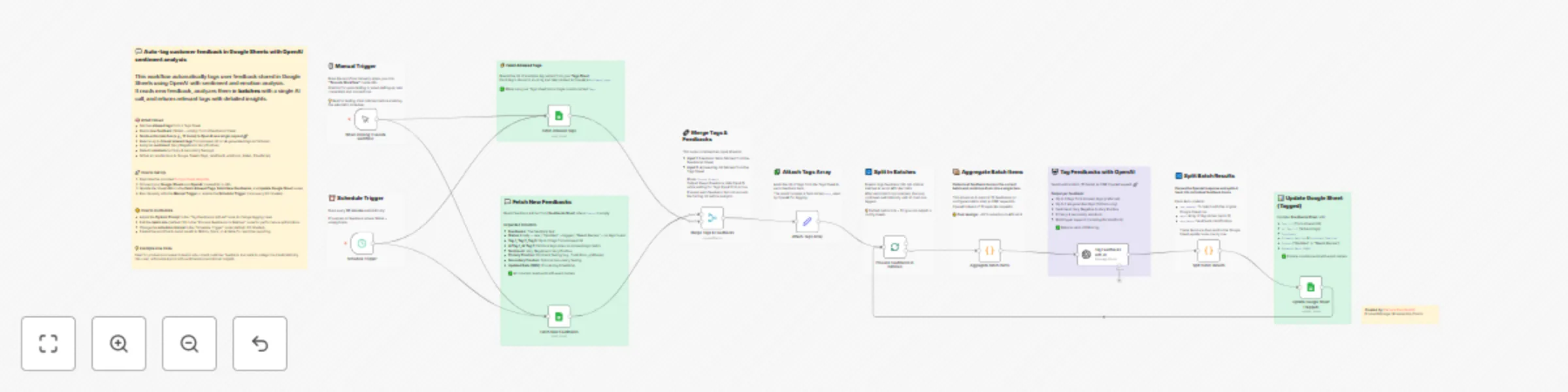
- Fetches allowed tags from a Tags sheet and new feedback entries (where Status is empty) from a Feedbacks sheet
- Merges tags with feedbacks and processes them in batches of 10
- Sends each batch to OpenAI with a structured prompt requesting tags, sentiment, and emotional analysis
- Writes results back to Google Sheets with tags, sentiment, emotions, and timestamps
Requirements
- Google Sheets account with OAuth2 credentials
- OpenAI API account (uses GPT-4o-mini model)
- Google Sheet template with two sheets: "Tags" (single column) and "Feedbacks" (with columns: Feedbacks, Status, Tag 1-3, Sentiment, Primary/Secondary Emotion, AI Tag 1-2, Updated Date)
Setup instructions
- Duplicate the provided Google Sheet template
- Connect your credentials in n8n:
- Google Sheets OAuth2 API
- OpenAI API
- Update Sheet URLs in these nodes:
- "Fetch Allowed Tags" - point to your Tags sheet
- "Fetch New Feedbacks" - point to your Feedbacks sheet
- "Update Google Sheet (Tagged)" - point to your Feedbacks sheet
- Test manually first using the Manual Trigger, then enable the Schedule Trigger for automatic processing every 60 minutes
How to customize
- Adjust batch size: Change the batch size in "Process Feedbacks in Batches" (default: 10) to process more or fewer feedbacks per API call
- Modify tagging logic: Edit the system prompt in "Tag Feedbacks with AI" to change how tags are selected or add custom sentiment categories
- Change schedule: Update the Schedule Trigger interval (default: 60 minutes) based on your feedback volume
- Extend the workflow: Add nodes to send results to Slack, Notion, or Airtable for real-time alerts on negative feedback