
Website monitoring, scheduling, and email alerts template

Workflow preview
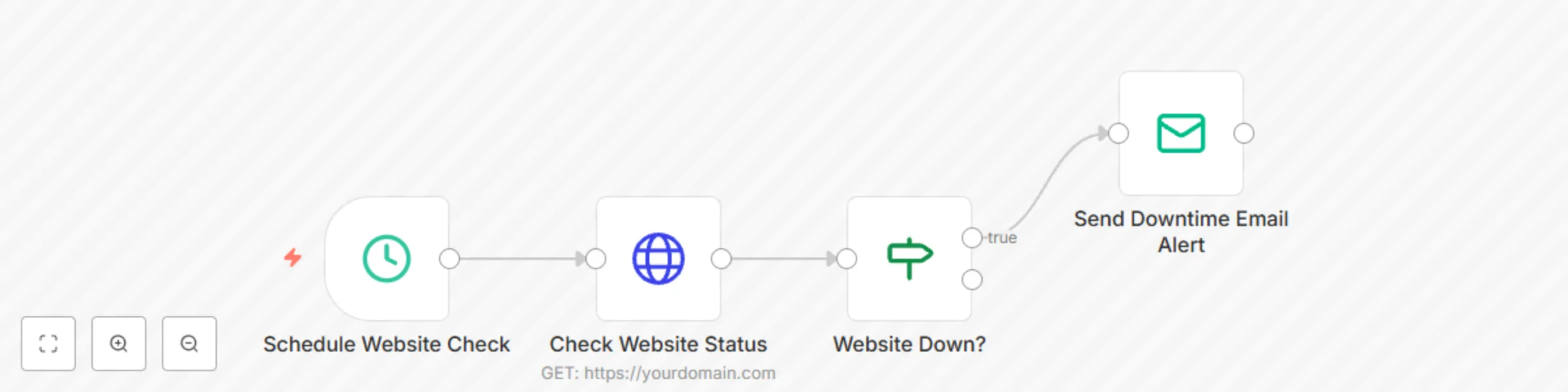
Workflow preview
100%
Website monitoring, scheduling, and email alerts template preview
Open on n8n.io

Important notice

This workflow is provided as-is. Please review and test before using in production.

1. Workflow Overview

Website Downtime Monitoring with Scheduled Checks and Email Alerts Easily monitor your website uptime and receive instant email alerts when it becomes unreachable — using this no code template p...

Best for

  • DevOps automation workflows
  • beginner n8n builders looking for reusable templates

Tools used

n8n-nodes-base.scheduletrigger, n8n-nodes-base.httprequest, n8n-nodes-base.if, n8n-nodes-base.emailsend

Source and attribution

This workflow is cataloged by N8N Workflows and links back to its original n8n.io source page by Anandkumar C.

Original n8n.io source

1.1 Workflow description

Title
Website monitoring, scheduling, and email alerts template
Workflow name
Website monitoring, scheduling, and email alerts template

🛠 Website Downtime Monitoring with Scheduled Checks and Email Alerts

Easily monitor your website uptime and receive instant email alerts when it becomes unreachable — using this no-code template powered by n8n, a free and flexible workflow automation tool.

This ready-to-use workflow periodically checks your website’s status and sends an alert email if it’s down.


⚙️ How it Works

  • Schedule Website Check
    Triggers the workflow at regular intervals (e.g., every 8 hours by default).

  • Check Website Status
    Sends an HTTP GET request to your site.

  • Evaluate Response
    Determines if the site is reachable (expects HTTP status 200).

  • Send Downtime Alert
    If the site is down, an alert email is sent to the specified address.


🔧 Steps to Customize

1. HTTP Request Node

Replace https://yourdomain.com with your actual website URL.

2. Send Email Node

Update the To Email and From Email fields with your addresses.

3. Adjust Monitoring Frequency

Modify the Schedule Trigger node to run every 5 minutes, hourly, or as needed.


✅ SMTP Configuration Instructions

Before emails can be sent, you need to configure SMTP credentials in n8n.

📨 Option 1: Gmail SMTP Setup

> Note: Gmail requires App Passwords (not your regular Gmail password) and 2FA to be enabled.

Steps:
  1. Go to Google Account Security Settings.
  2. Enable 2-Step Verification.
  3. Go to App Passwords.
  4. Create a new app password (choose Mail and Other, name it n8n).
  5. In n8n:
    • Go to CredentialsCreate NewSMTP.
    • Use the following values:
      • Host: smtp.gmail.com
      • Port: 465 (SSL) or 587 (TLS)
      • User: your Gmail address (e.g., [email protected])
      • Password: the App Password you generated

✉️ Option 2: Generic SMTP Setup

Use this if you're using your hosting provider's or business email SMTP server.

Example Values:
  • Host: smtp.yourdomain.com or provider-specific (e.g., smtp.sendgrid.net)
  • Port: 587 (TLS) or 465 (SSL)
  • User: your email address (e.g., [email protected])
  • Password: your email/SMTP password
  • Secure: Yes (if using 465 or TLS-enabled 587)

Then in the workflow's Send Email node, select the SMTP credentials you created.


📌 Requirements

  • A running instance of n8n (self-hosted or n8n.cloud)
  • SMTP credentials configured in n8n for email delivery
  • Basic familiarity with the n8n visual editor

🧠 Pro Tips

  • Rename Nodes: Use clear, descriptive names for maintainability.
  • Sticky Notes: Use stickies on the canvas to help explain logic for others.
  • Expand Alerts: Integrate with Slack, Discord, or Telegram for multi-channel alerts.

1.2 Logical Blocks

This catalog entry is organized from the workflow JSON. The node-level section below shows the executable blocks available for review before importing the template.

2. Block-by-Block Analysis

Block 1 - Schedule Website Check

Type / Role
n8n-nodes-base.scheduleTrigger - scheduleTrigger
Config choices
Version 1

Block 2 - Check Website Status

Type / Role
n8n-nodes-base.httpRequest - httpRequest
Config choices
Version 1

Block 3 - Website Down?

Type / Role
n8n-nodes-base.if - if
Config choices
Version 1

Block 4 - Send Downtime Email Alert

Type / Role
n8n-nodes-base.emailSend - emailSend
Config choices
Version 1

3. Summary Table

Workflow Website monitoring, scheduling, and email alerts template
Complexity beginner
Nodes 4
Categories DevOps
Author Anandkumar C
Published 20 Jun 2025

4. Reproducing the Workflow from Scratch

  1. 1. Download the workflow JSON

    Use the JSON export at /data/workflows/5067/5067.json as the source template for this automation.

  2. 2. Import the template into n8n

    Open n8n, import the downloaded JSON, and review each node before activating the workflow.

  3. 3. Configure credentials and variables

    Replace placeholder credentials, API keys, webhook URLs, account IDs, and environment-specific values with your own settings.

  4. 4. Test with sample data

    Run the workflow manually or in a staging workspace, inspect node output, and confirm downstream systems receive the expected data.

  5. 5. Activate and monitor

    Enable the workflow only after testing, then monitor executions, errors, and rate limits during the first production runs.

5. General Notes & Resources

Review imported nodes carefully before activation. This catalog entry is intended to help you inspect the workflow structure, understand required services, and find related templates faster.

Node names, credentials, schedules, webhook paths, and external service limits may need adjustment for your workspace.

Frequently asked questions

What does Website monitoring, scheduling, and email alerts template do?

Website Downtime Monitoring with Scheduled Checks and Email Alerts Easily monitor your website uptime and receive instant email alerts when it becomes unreachable — using this no code template p...

What do I need before importing this workflow?

Review the workflow JSON, configure any required credentials in n8n, and test the automation in a safe workspace before using it in production.

Can I customize this workflow?

Yes. Use the block-by-block analysis and the downloadable JSON to inspect each node, then adjust credentials, prompts, schedules, filters, or destinations for your DevOps use case.



