
Watermark and password-protect new Google Drive PDFs with Autype

Workflow preview
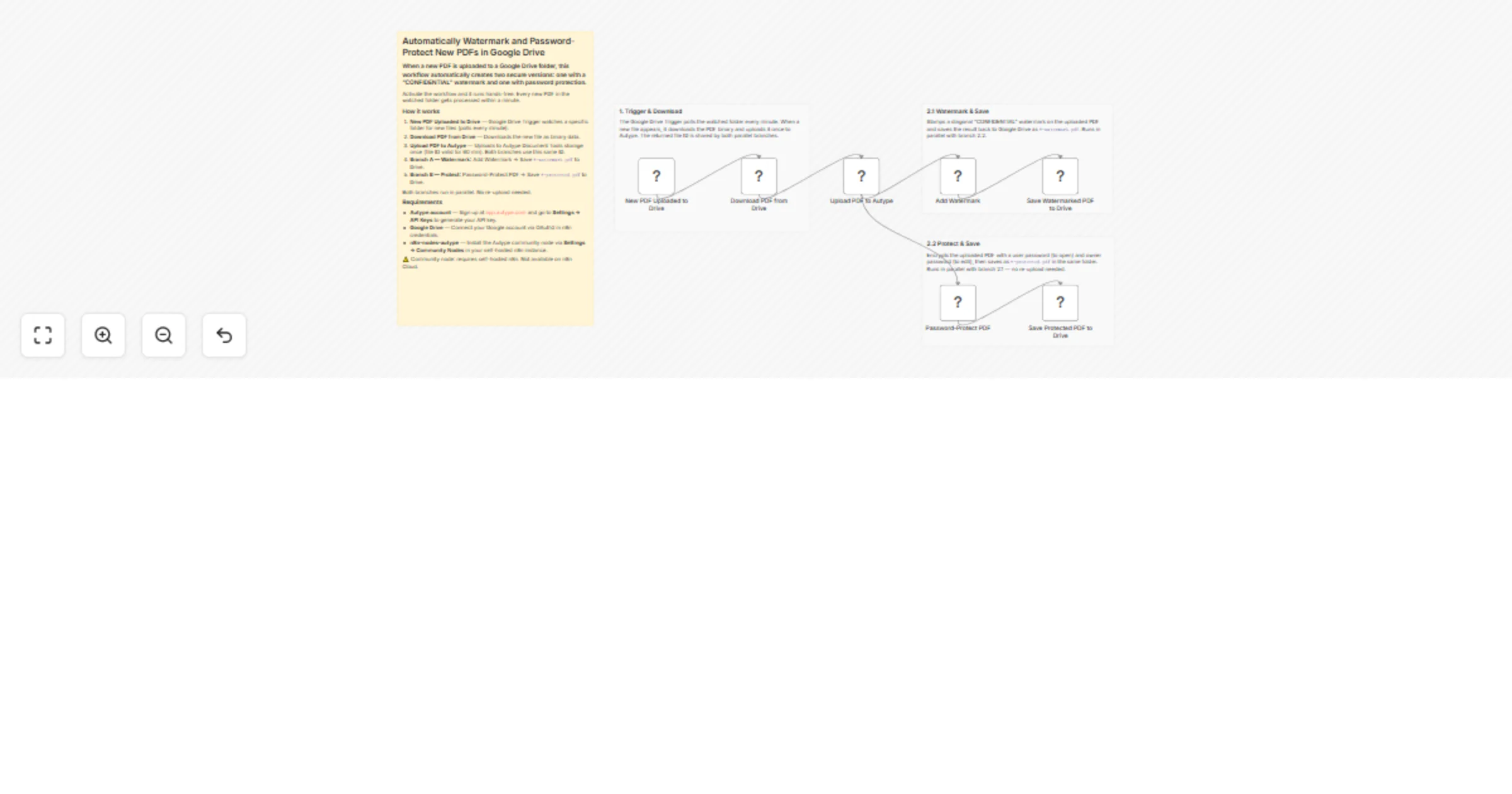
Workflow preview
100%
Watermark and password-protect new Google Drive PDFs with Autype preview
Open on n8n.io

1. Workflow Overview

Important: This workflow uses the Autype community node and requires a self hosted n8n instance. This workfl...

Best for

  • Document Extraction automation workflows
  • Multimodal AI automation workflows
  • intermediate n8n builders looking for reusable templates

Tools used

n8n-nodes-base.googledrivetrigger, n8n-nodes-base.googledrive, n8n-nodes-autype.autype, n8n-nodes-base.stickynote

Source and attribution

This workflow is cataloged by N8N Workflows and links back to its original n8n.io source page by 8Automator.

Original n8n.io source

1.1 Workflow description

Title
Watermark and password-protect new Google Drive PDFs with Autype
Workflow name
Watermark and password-protect new Google Drive PDFs with Autype

Important: This workflow uses the Autype community node and requires a self-hosted n8n instance.

This workflow watches a Google Drive folder for new PDF uploads. When a new file appears, it automatically creates two secure versions (one with a "CONFIDENTIAL" watermark and one with password protection) and saves both back to the same folder. Activate and forget.

Who is this for?

Legal teams, compliance officers, and anyone who needs every PDF in a shared folder to be watermarked and locked automatically. Common scenarios: securing contracts before client review, stamping internal reports with "CONFIDENTIAL", or ensuring all documents in a compliance folder are password-protected.

What this workflow does

The workflow uses a Google Drive Trigger to detect new PDFs in a watched folder. For each new file it creates filename-watermark.pdf (with a diagonal text watermark) and filename-protected.pdf (encrypted with user and owner passwords), then uploads both back to the same Google Drive folder.

How it works

  1. New PDF Uploaded to Drive — A Google Drive Trigger polls the watched folder every minute for new files.
  2. Download PDF from Drive — Downloads the new PDF as binary data.
  3. Upload PDF to Autype — Uploads the PDF to Autype Document Tools storage once. Returns a file ID used by both parallel branches.
  4. From here the workflow splits into two parallel branches:
  • Branch A — Watermark: Add Watermark → Save *-watermark.pdf to Drive
  • Branch B — Protect: Password-Protect PDF → Save *-protected.pdf to Drive
  1. Both branches reference the same Autype file ID from step 3. No re-upload needed.
  2. Output filenames are derived from the original filename via expression (e.g. report.pdfreport-watermark.pdf / report-protected.pdf).

Setup

  1. Install the Autype community node (n8n-nodes-autype) via Settings → Community Nodes.
  2. Create an Autype API credential with your API key from app.autype.com. See API Keys in Settings.
  3. Connect your Google account via OAuth2 in n8n credentials (Settings → Credentials → Google Drive OAuth2 API).
  4. Replace YOUR_FOLDER_ID in the trigger node and both Google Drive upload nodes with your actual folder ID. You can find it in the folder's URL: https://drive.google.com/drive/folders/YOUR_FOLDER_ID.
  5. Select your Autype credential in all Autype nodes and your Google Drive credential in all Google Drive nodes.
  6. Activate the workflow (it will now process every new PDF uploaded to the folder automatically)

Note: This is a community node. It is not maintained by the n8n team. You need a self-hosted n8n instance to use community nodes.

Requirements

  • Self-hosted n8n instance (community nodes are not available on n8n Cloud)
  • Autype account with API key (free tier available)
  • n8n-nodes-autype community node installed
  • Google Drive account with OAuth2 credentials configured in n8n

How to customize

  • Change the watched folder: Update YOUR_FOLDER_ID in the trigger and both upload nodes (you can use separate input and output folders if preferred)
  • Change watermark text: Edit the text field in the Add Watermark node (common options: "DRAFT", "INTERNAL USE ONLY", "DO NOT COPY", or your company name)
  • Adjust watermark style: Change font size, opacity (0 to 1), rotation angle, and color in the watermark options.
  • Change passwords: Update the user and owner passwords in the Password-Protect node (remove the user password if you only want to restrict editing, not opening)
  • Skip protection: Remove the protection branch (Protect → Save Protected) if you only need watermarked PDFs.
  • Skip watermark: Remove the watermark branch (Watermark → Save Watermarked) and keep only the protection branch if you only need encryption.
  • Add compression: Insert an Autype Compress operation before the Google Drive upload to reduce file size.
  • Use a different trigger: Replace the Google Drive Trigger with a webhook, email trigger, or any other trigger that provides binary PDF data.

1.2 Logical Blocks

This catalog entry is organized from the workflow JSON. The node-level section below shows the executable blocks available for review before importing the template.

2. Block-by-Block Analysis

Block 1 - New PDF Uploaded to Drive

Type / Role
n8n-nodes-base.googleDriveTrigger - googleDriveTrigger
Config choices
Version 1

Block 2 - Download PDF from Drive

Type / Role
n8n-nodes-base.googleDrive - googleDrive
Config choices
Version 3

Block 3 - Upload PDF to Autype

Type / Role
n8n-nodes-autype.autype - autype
Config choices
Version 1

Block 4 - Add Watermark

Type / Role
n8n-nodes-autype.autype - autype
Config choices
Version 1

Block 5 - Save Watermarked PDF to Drive

Type / Role
n8n-nodes-base.googleDrive - googleDrive
Config choices
Version 3

Block 6 - Password-Protect PDF

Type / Role
n8n-nodes-autype.autype - autype
Config choices
Version 1

Block 7 - Save Protected PDF to Drive

Type / Role
n8n-nodes-base.googleDrive - googleDrive
Config choices
Version 3

Block 8 - Sticky Note

Type / Role
n8n-nodes-base.stickyNote - stickyNote
Config choices
Version 1

Block 9 - Sticky Note1

Type / Role
n8n-nodes-base.stickyNote - stickyNote
Config choices
Version 1

Block 10 - Sticky Note2

Type / Role
n8n-nodes-base.stickyNote - stickyNote
Config choices
Version 1

Block 11 - Sticky Note3

Type / Role
n8n-nodes-base.stickyNote - stickyNote
Config choices
Version 1

3. Summary Table

Workflow Watermark and password-protect new Google Drive PDFs with Autype
Complexity intermediate
Nodes 11
Categories Document Extraction, Multimodal AI
Author 8Automator
Published 05 Mar 2026

4. Reproducing the Workflow from Scratch

  1. 1. Download the workflow JSON

    Use the JSON export at /data/workflows/13892/13892.json as the source template for this automation.

  2. 2. Import the template into n8n

    Open n8n, import the downloaded JSON, and review each node before activating the workflow.

  3. 3. Configure credentials and variables

    Replace placeholder credentials, API keys, webhook URLs, account IDs, and environment-specific values with your own settings.

  4. 4. Test with sample data

    Run the workflow manually or in a staging workspace, inspect node output, and confirm downstream systems receive the expected data.

  5. 5. Activate and monitor

    Enable the workflow only after testing, then monitor executions, errors, and rate limits during the first production runs.

5. General Notes & Resources

Review imported nodes carefully before activation. This catalog entry is intended to help you inspect the workflow structure, understand required services, and find related templates faster.

Node names, credentials, schedules, webhook paths, and external service limits may need adjustment for your workspace.

Frequently asked questions

What does Watermark and password-protect new Google Drive PDFs with Autype do?

Important: This workflow uses the Autype community node and requires a self hosted n8n instance. This workfl...

What do I need before importing this workflow?

Review the workflow JSON, configure any required credentials in n8n, and test the automation in a safe workspace before using it in production.

Can I customize this workflow?

Yes. Use the block-by-block analysis and the downloadable JSON to inspect each node, then adjust credentials, prompts, schedules, filters, or destinations for your Document Extraction, Multimodal AI use case.



