Validate, deduplicate, and store customers via API with Supabase, Slack, Telegram, and email

Workflow preview

Workflow preview
100%
Validate, deduplicate, and store customers via API with Supabase, Slack, Telegram, and email preview
Open on n8n.io

Important notice

This workflow is provided as-is. Please review and test before using in production.

1. Workflow Overview

(Retail) Customer Cleanup API → Supabase and send Notification This workflow provides an API first solution to validate, clean, deduplicate and store customer data in Supabase. It ensures consisten...

Best for

  • CRM automation workflows
  • AI Summarization automation workflows
  • advanced n8n builders looking for reusable templates

Tools used

n8n-nodes-base.code, n8n-nodes-base.supabase, n8n-nodes-base.if, n8n-nodes-base.respondtowebhook, n8n-nodes-base.webhook, n8n-nodes-base.slack, n8n-nodes-base.telegram, n8n-nodes-base.gmail

Source and attribution

This workflow is cataloged by N8N Workflows and links back to its original n8n.io source page by WeblineIndia.

Original n8n.io source

1.1 Workflow description

Title
Validate, deduplicate, and store customers via API with Supabase, Slack, Telegram, and email
Workflow name
Validate, deduplicate, and store customers via API with Supabase, Slack, Telegram, and email

(Retail) Customer Cleanup API → Supabase and send Notification

This workflow provides an API-first solution to validate, clean, deduplicate and store customer data in Supabase. It ensures consistent customer records, prevents duplicates and keeps both internal teams and customers informed through automated notifications.

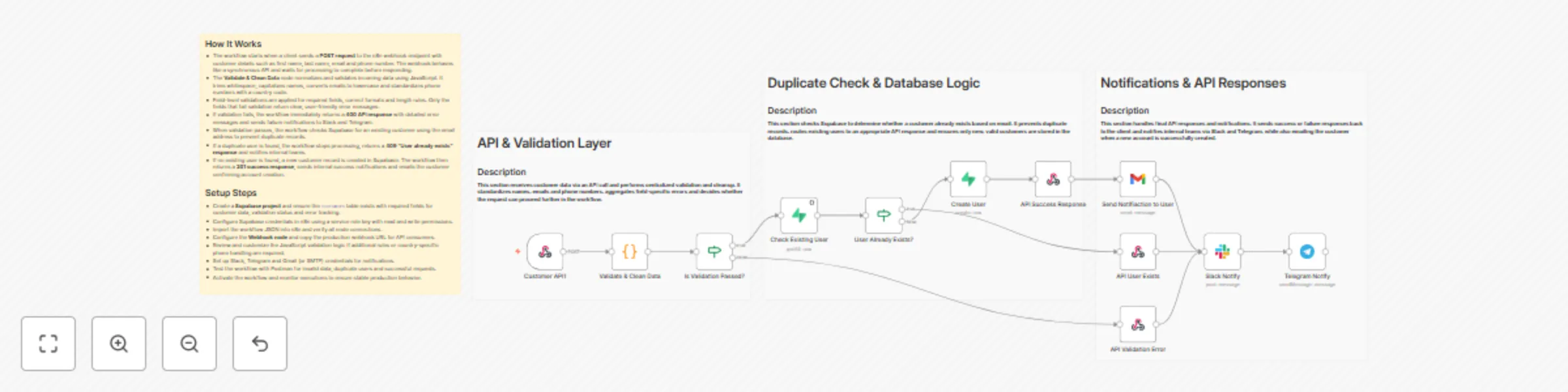
This workflow acts as a backend customer intake API. It validates and normalizes incoming customer data, checks for existing users in Supabase, stores new customers safely and returns clear API responses. Internal teams receive Slack and Telegram updates, while customers get an email confirmation on successful creation.

You receive:

  • Centralized customer data validation
  • Automatic duplicate prevention
  • Supabase-backed customer storage
  • Real-time API responses
  • Team notifications + user confirmation email

Ideal for retail, e-commerce and SaaS teams that want clean customer data without manual intervention.

Quick Start – Implementation Steps

  1. Import the provided n8n workflow JSON.
  2. Configure Supabase credentials with read/write access.
  3. Connect Slack, Telegram and Gmail/SMTP credentials.
  4. Copy the Webhook URL and use it as your customer intake API.
  5. Activate the workflow — your customer API is live.

What It Does

This workflow automates customer data intake and processing:

  1. Receives customer data via a POST API call.
  2. Cleans and normalizes names, email and phone numbers.
  3. Validates required fields and formats using JavaScript.
  4. Aggregates clear, field-specific validation errors.
  5. Checks Supabase to prevent duplicate users.
  6. Stores valid, new customers in Supabase.
  7. Returns structured API responses (success, validation error or duplicate).
  8. Sends notifications to Slack and Telegram.
  9. Emails the customer after successful account creation.

This ensures reliable, consistent customer records across systems.

Who’s It For

This workflow is ideal for:

  • Retail and e-commerce platforms
  • CRM and customer data teams
  • SaaS product teams
  • Backend automation teams
  • Marketing teams needing clean contact lists
  • Developers building API-driven systems

Requirements to Use This Workflow

To run this workflow, you need:

  • n8n instance (cloud or self-hosted)
  • Supabase project with a customers table
  • Supabase service role key
  • Slack workspace with API access
  • Telegram bot + chat ID
  • Gmail or SMTP account for user notifications

How It Works

  1. API Request – Client sends customer data to the webhook endpoint.
  2. Validation & Cleanup – JavaScript validates and formats data.
  3. Validation Fail – Returns 400 response with clear error messages.
  4. Duplicate Check – Supabase is queried using the email address.
  5. Duplicate Found – Returns 409 response without creating a record.
  6. Create Customer – New customer is saved in Supabase.
  7. Success Response – API confirms successful creation.
  8. Notifications – Slack, Telegram and customer email are triggered.

Setup Steps

  1. Create a Supabase table with fields for customer data, validation status and errors.
  2. Add Supabase credentials to n8n.
  3. Import the workflow JSON into n8n.
  4. Configure the Webhook node and copy the API URL.
  5. Review the validation logic if custom rules are required.
  6. Configure Slack, Telegram and email credentials.
  7. Test using Postman for invalid, duplicate and valid requests.
  8. Activate the workflow.

How To Customize Nodes

Customize Validation Rules

Update the JavaScript validation node to add country-specific phone rules or additional fields.

Customize Duplicate Logic

Extend duplicate checks to include phone numbers or other identifiers.

Customize Notifications

Modify Slack and Telegram messages, add emojis, mentions or execution metadata.

Add-Ons (Optional Enhancements)

You can extend this workflow to:

  • Add API key authentication
  • Enable rate limiting
  • Log failed attempts separately
  • Support multi-country phone validation
  • Add CRM or email marketing sync
  • Implement soft deletes or upserts

Use Case Examples

1. Customer Registration API

Centralize customer creation for web and mobile apps.

2. Data Hygiene Automation

Prevent invalid or duplicate contacts in your database.

3. Retail & CRM Integration

Keep customer records consistent across systems.

4. Marketing Readiness

Ensure only clean, valid contacts enter campaigns.

Troubleshooting Guide

Issue Possible Cause Solution
Validation always fails Incorrect payload structure Ensure data is sent in request body
Duplicate user created Duplicate check misconfigured Verify Supabase filter conditions
No Slack alert Invalid credentials Reconnect Slack API
No email sent Gmail/SMTP not configured Verify sender account
API not responding Webhook not active Activate the workflow

Need Help?

If you need help customizing or extending this workflow, adding authentication, scaling for high traffic, integrating CRMs or enhancing validation, the n8n automation team at WeblineIndia can assist you with production-ready automation and integration support. Contact us today.

1.2 Logical Blocks

This catalog entry is organized from the workflow JSON. The node-level section below shows the executable blocks available for review before importing the template.

2. Block-by-Block Analysis

Block 1 - Validate & Clean Data

Type / Role
n8n-nodes-base.code - code
Config choices
Version 2

Block 2 - Check Existing User

Type / Role
n8n-nodes-base.supabase - supabase
Config choices
Version 1

Block 3 - User Already Exists?

Type / Role
n8n-nodes-base.if - if
Config choices
Version 2

Block 4 - Create User

Type / Role
n8n-nodes-base.supabase - supabase
Config choices
Version 1

Block 5 - API User Exists

Type / Role
n8n-nodes-base.respondToWebhook - respondToWebhook
Config choices
Version 1

Block 6 - API Validation Error

Type / Role
n8n-nodes-base.respondToWebhook - respondToWebhook
Config choices
Version 1

Block 7 - Customer API1

Type / Role
n8n-nodes-base.webhook - webhook
Config choices
Version 1

Block 8 - API Success Response

Type / Role
n8n-nodes-base.respondToWebhook - respondToWebhook
Config choices
Version 1

Block 9 - Slack Notify

Type / Role
n8n-nodes-base.slack - slack
Config choices
Version 2

Block 10 - Telegram Notify

Type / Role
n8n-nodes-base.telegram - telegram
Config choices
Version 1

Block 11 - Send Notifiaction to User

Type / Role
n8n-nodes-base.gmail - gmail
Config choices
Version 2.1

Block 12 - Sticky Note

Type / Role
n8n-nodes-base.stickyNote - stickyNote
Config choices
Version 1

Block 13 - Sticky Note1

Type / Role
n8n-nodes-base.stickyNote - stickyNote
Config choices
Version 1

Block 14 - Sticky Note2

Type / Role
n8n-nodes-base.stickyNote - stickyNote
Config choices
Version 1

Block 15 - Sticky Note3

Type / Role
n8n-nodes-base.stickyNote - stickyNote
Config choices
Version 1

Block 16 - Is Validation Passed?

Type / Role
n8n-nodes-base.if - if
Config choices
Version 2

3. Summary Table

Workflow Validate, deduplicate, and store customers via API with Supabase, Slack, Telegram, and email
Complexity advanced
Nodes 16
Categories CRM, AI Summarization
Author WeblineIndia
Published 01 Jan 2026

4. Reproducing the Workflow from Scratch

  1. 1. Download the workflow JSON

    Use the JSON export at /data/workflows/12366/12366.json as the source template for this automation.

  2. 2. Import the template into n8n

    Open n8n, import the downloaded JSON, and review each node before activating the workflow.

  3. 3. Configure credentials and variables

    Replace placeholder credentials, API keys, webhook URLs, account IDs, and environment-specific values with your own settings.

  4. 4. Test with sample data

    Run the workflow manually or in a staging workspace, inspect node output, and confirm downstream systems receive the expected data.

  5. 5. Activate and monitor

    Enable the workflow only after testing, then monitor executions, errors, and rate limits during the first production runs.

5. General Notes & Resources

Review imported nodes carefully before activation. This catalog entry is intended to help you inspect the workflow structure, understand required services, and find related templates faster.

Node names, credentials, schedules, webhook paths, and external service limits may need adjustment for your workspace.

Frequently asked questions

What does Validate, deduplicate, and store customers via API with Supabase, Slack, Telegram, and email do?

(Retail) Customer Cleanup API → Supabase and send Notification This workflow provides an API first solution to validate, clean, deduplicate and store customer data in Supabase. It ensures consisten...

What do I need before importing this workflow?

Review the workflow JSON, configure any required credentials in n8n, and test the automation in a safe workspace before using it in production.

Can I customize this workflow?

Yes. Use the block-by-block analysis and the downloadable JSON to inspect each node, then adjust credentials, prompts, schedules, filters, or destinations for your CRM, AI Summarization use case.