Unlimited website down checker - Uptime Robot alternative

Workflow preview

Workflow preview
100%
Unlimited website down checker - Uptime Robot alternative preview
Open on n8n.io

Important notice

This workflow is provided as-is. Please review and test before using in production.

1. Workflow Overview

Video Introduction Want to automate your inbox or need a ...

Best for

  • DevOps automation workflows
  • advanced n8n builders looking for reusable templates

Tools used

n8n-nodes-base.scheduletrigger, n8n-nodes-base.set, n8n-nodes-base.gmail, n8n-nodes-base.httprequest, n8n-nodes-base.switch, n8n-nodes-base.splitout, n8n-nodes-base.merge, n8n-nodes-base.wait

Source and attribution

This workflow is cataloged by N8N Workflows and links back to its original n8n.io source page by Milan Vasarhelyi - SmoothWork.

Original n8n.io source

1.1 Workflow description

Title
Unlimited website down checker - Uptime Robot alternative
Workflow name
Unlimited website down checker - Uptime Robot alternative

Video Introduction

Want to automate your inbox or need a custom workflow? 📞 Book a Call | 💬 DM me on Linkedin

Get Alerted When Your Website Is Down – n8n as an Uptime Robot Alternative
If you manage a website (or client sites), getting notified when your site goes down is critical. But you’ve probably experienced alert fatigue if you’ve ever received a flood of downtime emails for every tiny outage. These short hiccups are common, and most monitoring tools don’t let you filter them out.

Here’s how you can set up website downtime notifications with n8n - no extra subscriptions, and no more false positives spamming your inbox. For your most important sites, you can even get direct text alerts to your phone.

We’ll use n8n, a powerful automation tool with thousands of templates and integrations. You can run it in the cloud or even self-host it for free.


Why Use n8n for Website Monitoring?

Uptime Robot and similar services have limitations or get expensive fast if you monitor several sites. n8n gives you full control - you choose when and how you get notified, set your own timing and thresholds, and you aren’t stuck with default alert logic.

Plus, n8n can automate much more than just uptime monitoring: use it to handle other business workflows too.


Quick Start: Free n8n Website Monitoring Template

  • Use the template to get started fast.
  • Log in or sign up for n8n Cloud, or self-host for free if you prefer.
  • Configure your schedule (default: hourly) and list the sites you want to monitor.
  • Key setting: wait seconds. Recommended: 300 seconds (5 minutes). If your site goes down, the workflow waits before sending an alert—no notification for a 1-2 minute outage, only real, persistent problems.

How to Test & Use

  1. Activate the workflow.
    Toggle it on in n8n and it’ll check your sites automatically.
  2. Test instantly:
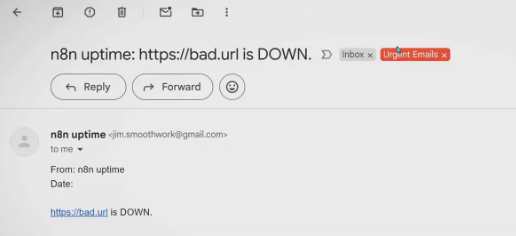
    Add a non-existent URL and run the workflow. After the wait time, you’ll get an email alert for that URL.
  3. Notifications stay organized:
    Alerts go straight to your inbox (see my AI email labelling template if you want color-coded organization).

Get Critical Alerts on Your Phone (Telegram)

Email is great, but for your most important sites you want instant notifications on your phone.
Best option: Use Telegram. n8n can send you messages via a Telegram bot—easy to set up, free, and works in seconds.

How:

  • Create a Telegram bot via BotFather (instructions in the template).
  • Add your bot token and chat ID to n8n.
  • Now, you’ll get downtime alerts right on Telegram—no missed notifications, no extra costs.

FAQ

  • Can I monitor unlimited sites?
    Yes, just list them all in the config.
  • What if downtime is just a few seconds?
    The default 5-minute wait filters these out.
  • Do I need a paid n8n plan?
    No - self-hosting is free, and the workflow works on free plans.
  • Why not SMS or WhatsApp?
    Telegram bots are fastest, easiest, and don’t require extra API setup or subscriptions.

1.2 Logical Blocks

This catalog entry is organized from the workflow JSON. The node-level section below shows the executable blocks available for review before importing the template.

2. Block-by-Block Analysis

Block 1 - Schedule Trigger

Type / Role
n8n-nodes-base.scheduleTrigger - scheduleTrigger
Config choices
Version 1.2

Block 2 - Calculate Status

Type / Role
n8n-nodes-base.set - set
Config choices
Version 3.3

Block 3 - Send Email Alert

Type / Role
n8n-nodes-base.gmail - gmail
Config choices
Version 2.1

Block 4 - Perform Site Test

Type / Role
n8n-nodes-base.httpRequest - httpRequest
Config choices
Version 4.2

Block 5 - Status Router

Type / Role
n8n-nodes-base.switch - switch
Config choices
Version 3

Block 6 - Split Out

Type / Role
n8n-nodes-base.splitOut - splitOut
Config choices
Version 1

Block 7 - Config

Type / Role
n8n-nodes-base.set - set
Config choices
Version 3.4

Block 8 - Edit Fields

Type / Role
n8n-nodes-base.set - set
Config choices
Version 3.4

Block 9 - Merge

Type / Role
n8n-nodes-base.merge - merge
Config choices
Version 3.2

Block 10 - Wait

Type / Role
n8n-nodes-base.wait - wait
Config choices
Version 1.1

Block 11 - Calculate Status1

Type / Role
n8n-nodes-base.set - set
Config choices
Version 3.3

Block 12 - Perform Site Test1

Type / Role
n8n-nodes-base.httpRequest - httpRequest
Config choices
Version 4.2

Block 13 - Merge1

Type / Role
n8n-nodes-base.merge - merge
Config choices
Version 3.2

Block 14 - Status Router1

Type / Role
n8n-nodes-base.switch - switch
Config choices
Version 3

Block 15 - Sticky Note1

Type / Role
n8n-nodes-base.stickyNote - stickyNote
Config choices
Version 1

Block 16 - Sticky Note2

Type / Role
n8n-nodes-base.stickyNote - stickyNote
Config choices
Version 1

Block 17 - Sticky Note3

Type / Role
n8n-nodes-base.stickyNote - stickyNote
Config choices
Version 1

Block 18 - Send a text message

Type / Role
n8n-nodes-base.telegram - telegram
Config choices
Version 1.2

Block 19 - Sticky Note

Type / Role
n8n-nodes-base.stickyNote - stickyNote
Config choices
Version 1

Block 20 - Sticky Note10

Type / Role
n8n-nodes-base.stickyNote - stickyNote
Config choices
Version 1

Block 21 - Sticky Note4

Type / Role
n8n-nodes-base.stickyNote - stickyNote
Config choices
Version 1

3. Summary Table

Workflow Unlimited website down checker - Uptime Robot alternative
Complexity advanced
Nodes 21
Categories DevOps
Author Milan Vasarhelyi - SmoothWork
Published 11 Jul 2025

4. Reproducing the Workflow from Scratch

  1. 1. Download the workflow JSON

    Use the JSON export at /data/workflows/5887/5887.json as the source template for this automation.

  2. 2. Import the template into n8n

    Open n8n, import the downloaded JSON, and review each node before activating the workflow.

  3. 3. Configure credentials and variables

    Replace placeholder credentials, API keys, webhook URLs, account IDs, and environment-specific values with your own settings.

  4. 4. Test with sample data

    Run the workflow manually or in a staging workspace, inspect node output, and confirm downstream systems receive the expected data.

  5. 5. Activate and monitor

    Enable the workflow only after testing, then monitor executions, errors, and rate limits during the first production runs.

5. General Notes & Resources

Review imported nodes carefully before activation. This catalog entry is intended to help you inspect the workflow structure, understand required services, and find related templates faster.

Node names, credentials, schedules, webhook paths, and external service limits may need adjustment for your workspace.

Frequently asked questions

What does Unlimited website down checker - Uptime Robot alternative do?

Video Introduction Want to automate your inbox or need a ...

What do I need before importing this workflow?

Review the workflow JSON, configure any required credentials in n8n, and test the automation in a safe workspace before using it in production.

Can I customize this workflow?

Yes. Use the block-by-block analysis and the downloadable JSON to inspect each node, then adjust credentials, prompts, schedules, filters, or destinations for your DevOps use case.