
Turn your website docs into a GPT-4.1-mini support chatbot with MrScraper and Pinecone

Workflow preview
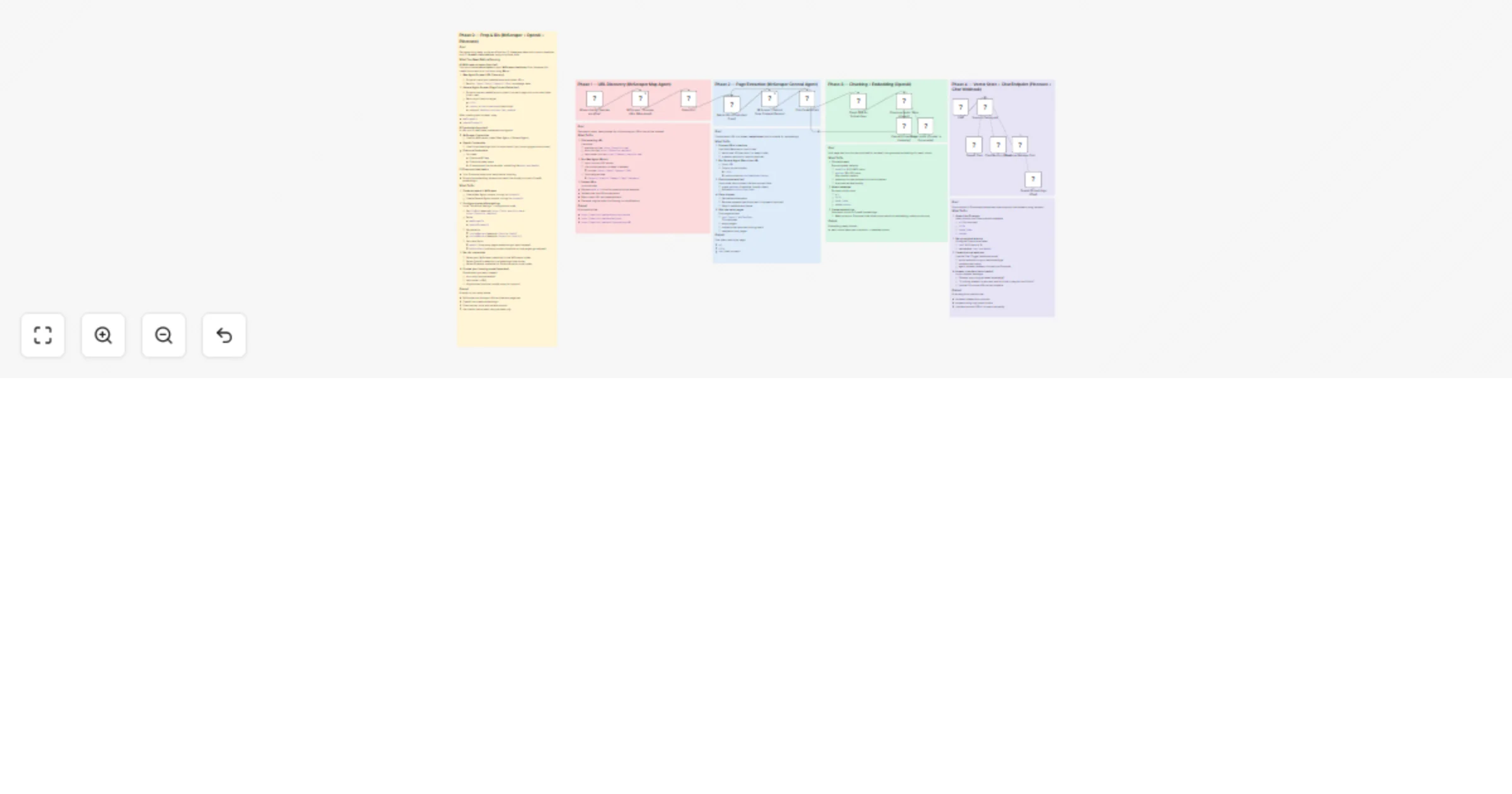
Workflow preview
100%
Turn your website docs into a GPT-4.1-mini support chatbot with MrScraper and Pinecone preview
Open on n8n.io

1. Workflow Overview

Description This n8n template turns any website or documentation portal into a fully functional AI powered support chatbot — no manual copy pasting, no static FAQs. It uses MrScraper to crawl and e...

Best for

  • Support Chatbot automation workflows
  • AI RAG automation workflows
  • advanced n8n builders looking for reusable templates

Tools used

n8n-nodes-base.manualtrigger, n8n-nodes-mrscraper.mrscraper, n8n-nodes-base.splitinbatches, n8n-nodes-base.code, @n8n/n8n-nodes-langchain.embeddingsopenai, @n8n/n8n-nodes-langchain.vectorstorepinecone, @n8n/n8n-nodes-langchain.memorybufferwindow, @n8n/n8n-nodes-langchain.agent

Source and attribution

This workflow is cataloged by N8N Workflows and links back to its original n8n.io source page by riandra.

Original n8n.io source

1.1 Workflow description

Title
Turn your website docs into a GPT-4.1-mini support chatbot with MrScraper and Pinecone
Workflow name
Turn your website docs into a GPT-4.1-mini support chatbot with MrScraper and Pinecone

Description

This n8n template turns any website or documentation portal into a fully functional AI-powered support chatbot — no manual copy-pasting, no static FAQs. It uses MrScraper to crawl and extract your site's content, OpenAI to generate embeddings, and Pinecone to store and retrieve that knowledge at chat time.

The result is a retrieval-augmented chatbot that answers questions using only your actual website content, always cites its sources, and never hallucinates policies or pricing.


How It Works

  • Phase 1 – URL Discovery: The Map Agent crawls your target domain using include/exclude patterns to discover all relevant documentation or help center pages. It returns a clean, deduplicated list of URLs ready for content extraction.
  • Phase 2 – Page Content Extraction: Each discovered URL is processed in controlled batches by the General Agent, which extracts the readable content (title + main text) from every page. Low-quality or near-empty pages are automatically filtered out.
  • Phase 3 – Chunking & Embedding: Page text is split into overlapping chunks (default: ~1,100 chars with 180-char overlap) to preserve context at boundaries. Each chunk is sent to OpenAI Embeddings to generate a vector, then stored in Pinecone with metadata including the source URL, page title, and chunk index.
  • Phase 4 – Chat Endpoint: A Chat Trigger exposes a webhook endpoint your website or widget can connect to. When a user asks a question, the Support Chat Agent queries Pinecone for the most relevant chunks and generates a grounded answer using GPT-4.1-mini — always with source URLs included and strict anti-hallucination rules enforced.

How to Set Up

  1. Create 2 scrapers in your MrScraper account:
  • Map Agent Scraper (for crawling and discovering page URLs)
  • General Agent Scraper (for extracting title + content from each page)
  • Copy the scraperId for each — you'll need these in n8n.
  1. Set up your Pinecone index:
  • Create a Pinecone index with dimensions that match your chosen OpenAI embedding model (e.g. 1536 for text-embedding-ada-002)
  • Choose a namespace (recommended format: docs-yourdomain)
  1. Add your credentials in n8n:
  • MrScraper API token
  • OpenAI API key (used for both embeddings and the chat model)
  • Pinecone API key
  1. Configure the Map Agent node:
  • Set your target domain or docs root URL (e.g. https://docs.yoursite.com)
  • Set includePatterns to focus on relevant sections (e.g. /docs/, /help/, /support/)
  • Optionally set excludePatterns to skip noise (e.g. /assets/, /tag/, /static/)
  1. Configure the General Agent node:
  • Enter your General Agent scraperId
  • Adjust the batch size in the SplitInBatches node (start with 1–5 to stay within rate limits)
  1. Configure the Pinecone nodes:
  • Select your Pinecone index in both the Upsert and Retriever nodes
  • Set the correct namespace in both nodes so indexing and retrieval use the same data
  1. Customise the chatbot system prompt:
  • Edit the Support Chat Agent's system message to set the chatbot's name, tone, and rules
  • Adjust topK in the Pinecone Retriever (default: 8) based on how much context you want per answer
  1. Connect your chat widget or frontend to the Chat Trigger webhook URL generated by n8n

Requirements

  • MrScraper account with API access enabled
  • OpenAI account (for embeddings and GPT-4.1-mini chat)
  • Pinecone account with an index created and ready

Good to Know

  • The overlap between chunks (default 180 chars) is intentional — it prevents answers from being cut off at chunk boundaries and significantly improves retrieval quality.
  • The chatbot is configured to cite 1–3 source URLs per answer, so users can always verify the information themselves.
  • The anti-hallucination rules in the system prompt instruct the agent to say it can't find an answer rather than guess — making it safe to use for support, pricing, or policy questions.
  • Re-indexing is as simple as re-running the workflow. Use a consistent Pinecone namespace and upsert mode to update existing vectors without duplicating them.

Customising This Workflow

  • Swap the chat model: Replace GPT-4.1-mini with GPT-4o or another OpenAI model for higher-quality answers on complex queries.
  • Scheduled re-indexing: Add a Schedule Trigger to automatically re-crawl and re-index your docs whenever content changes.
  • Multiple knowledge bases: Use different Pinecone namespaces (e.g. docs-product, docs-api) and route questions to the right namespace based on user intent.
  • Embed on your website: Connect the Chat Trigger webhook to any chat widget library to give your users a live support experience powered entirely by your own documentation.
  • Multilingual support: Add a translation node before chunking to index content in multiple languages and serve a global audience.

1.2 Logical Blocks

This catalog entry is organized from the workflow JSON. The node-level section below shows the executable blocks available for review before importing the template.

2. Block-by-Block Analysis

Block 1 - When clicking ‘Execute workflow’

Type / Role
n8n-nodes-base.manualTrigger - manualTrigger
Config choices
Version 1

Block 2 - MrScraper - Discover URLs (Map Agent)

Type / Role
n8n-nodes-mrscraper.mrscraper - mrscraper
Config choices
Version 1

Block 3 - Batch URLs (Controlled Crawl)

Type / Role
n8n-nodes-base.splitInBatches - splitInBatches
Config choices
Version 3

Block 4 - MrScraper - Extract Page Content (General Agent)

Type / Role
n8n-nodes-mrscraper.mrscraper - mrscraper
Config choices
Version 1

Block 5 - Chunk Text for Embeddings

Type / Role
n8n-nodes-base.code - code
Config choices
Version 2

Block 6 - OpenAI Embeddings (Indexing)

Type / Role
@n8n/n8n-nodes-langchain.embeddingsOpenAi - embeddingsOpenAi
Config choices
Version 1.2

Block 7 - Pinecone Vector Store (Upsert)

Type / Role
@n8n/n8n-nodes-langchain.vectorStorePinecone - vectorStorePinecone
Config choices
Version 1.3

Block 8 - Chat Memory (Short)

Type / Role
@n8n/n8n-nodes-langchain.memoryBufferWindow - memoryBufferWindow
Config choices
Version 1.3

Block 9 - OpenAI Embeddings (Chat)

Type / Role
@n8n/n8n-nodes-langchain.embeddingsOpenAi - embeddingsOpenAi
Config choices
Version 1.2

Block 10 - Pinecone Retriever Tool

Type / Role
@n8n/n8n-nodes-langchain.vectorStorePinecone - vectorStorePinecone
Config choices
Version 1.3

Block 11 - Support Chat Agent

Type / Role
@n8n/n8n-nodes-langchain.agent - agent
Config choices
Version 3

Block 12 - Sticky Note

Type / Role
n8n-nodes-base.stickyNote - stickyNote
Config choices
Version 1

Block 13 - Sticky Note1

Type / Role
n8n-nodes-base.stickyNote - stickyNote
Config choices
Version 1

Block 14 - Sticky Note2

Type / Role
n8n-nodes-base.stickyNote - stickyNote
Config choices
Version 1

Block 15 - Extract Url

Type / Role
n8n-nodes-base.code - code
Config choices
Version 2

Block 16 - Sticky Note3

Type / Role
n8n-nodes-base.stickyNote - stickyNote
Config choices
Version 1

Block 17 - Sticky Note4

Type / Role
n8n-nodes-base.stickyNote - stickyNote
Config choices
Version 1

Block 18 - Sticky Note5

Type / Role
n8n-nodes-base.stickyNote - stickyNote
Config choices
Version 1

Block 19 - Sticky Note6

Type / Role
n8n-nodes-base.stickyNote - stickyNote
Config choices
Version 1

Block 20 - Sticky Note7

Type / Role
n8n-nodes-base.stickyNote - stickyNote
Config choices
Version 1

Block 21 - Sticky Note8

Type / Role
n8n-nodes-base.stickyNote - stickyNote
Config choices
Version 1

Block 22 - Docs Loader (Chunks → Documents)

Type / Role
@n8n/n8n-nodes-langchain.documentDefaultDataLoader - documentDefaultDataLoader
Config choices
Version 1.1

Block 23 - OpenAI Chat

Type / Role
@n8n/n8n-nodes-langchain.lmChatOpenAi - lmChatOpenAi
Config choices
Version 1.3

Block 24 - Chat

Type / Role
@n8n/n8n-nodes-langchain.chat - chat
Config choices
Version 1.2

Showing the first 24 of 25 workflow blocks. Download the JSON for the full node graph.

3. Summary Table

Workflow Turn your website docs into a GPT-4.1-mini support chatbot with MrScraper and Pinecone
Complexity advanced
Nodes 25
Categories Support Chatbot, AI RAG
Author riandra
Published 02 Mar 2026

4. Reproducing the Workflow from Scratch

  1. 1. Download the workflow JSON

    Use the JSON export at /data/workflows/13802/13802.json as the source template for this automation.

  2. 2. Import the template into n8n

    Open n8n, import the downloaded JSON, and review each node before activating the workflow.

  3. 3. Configure credentials and variables

    Replace placeholder credentials, API keys, webhook URLs, account IDs, and environment-specific values with your own settings.

  4. 4. Test with sample data

    Run the workflow manually or in a staging workspace, inspect node output, and confirm downstream systems receive the expected data.

  5. 5. Activate and monitor

    Enable the workflow only after testing, then monitor executions, errors, and rate limits during the first production runs.

5. General Notes & Resources

Review imported nodes carefully before activation. This catalog entry is intended to help you inspect the workflow structure, understand required services, and find related templates faster.

Node names, credentials, schedules, webhook paths, and external service limits may need adjustment for your workspace.

Frequently asked questions

What does Turn your website docs into a GPT-4.1-mini support chatbot with MrScraper and Pinecone do?

Description This n8n template turns any website or documentation portal into a fully functional AI powered support chatbot — no manual copy pasting, no static FAQs. It uses MrScraper to crawl and e...

What do I need before importing this workflow?

Review the workflow JSON, configure any required credentials in n8n, and test the automation in a safe workspace before using it in production.

Can I customize this workflow?

Yes. Use the block-by-block analysis and the downloadable JSON to inspect each node, then adjust credentials, prompts, schedules, filters, or destinations for your Support Chatbot, AI RAG use case.



