Transform cloud documentation into security baselines with OpenAI and GDrive
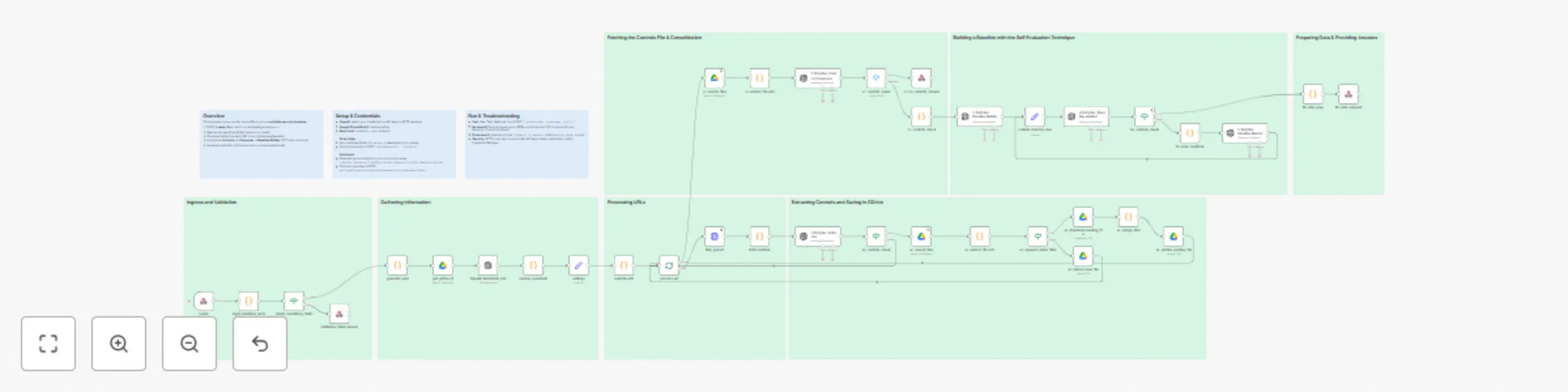
Workflow preview

$20/month : Unlimited workflows
2500 executions/month

THE #1 IN WEB SCRAPING
Scrape any website without limits
HOSTINGER  Early Deal
DISCOUNT 20% Try free
Early DealDISCOUNT 20%
Self-hosted n8n
Unlimited workflows - from $4.99/mo

#1 hub for scraping, AI & automation
6000+ actors - $5 credits/mo
Important notice
This workflow is provided as-is. Please review and test before using in production.
Overview
What this template does
Transforms provider documentation (URLs) into an auditable, enforceable multicloud security control baseline. It:
- Fetches and sanitizes HTML
- Uses AI to extract security requirements (strict 3-line TXT blocks)
- Composes enforceable controls (strict 7-line TXT blocks with true-equivalence consolidation)
- Builds the final baseline (TXT or JSON, see Outputs) with a
Technology:header - Returns a downloadable artifact via webhook and can append/create the file in Google Drive
Why it’s useful
Eliminates manual copy-paste and produces a consistent, portable baseline ready for review, audit, or enforcement tooling—ideal for rapidly generating or refreshing baselines across cloud providers and services.
Multicloud support
The workflow is multicloud by design. Provide the target cloud in the request and run the same pipeline for:
- AWS, Azure, GCP (out of the box)
- Extensible to other providers/services by adjusting prompts and routing logic
How it works (high level)
POST /create(Basic Auth) with{ cloudProvider, technology, urls[] }- Input validation → generate
uuid→ resolve Google Drive folder (search-or-create) - Download & sanitize each URL
- AI pipeline: Extractor → Composer → Baseline Builder → (optional) Baseline Auditor
- Append/create file in Drive and return a downloadable artifact (TXT/JSON) via webhook
Request (webhook)
Method: POST
URL: https://<your-n8n>/webhook/create
Auth: Basic Auth
Headers: Content-Type: application/json
Example input (Postman/CLI)
{
  "cloudProvider": "aws",
  "technology": "Amazon S3",
  "urls": [
    "https://docs.aws.amazon.com/AmazonS3/latest/userguide/security-best-practices.html",
    "https://www.trendmicro.com/cloudoneconformity/knowledge-base/aws/S3/",
    "https://repost.aws/knowledge-center/secure-s3-resources"
  ]
}
Field reference
cloudProvider(string, required) — case-insensitive. Supported:aws,azure,gcp.technology(string, required) — e.g.,"Amazon S3","Azure Storage","Google Cloud Storage".urls(string[], required) — 1–20http(s)URLs (official/reputable docs).
Optional (Google Drive destination):
gdriveTargetId(string) — Google Drive folderId used for append/create.gdrivePath(string) — Path like"DefySec/Baselines"(folders are created if missing).gdriveTargetName(string) — Folder name to find/create underroot.
Optional (Assistant overrides):
assistantExtractorId,assistantComposerId,assistantBaselineId,assistantAuditorId(strings)
Resolution precedence
- Drive:
gdriveTargetId→gdrivePath→gdriveTargetName→ default folder. - Assistants: explicit IDs above → dynamic resolution by name (expects
1_DefySec_Extractor,2_DefySec_Control_Composer,3_DefySec Baseline Builder,4_DefySec_Baseline_Auditor).
Validation
- Rejects empty
urlsor non-http(s)schemes; normalizescloudProvidertoaws|azure|gcp. - Sanitizes fetched HTML (removes scripts/styles/headers) before AI steps.
Outputs
- Primary: downloadable TXT file
controls_<technology>_<timestamp>.txt(via webhook). - Composer outcomes: if no groups to consolidate →
NO_CONTROLS_TO_BE_CONSOLIDATED; if nothing valid remains →NO_CONTROLS_FOUND. - JSON path: when the Builder stage is configured for JSON-only output (strict schema), the workflow returns a
.jsonartifact and the Auditor validates it (see next section).
Techniques used (from the built-in assistants)
- Provider-aware extraction with strict TXT contract (3 lines): Extractor limits itself to the declared provider/technology, outputs only
Description/Reference/SecurityObjective, and applies a reflexive quality check before emitting. - Normalization & strict header parsing: Composer normalizes whitespace/fences, requires the
CloudProvider/Technologyheader, and ignores anything outside the exact 3-line block shape. - True-equivalence grouping & consolidation: Composer groups only when intent, enforcement locus/mechanism, scope, and mode/setting all match—otherwise items remain distinct.
- 7-line enforceable control format: Composer renders each (consolidated or unique) control in exactly seven labeled lines to keep results auditable and automatable.
- Builder with JSON-only schema & technology inference: Builder parses 7-line blocks, infers
technology, consolidates true equivalents again if needed, and returns pure JSON matching a canonical schema (with counters inmeta). - Self-evaluation loop (Auditor): Auditor unwraps transport, validates schema & content, checks provider terminology/scope/automation, and returns either
GOOD_ENOUGHor a JSON instruction set for the Builder to fix and re-emit—enabling reflective improvement. - Reference prioritization: Across stages, official provider documentation is preferred in
References(AWS/Azure/GCP).
Customization & extensions
- Prompt-reflective techniques: keep (or extend) the Auditor loop to add more review passes and quality gates.
- Compliance assistants: add assistants to analyze/label controls for HIPAA, PCI DSS, SOX (and others), emitting mappings, gaps, and remediation notes.
- Implementation context: feed internal implementation docs, runbooks, or Architecture Decision Records (ADRs); use these as grounding to generate or refine controls (works with local/self-hosted LLMs, too).
- Local/self-hosted LLMs: swap OpenAI nodes for your on-prem LLM endpoint while keeping the pipeline.
- Provider-specific outputs: extend the final stage to export Policy-as-Code or IaC snippets (Rego/Sentinel, CloudFormation Guard, Bicep/ARM, Terraform validations).
Assistant configuration & prompts
- Full assistant configurations and prompts (Extractor, Composer, Baseline Builder, Baseline Auditor) are available here: https://github.com/followdrabbit/n8nlabs/tree/main/Lab03%20-%20Multicloud%20AI%20Security%20Control%20Baseline%20Builder/Assistants
Security & privacy
- No hardcoded secrets in HTTP nodes; use n8n’s Credential Manager.
- Drive operations are optional and folder-scoped.
- For sensitive environments, switch to a local LLM and provide only sanitized/approved inputs.
Quick test (curl)
curl -X POST "https://<your-n8n>/webhook/create" \
  -u "<user>:<pass>" \
  -H "Content-Type: application/json" \
  -d '{
        "cloudProvider":"aws",
        "technology":"Amazon S3",
        "urls":[
          "https://docs.aws.amazon.com/AmazonS3/latest/userguide/security-best-practices.html"
        ]
      }' \
  -OJ