Track play store app rankings with SerpApi, Baserow & Slack alerts
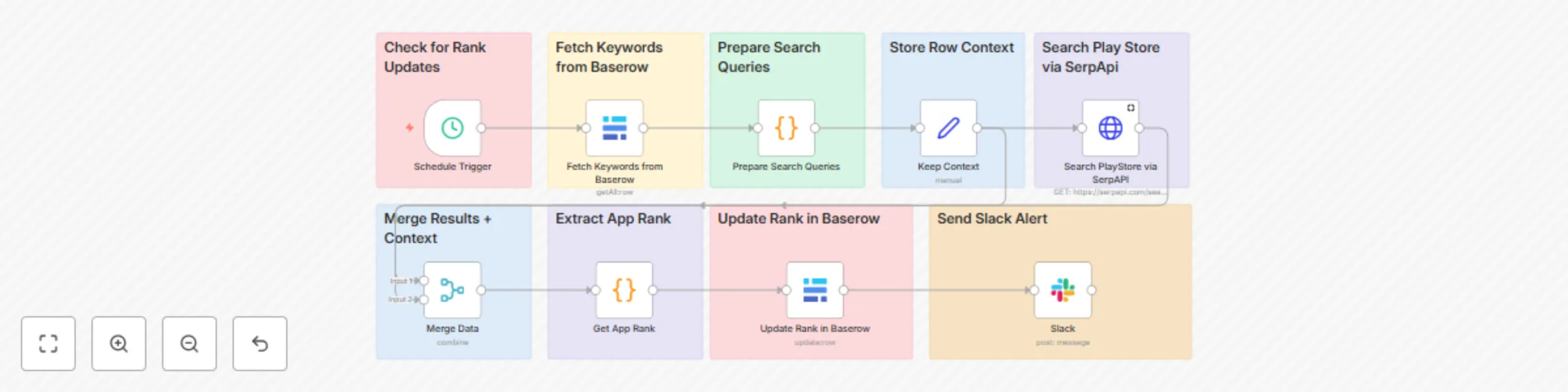
Workflow preview


 Early Deal
DISCOUNT 20%

Important notice
This workflow is provided as-is. Please review and test before using in production.
Overview
Automatically track your Android app’s keyword rankings on Google Play. This workflow checks ranks via SerpApi, updates a Baserow table, and posts a heads-up in Slack so your team can review changes quickly.
💡 Perfect for
ASO teams tracking daily keyword positions
Growth & marketing standups that want quick rank visibility
Lightweight historical logging without a full BI stack
🧠 What it does
Runs on a schedule (e.g., weekly)
Queries SerpApi for each keyword’s Play Store ranking
Saves results to Baserow: Current Rank, Previous Rank, Last modified
Sends a Slack alert: “Ranks updated — review in Baserow”
⚡ Requirements
SerpApi account & API key
Baserow account + API token
Slack connection (bot/app or credential in n8n)
⚙️ Setup Instructions
- Create a Baserow table
Create a new table (any name). Add user-field names exactly:
Keywords (text)
Current Rank (number)
Previous Rank (number)
Last modified (date/time)
Optional fields you can add later: Notes, Locale, Store Country, App Package ID.
- Connect credentials in n8n
Baserow: add your API token and select your Database and Table in the Baserow nodes.
Slack: connect your Slack account/workspace in the Slack node.
SerpApi: open the HTTP Request node and put your API key under Query Parameters → api_key = YOUR_KEY.
- Verify field mapping
In the Baserow (Update Row) node, map:
Row ID → {{$json.id}}
Current Rank → {{$json["Current Rank"]}}
Previous Rank → your code node should set this (the template copies the old “Current Rank” into “Previous Rank” before writing the new one)
Last modified → {{$now}} (or the timestamp you compute)
🛟 Notes & Tips
If you prefer a single daily Slack summary instead of multiple pings, add a Code node after updates to aggregate lines and send one message.
Treat 0 or missing ranks as “not found” and flag them in Slack if helpful.
For multi-country tracking, include hl/gl (locale/country) in your SerpApi query params and store them as columns.
🤝 Need a hand?
I’m happy to help you get this running smoothly—or tailor it to your brand.
Reach out to me via email: [email protected]