Track certification requirements with ScrapeGraphAI, GitLab and Rocket.Chat
Workflow preview


 Early Deal
DISCOUNT 20%

Important notice
This workflow is provided as-is. Please review and test before using in production.
Overview
Certification Requirement Tracker with Rocket.Chat and GitLab
⚠️ COMMUNITY TEMPLATE DISCLAIMER: This is a community-contributed template that uses ScrapeGraphAI (a community node). Please ensure you have the ScrapeGraphAI community node installed in your n8n instance before using this template.
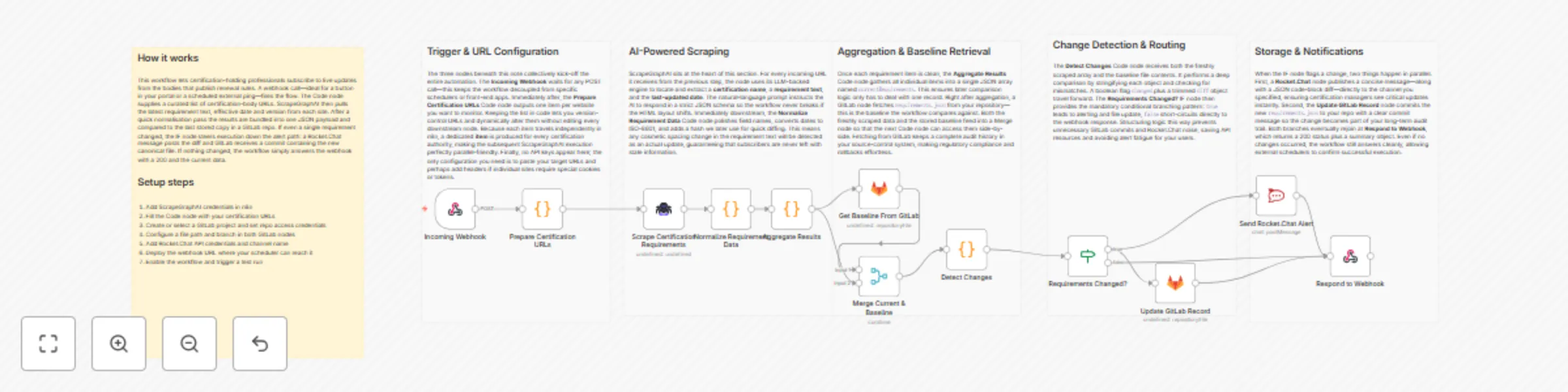
This workflow automatically monitors websites of certification bodies and industry associations, detects changes in certification requirements, commits the updated information to a GitLab repository, and notifies a Rocket.Chat channel. Ideal for professionals and compliance teams who must stay ahead of annual updates and renewal deadlines.
Pre-conditions/Requirements
Prerequisites
- Running n8n instance (self-hosted or n8n.cloud)
- ScrapeGraphAI community node installed and active
- Rocket.Chat workspace (self-hosted or cloud)
- GitLab account and repository for documentation
- Publicly reachable URL for incoming webhooks (use n8n tunnel, Ngrok, or a reverse proxy)
Required Credentials
- ScrapeGraphAI API Key – Enables scraping of certification pages
- Rocket.Chat Access Token & Server URL – To post update messages
- GitLab Personal Access Token – With
apiandwrite_repositoryscopes
Specific Setup Requirements
| Item | Example Value | Notes |
|---|---|---|
| GitLab Repo | gitlab.com/company/cert-tracker |
Markdown files will be committed here |
| Rocket.Chat Channel | #certification-updates |
Receives update alerts |
| Certification Source URLs file | /data/sourceList.json in the repository |
List of URLs to scrape |
How it works
This workflow automatically monitors websites of certification bodies and industry associations, detects changes in certification requirements, commits the updated information to a GitLab repository, and notifies a Rocket.Chat channel. Ideal for professionals and compliance teams who must stay ahead of annual updates and renewal deadlines.
Key Steps:
- Webhook Trigger: Fires on a scheduled HTTP call (e.g., via cron) or manual trigger.
- Code (Prepare Source List): Reads/constructs a list of certification URLs to scrape.
- ScrapeGraphAI: Fetches HTML content and extracts requirement sections.
- Merge: Combines newly scraped data with the last committed snapshot.
- IF Node: Determines if a change occurred (hash/length comparison).
- GitLab: Creates a branch, commits updated Markdown/JSON files, and opens an MR (optional).
- Rocket.Chat: Posts a message summarizing changes and linking to the GitLab diff.
- Respond to Webhook: Returns a JSON summary to the requester (useful for monitoring or chained automations).
Set up steps
Setup Time: 20-30 minutes
- Install Community Node: In n8n UI, go to Settings → Community Nodes and install
@n8n/community-node-scrapegraphai. - Create Credentials:
a. ScrapeGraphAI – paste your API key.
b. Rocket.Chat – create a personal access token (Personal Access Tokens → New Token) and configure credentials.
c. GitLab – create PAT withapi+write_repositoryscopes and add to n8n. - Clone the Template: Import this workflow JSON into your n8n instance.
- Edit StickyNote: Replace placeholder URLs with actual certification-source URLs or point to a repo file.
- Configure GitLab Node: Set your repository, default branch, and commit message template.
- Configure Rocket.Chat Node: Select credential, channel, and message template (markdown supported).
- Expose Webhook: If self-hosting, enable n8n tunnel or configure reverse proxy to make the webhook public.
- Test Run: Trigger the workflow manually; verify GitLab commit/MR and Rocket.Chat notification.
- Automate: Schedule an external cron (or n8n Cron node) to
POSTto the webhook yearly, quarterly, or monthly as needed.
Node Descriptions
Core Workflow Nodes:
- stickyNote – Human-readable instructions/documentation embedded in the flow.
- webhook – Entry point; accepts
POST /cert-trackerrequests. - code (Prepare Source List) – Generates an array of URLs; can pull from GitLab or an environment variable.
- scrapegraphAi – Scrapes each URL and extracts certification requirement sections using CSS/XPath selectors.
- merge (by key) – Joins new data with previous snapshot for change detection.
- if (Changes?) – Branches logic based on whether differences exist.
- gitlab – Creates/updates files and opens merge requests containing new requirements.
- rocketchat – Sends formatted update to designated channel.
- respondToWebhook – Returns
200 OKwith a JSON summary.
Data Flow:
- webhook → code → scrapegraphAi → merge → if
- if (true) → gitlab → rocketchat
- if (false) → respondToWebhook
Customization Examples
Change Scraping Frequency
// Replace external cron with n8n Cron node
{
  "nodes": [
    {
      "name": "Cron",
      "type": "n8n-nodes-base.cron",
      "parameters": {
        "schedule": {
          "hour": "0",
          "minute": "0",
          "dayOfMonth": "1"
        }
      }
    }
  ]
}
Extend Notification Message
// Rocket.Chat node → Message field
const diffUrl = $json["gitlab_diff_url"];
const count = $json["changes_count"];
return `:bell: **${count} Certification Requirement Update(s)**\n\nView diff: ${diffUrl}`;
Data Output Format
The workflow outputs structured JSON data:
{
  "timestamp": "2024-05-15T12:00:00Z",
  "changesDetected": true,
  "changesCount": 3,
  "gitlab_commit_sha": "a1b2c3d4",
  "gitlab_diff_url": "https://gitlab.com/company/cert-tracker/-/merge_requests/42",
  "notifiedChannel": "#certification-updates"
}
Troubleshooting
Common Issues
- ScrapeGraphAI returns empty results – Verify your CSS/XPath selectors and API key quota.
- GitLab commit fails (401 Unauthorized) – Ensure PAT has
apiandwrite_repositoryscopes and is not expired.
Performance Tips
- Limit the number of pages scraped per run to avoid API rate limits.
- Cache last-scraped HTML in an S3 bucket or database to reduce redundant requests.
Pro Tips:
- Use GitLab CI to auto-deploy documentation site whenever new certification files are merged.
- Enable Rocket.Chat threading to keep discussions organized per update.
- Tag stakeholders in Rocket.Chat messages with
@cert-teamfor instant visibility.