
Sync new Shopify orders to Google Sheets with GPT-4.1-mini analysis

Workflow preview
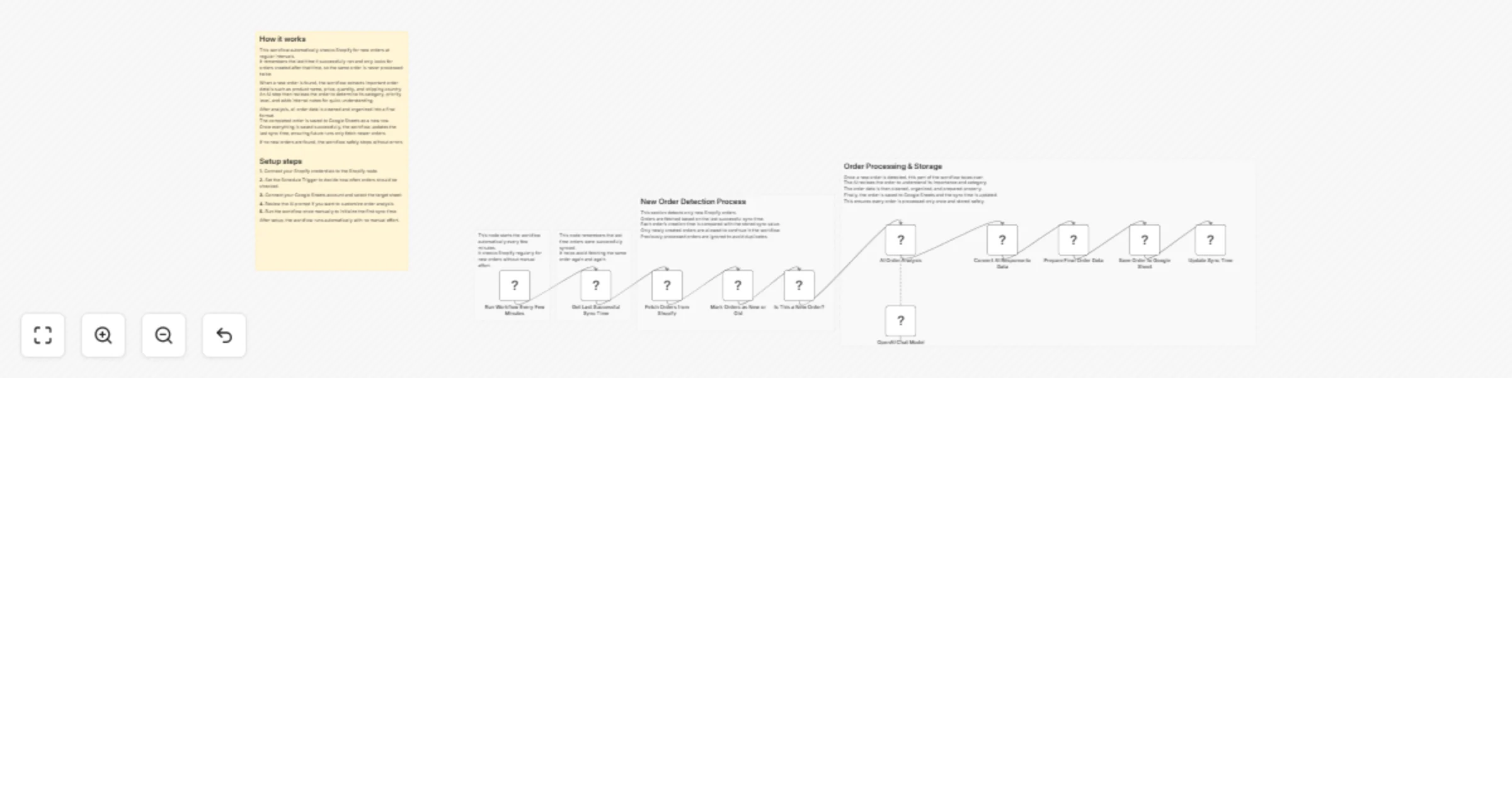
Workflow preview
100%
Sync new Shopify orders to Google Sheets with GPT-4.1-mini analysis preview
Open on n8n.io

1. Workflow Overview

Shopify New Orders Auto Sync to Google Sheets & AI Analysis This workflow automatically fetches new Shopify orders on a schedule, detects only newly created orders, enriches them using AI, and stor...

Best for

  • Document Extraction automation workflows
  • AI Summarization automation workflows
  • advanced n8n builders looking for reusable templates

Tools used

@n8n/n8n-nodes-langchain.lmchatopenai, n8n-nodes-base.scheduletrigger, n8n-nodes-base.code, n8n-nodes-base.shopify, n8n-nodes-base.if, @n8n/n8n-nodes-langchain.agent, n8n-nodes-base.set, n8n-nodes-base.googlesheets

Source and attribution

This workflow is cataloged by N8N Workflows and links back to its original n8n.io source page by WeblineIndia.

Original n8n.io source

1.1 Workflow description

Title
Sync new Shopify orders to Google Sheets with GPT-4.1-mini analysis
Workflow name
Sync new Shopify orders to Google Sheets with GPT-4.1-mini analysis

Shopify New Orders Auto-Sync to Google Sheets & AI Analysis

This workflow automatically fetches new Shopify orders on a schedule, detects only newly created orders, enriches them using AI, and stores clean, structured data in Google Sheets for reporting and tracking.

This workflow runs on a schedule, fetches recent Shopify orders, checks which ones are new using a stored sync timestamp, analyzes each new order with AI, and saves the final results into Google Sheets.

You receive:

  • Automatic order sync without webhooks
  • Duplicate-free processing using last sync tracking
  • AI-generated order insights (category, priority, notes)
  • Clean Google Sheets storage for reporting

Ideal for teams that want reliable order tracking, analysis, and reporting without relying on Shopify webhooks.

Quick Start – Implementation Steps

  1. Connect your Shopify API credentials.
  2. Set the Schedule Trigger (e.g., every 15 minutes).
  3. Connect your Google Sheets account and select a sheet.
  4. Configure the AI node for order analysis.
  5. Activate the workflow — automated order sync begins.

What It Does

This workflow automates Shopify order processing:

  1. Runs on a defined schedule.
  2. Loads the last successful sync time from workflow static data.
  3. Fetches Shopify orders created after that time.
  4. Identifies only new orders to prevent duplicates.
  5. Extracts key order details:
  • Order ID & number
  • Product name & quantity
  • Prices & currency
  • Shipping country
  1. Uses AI to analyze each order and generate:
  • Product category
  • Priority level
  • Internal review notes
  1. Formats the final data into clean fields.
  2. Saves each new order as a row in Google Sheets.
  3. Updates the last sync timestamp after successful processing.

Who’s It For

This workflow is ideal for:

  • E-commerce operations teams
  • Finance & accounting teams
  • Store owners using Shopify
  • Teams tracking orders in spreadsheets
  • Businesses without Shopify webhook access
  • Anyone needing automated order backups

Requirements to Use This Workflow

To run this workflow, you will need:

  • n8n instance (self-hosted or cloud)
  • Shopify Admin API access
  • Google Sheets account
  • Optional: AI credentials (OpenAI or compatible)
  • Basic understanding of Shopify order data

How It Works

  1. Scheduled Trigger – Workflow runs at fixed intervals.
  2. Load Last Sync – Reads the last processed timestamp.
  3. Fetch Shopify Orders – Retrieves recent orders.
  4. New Order Detection – Filters only unprocessed orders.
  5. AI Order Analysis – Adds category, priority, and notes.
  6. Prepare Final Data – Cleans and structures fields.
  7. Save to Google Sheets – Appends a new row per order.
  8. Update Sync Time – Stores the latest successful run time.

If no new orders exist, the workflow exits safely without errors.

Setup Steps

  1. Import the workflow JSON into n8n.
  2. Open the Schedule Trigger and set the desired frequency.
  3. Configure the Shopify node with your store credentials.
  4. Connect the Google Sheets node and map columns correctly.
  5. Review the AI prompt for customization.
  6. Run the workflow once manually to initialize sync data.
  7. Activate the workflow.

How To Customize Nodes

Change Sync Frequency

Adjust the Schedule Trigger to run every few minutes, hourly, or daily.

Customize AI Analysis

Modify the AI prompt to:

  • Change priority rules
  • Add risk or fraud flags
  • Generate internal comments

Extend Google Sheets Fields

You can add:

  • Customer email
  • Payment status
  • Fulfillment status
  • AI confidence score

Add-Ons (Optional Enhancements)

You can extend this workflow to:

  • Send Slack or email notifications
  • Generate daily summary reports
  • Detect high-value orders
  • Add fraud or risk scoring
  • Store data in a database instead of Sheets
  • Support multiple Shopify stores
  • Create dashboards from Google Sheets

Use Case Examples

1. Operations Reporting

Track daily orders in a shared spreadsheet.

2. Finance & Accounting

Maintain an independent record of all sales.

3. Order Review

Use AI notes to quickly understand important orders.

4. Backup & Auditing

Keep an external copy of Shopify order data.

Troubleshooting Guide

Issue Possible Cause Solution
No orders fetched lastSync too recent Reset static data
Duplicate orders Sync update missing Ensure last sync node runs
AI output not parsed Invalid JSON Adjust AI prompt
Sheet not updating Column mismatch Match headers exactly
Workflow stops early No new data Enable “Always Output Data”

Need Help?

If you need help extending this workflow by adding alerts, dashboards advanced AI logic or scaling for production, then our n8n automation developers at WeblineIndia team are happy to assist with advanced n8n automation and Shopify integrations.

1.2 Logical Blocks

This catalog entry is organized from the workflow JSON. The node-level section below shows the executable blocks available for review before importing the template.

2. Block-by-Block Analysis

Block 1 - OpenAI Chat Model

Type / Role
@n8n/n8n-nodes-langchain.lmChatOpenAi - lmChatOpenAi
Config choices
Version 1.2

Block 2 - Run Workflow Every Few Minutes

Type / Role
n8n-nodes-base.scheduleTrigger - scheduleTrigger
Config choices
Version 1.2

Block 3 - Get Last Successful Sync Time

Type / Role
n8n-nodes-base.code - code
Config choices
Version 2

Block 4 - Fetch Orders from Shopify

Type / Role
n8n-nodes-base.shopify - shopify
Config choices
Version 1

Block 5 - Mark Orders as New or Old

Type / Role
n8n-nodes-base.code - code
Config choices
Version 2

Block 6 - Is This a New Order?

Type / Role
n8n-nodes-base.if - if
Config choices
Version 2.2

Block 7 - AI Order Analysis

Type / Role
@n8n/n8n-nodes-langchain.agent - agent
Config choices
Version 3

Block 8 - Prepare Final Order Data

Type / Role
n8n-nodes-base.set - set
Config choices
Version 3.4

Block 9 - Convert AI Response to Data

Type / Role
n8n-nodes-base.code - code
Config choices
Version 2

Block 10 - Save Order to Google Sheet

Type / Role
n8n-nodes-base.googleSheets - googleSheets
Config choices
Version 4.7

Block 11 - Update Sync Time

Type / Role
n8n-nodes-base.code - code
Config choices
Version 2

Block 12 - Sticky Note

Type / Role
n8n-nodes-base.stickyNote - stickyNote
Config choices
Version 1

Block 13 - Sticky Note1

Type / Role
n8n-nodes-base.stickyNote - stickyNote
Config choices
Version 1

Block 14 - Sticky Note2

Type / Role
n8n-nodes-base.stickyNote - stickyNote
Config choices
Version 1

Block 15 - Sticky Note3

Type / Role
n8n-nodes-base.stickyNote - stickyNote
Config choices
Version 1

Block 16 - Sticky Note4

Type / Role
n8n-nodes-base.stickyNote - stickyNote
Config choices
Version 1

3. Summary Table

Workflow Sync new Shopify orders to Google Sheets with GPT-4.1-mini analysis
Complexity advanced
Nodes 16
Categories Document Extraction, AI Summarization
Author WeblineIndia
Published 26 Mar 2026

4. Reproducing the Workflow from Scratch

  1. 1. Download the workflow JSON

    Use the JSON export at /data/workflows/14365/14365.json as the source template for this automation.

  2. 2. Import the template into n8n

    Open n8n, import the downloaded JSON, and review each node before activating the workflow.

  3. 3. Configure credentials and variables

    Replace placeholder credentials, API keys, webhook URLs, account IDs, and environment-specific values with your own settings.

  4. 4. Test with sample data

    Run the workflow manually or in a staging workspace, inspect node output, and confirm downstream systems receive the expected data.

  5. 5. Activate and monitor

    Enable the workflow only after testing, then monitor executions, errors, and rate limits during the first production runs.

5. General Notes & Resources

Review imported nodes carefully before activation. This catalog entry is intended to help you inspect the workflow structure, understand required services, and find related templates faster.

Node names, credentials, schedules, webhook paths, and external service limits may need adjustment for your workspace.

Frequently asked questions

What does Sync new Shopify orders to Google Sheets with GPT-4.1-mini analysis do?

Shopify New Orders Auto Sync to Google Sheets & AI Analysis This workflow automatically fetches new Shopify orders on a schedule, detects only newly created orders, enriches them using AI, and stor...

What do I need before importing this workflow?

Review the workflow JSON, configure any required credentials in n8n, and test the automation in a safe workspace before using it in production.

Can I customize this workflow?

Yes. Use the block-by-block analysis and the downloadable JSON to inspect each node, then adjust credentials, prompts, schedules, filters, or destinations for your Document Extraction, AI Summarization use case.



