
Send n8n error reports to LINE

Workflow preview
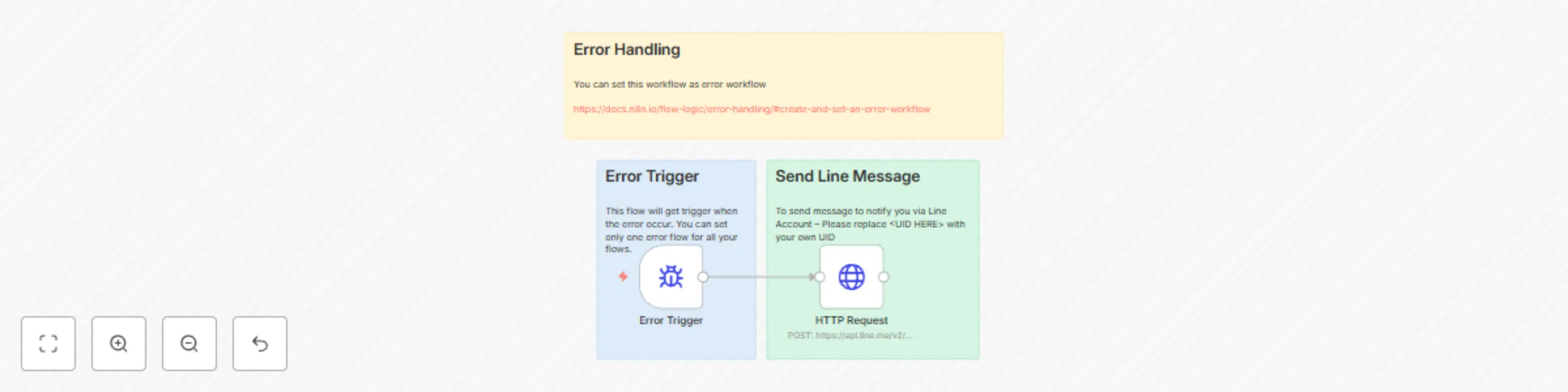
Workflow preview
100%
Send n8n error reports to LINE preview
Open on n8n.io

Important notice

This workflow is provided as-is. Please review and test before using in production.

1. Workflow Overview

This workflow template, "n8n Error Report to LINE," is designed to streamline error handling by sending real time notifications to your LINE account whenever an error occurs in any of your n8n work...

Best for

  • DevOps automation workflows
  • intermediate n8n builders looking for reusable templates

Tools used

n8n-nodes-base.errortrigger, n8n-nodes-base.httprequest, n8n-nodes-base.stickynote

Source and attribution

This workflow is cataloged by N8N Workflows and links back to its original n8n.io source page by [email protected].

Original n8n.io source

1.1 Workflow description

Title
Send n8n error reports to LINE
Workflow name
Send n8n error reports to LINE

This workflow template, "n8n Error Report to LINE," is designed to streamline error handling by sending real-time notifications to your LINE account whenever an error occurs in any of your n8n workflows. By integrating with the LINE Messaging API , this template ensures you stay informed about workflow failures, allowing you to take immediate action and minimize downtime.

Whether you're a developer managing multiple workflows or a business owner relying on automation, this template provides a simple yet powerful way to monitor and resolve errors efficiently.

Who Is This Template For?

Developers: Who manage complex n8n workflows and need real-time error notifications. DevOps Teams: Looking to enhance monitoring and incident response for automated systems. Business Owners: Who rely on n8n workflows for critical operations and want to ensure reliability. Automation Enthusiasts: Seeking tools to simplify error tracking and improve workflow performance.

What Problem Does This Workflow Solve?

When automating processes with n8n, errors can occur due to various reasons such as misconfigurations, API changes, or unexpected inputs. Without proper error handling, these issues may go unnoticed, leading to delays or disruptions. This workflow solves that problem by:

  1. Automatically detecting errors in your n8n workflows.
  2. Sending instant notifications to your LINE account with details about the failed workflow, including its name and execution URL. Allowing you to quickly identify and resolve issues, ensuring smooth operation of your automated systems.

What This Workflow Does

  1. Error Trigger: The workflow is triggered automatically whenever an error occurs in any n8n workflow configured to use this error-handling flow.
  2. Send Notification via LINE: Using the LINE Push API , the workflow sends a message to your LINE account with key details about the error, such as the workflow name and execution URL.

You can also customize the notification message to include additional information or format it to suit your preferences.

Setup Guide

Pre-Requisites

  • Access to the LINE Developers Console with a registered bot and access to the Push API. https://developers.line.biz/console/ API Reference
  • Basic knowledge of n8n workflows and JSON formatting.
  • An active n8n instance where you can configure error workflows.

Step-by-Step Setup

  • Configure the Error Trigger: Set this workflow as the default error workflow in your n8n instance. https://docs.n8n.io/flow-logic/error-handling/
  • Set Up LINE Push API: Replace <UID HERE> in the HTTP Request node with your LINE user ID to ensure notifications are sent to the correct account.

1.2 Logical Blocks

This catalog entry is organized from the workflow JSON. The node-level section below shows the executable blocks available for review before importing the template.

2. Block-by-Block Analysis

Block 1 - Error Trigger

Type / Role
n8n-nodes-base.errorTrigger - errorTrigger
Config choices
Version 1

Block 2 - HTTP Request

Type / Role
n8n-nodes-base.httpRequest - httpRequest
Config choices
Version 4.2

Block 3 - Sticky Note

Type / Role
n8n-nodes-base.stickyNote - stickyNote
Config choices
Version 1

Block 4 - Sticky Note1

Type / Role
n8n-nodes-base.stickyNote - stickyNote
Config choices
Version 1

Block 5 - Sticky Note2

Type / Role
n8n-nodes-base.stickyNote - stickyNote
Config choices
Version 1

3. Summary Table

Workflow Send n8n error reports to LINE
Complexity intermediate
Nodes 5
Categories DevOps
Author [email protected]
Published 12 Mar 2025

4. Reproducing the Workflow from Scratch

  1. 1. Download the workflow JSON

    Use the JSON export at /data/workflows/3141/3141.json as the source template for this automation.

  2. 2. Import the template into n8n

    Open n8n, import the downloaded JSON, and review each node before activating the workflow.

  3. 3. Configure credentials and variables

    Replace placeholder credentials, API keys, webhook URLs, account IDs, and environment-specific values with your own settings.

  4. 4. Test with sample data

    Run the workflow manually or in a staging workspace, inspect node output, and confirm downstream systems receive the expected data.

  5. 5. Activate and monitor

    Enable the workflow only after testing, then monitor executions, errors, and rate limits during the first production runs.

5. General Notes & Resources

Review imported nodes carefully before activation. This catalog entry is intended to help you inspect the workflow structure, understand required services, and find related templates faster.

Node names, credentials, schedules, webhook paths, and external service limits may need adjustment for your workspace.

Frequently asked questions

What does Send n8n error reports to LINE do?

This workflow template, "n8n Error Report to LINE," is designed to streamline error handling by sending real time notifications to your LINE account whenever an error occurs in any of your n8n work...

What do I need before importing this workflow?

Review the workflow JSON, configure any required credentials in n8n, and test the automation in a safe workspace before using it in production.

Can I customize this workflow?

Yes. Use the block-by-block analysis and the downloadable JSON to inspect each node, then adjust credentials, prompts, schedules, filters, or destinations for your DevOps use case.



