
Send meeting summaries with Mailchimp and MongoDB

Workflow preview
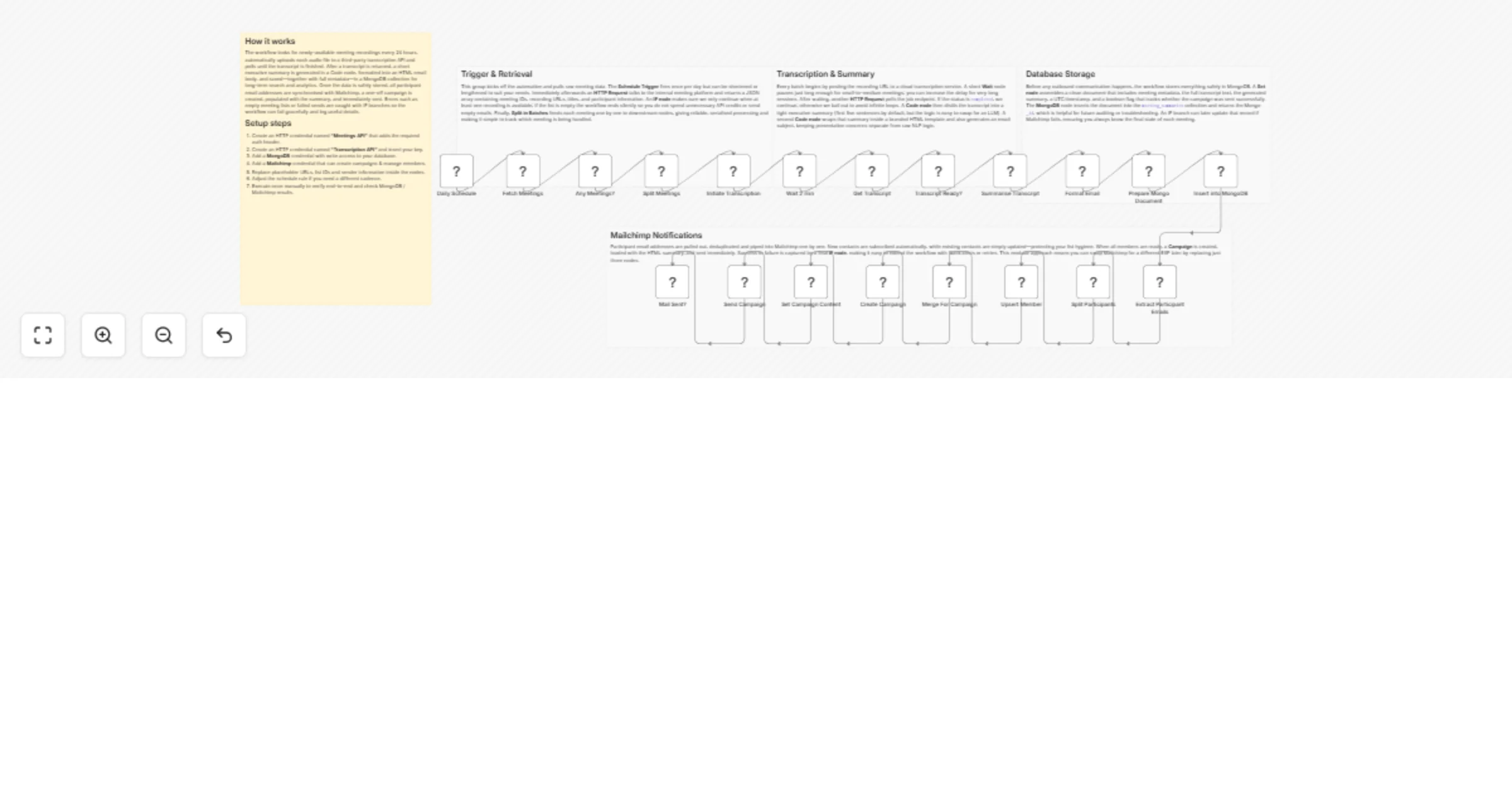
Workflow preview
100%
Send meeting summaries with Mailchimp and MongoDB preview
Open on n8n.io

1. Workflow Overview

Meeting Notes Distributor – Mailchimp and MongoDB This workflow automatically converts raw meeting recordings or written notes into concise summaries, stores them in MongoDB for future reference, a...

Best for

  • Document Extraction automation workflows
  • AI Summarization automation workflows
  • advanced n8n builders looking for reusable templates

Tools used

n8n-nodes-base.stickynote, n8n-nodes-base.scheduletrigger, n8n-nodes-base.httprequest, n8n-nodes-base.if, n8n-nodes-base.splitinbatches, n8n-nodes-base.wait, n8n-nodes-base.code, n8n-nodes-base.set

Source and attribution

This workflow is cataloged by N8N Workflows and links back to its original n8n.io source page by vinci-king-01.

Original n8n.io source

1.1 Workflow description

Title
Send meeting summaries with Mailchimp and MongoDB
Workflow name
Send meeting summaries with Mailchimp and MongoDB

Meeting Notes Distributor – Mailchimp and MongoDB

This workflow automatically converts raw meeting recordings or written notes into concise summaries, stores them in MongoDB for future reference, and distributes the summaries to all meeting participants through Mailchimp. It is ideal for teams that want to keep everyone aligned without manual copy-and-paste or email chains.

Pre-conditions/Requirements

Prerequisites

  • n8n instance (self-hosted or cloud)
  • Audio transcription service or written notes available via HTTP endpoint
  • MongoDB database (cloud or self-hosted)
  • Mailchimp account with an existing Audience list

Required Credentials

  • MongoDB – Connection string with insert permission
  • Mailchimp API Key – To send campaigns
  • (Optional) HTTP Service Auth – If your transcription/notes endpoint is secured

Specific Setup Requirements

Component Example Value Notes
MongoDB Database meeting_notes Database in which summaries will be stored
Collection Name summaries Collection automatically created if it doesn’t exist
Mailchimp List Meeting Participants Audience list containing participant email addresses
Notes Endpoint https://example.com/api/meetings/{id} Returns raw transcript or note text (JSON)

How it works

This workflow automatically converts raw meeting recordings or written notes into concise summaries, stores them in MongoDB for future reference, and distributes the summaries to all meeting participants through Mailchimp. It is ideal for teams that want to keep everyone aligned without manual copy-and-paste or email chains.

Key Steps:

  • Schedule Trigger: Fires daily (or on-demand) to check for new meeting notes.
  • HTTP Request: Downloads raw notes or transcript from your endpoint.
  • Code Node: Uses an AI or custom function to generate a concise summary.
  • If Node: Skips processing if the summary already exists in MongoDB.
  • MongoDB: Inserts the new summary document.
  • Split in Batches: Splits participants into Mailchimp-friendly batch sizes.
  • Mailchimp: Sends personalized summary emails to each participant.
  • Wait: Ensures rate limits are respected between Mailchimp calls.
  • Merge: Consolidates success/failure results for logging or alerting.

Set up steps

Setup Time: 15-25 minutes

  1. Clone the workflow: Import or copy the JSON into your n8n instance.
  2. Configure Schedule Trigger: Set the cron expression (e.g., every weekday at 18:00).
  3. Set HTTP Request URL: Replace placeholder with your transcription/notes endpoint. Add auth headers if needed.
  4. Add MongoDB Credentials: Enter your connection string in the MongoDB node.
  5. Customize Summary Logic: Open the Code node to tweak summarization length, language, or model.
  6. Mailchimp Credentials: Supply your API key and select the correct Audience list.
  7. Map Email Fields: Ensure participant emails are supplied from transcription metadata or external source.
  8. Test Run: Execute once manually to verify MongoDB insert and email delivery.
  9. Activate Workflow: Enable the workflow so it runs on its defined schedule.

Node Descriptions

Core Workflow Nodes:

  • Schedule Trigger – Initiates the workflow at predefined intervals.
  • HTTP Request – Retrieves the latest meeting data (transcript or notes).
  • Code – Generates a summarized version of the meeting content.
  • If – Checks MongoDB for duplicates to avoid re-sending.
  • MongoDB – Stores finalized summaries for archival and audit.
  • SplitInBatches – Breaks participant list into manageable chunks.
  • Mailchimp – Sends summary emails via campaigns or transactional messages.
  • Wait – Pauses between batches to honor Mailchimp rate limits.
  • Merge – Aggregates success/failure responses for logging.

Data Flow:

  1. Schedule TriggerHTTP RequestCodeIf
  2. If summary is new: MongoDBSplitInBatchesMailchimpWait
  3. Merge collates all results

Customization Examples

1. Change Summary Length

// Inside the Code Node
const rawText = items[0].json.text;
const maxSentences = 5; // adjust to 3, 7, etc.
items[0].json.summary = summarize(rawText, maxSentences);
return items;

2. Personalize Mailchimp Subject

// In the Set node before Mailchimp
items[0].json.subject = `Recap: ${items[0].json.meetingTitle} – ${new Date().toLocaleDateString()}`;
return items;

Data Output Format

The workflow outputs structured JSON data:

{
 "meetingId": "abc123",
 "meetingTitle": "Quarterly Planning",
 "summary": "Key decisions on roadmap, budget approvals...",
 "participants": [
 "[email protected]",
 "[email protected]"
 ],
 "mongoInsertId": "65d9278fa01e3f94b1234567",
 "mailchimpBatchIds": ["2024-01-01T12:00:00Z#1", "2024-01-01T12:01:00Z#2"]
}

Troubleshooting

Common Issues

  1. Mailchimp rate-limit errors – Increase Wait node delay or reduce batch size.
  2. Duplicate summaries – Ensure the If node correctly queries MongoDB using meeting ID as a unique key.

Performance Tips

  • Keep batch sizes under 500 to stay well within Mailchimp limits.
  • Offload AI summarization to external services if Code node execution time is high.

Pro Tips:

  • Store full transcripts in MongoDB GridFS for future reference.
  • Use environment variables in n8n for all API keys to simplify workflow export/import.
  • Add a notifier (e.g., Slack node) after Merge to alert admins on failures.

This is a community template provided “as-is” without warranty. Always validate the workflow in a test environment before using it in production.

1.2 Logical Blocks

This catalog entry is organized from the workflow JSON. The node-level section below shows the executable blocks available for review before importing the template.

2. Block-by-Block Analysis

Block 1 - 📒 Meeting Notes Distributor – Overview

Type / Role
n8n-nodes-base.stickyNote - stickyNote
Config choices
Version 1

Block 2 - Trigger & Retrieval (Info)

Type / Role
n8n-nodes-base.stickyNote - stickyNote
Config choices
Version 1

Block 3 - Transcription & Summary (Info)

Type / Role
n8n-nodes-base.stickyNote - stickyNote
Config choices
Version 1

Block 4 - Database Storage (Info)

Type / Role
n8n-nodes-base.stickyNote - stickyNote
Config choices
Version 1

Block 5 - Mailchimp Notifications (Info)

Type / Role
n8n-nodes-base.stickyNote - stickyNote
Config choices
Version 1

Block 6 - Daily Schedule

Type / Role
n8n-nodes-base.scheduleTrigger - scheduleTrigger
Config choices
Version 1

Block 7 - Fetch Meetings

Type / Role
n8n-nodes-base.httpRequest - httpRequest
Config choices
Version 4

Block 8 - Any Meetings?

Type / Role
n8n-nodes-base.if - if
Config choices
Version 2

Block 9 - Split Meetings

Type / Role
n8n-nodes-base.splitInBatches - splitInBatches
Config choices
Version 3

Block 10 - Initiate Transcription

Type / Role
n8n-nodes-base.httpRequest - httpRequest
Config choices
Version 4

Block 11 - Wait 2 min

Type / Role
n8n-nodes-base.wait - wait
Config choices
Version 1

Block 12 - Get Transcript

Type / Role
n8n-nodes-base.httpRequest - httpRequest
Config choices
Version 4

Block 13 - Transcript Ready?

Type / Role
n8n-nodes-base.if - if
Config choices
Version 2

Block 14 - Summarise Transcript

Type / Role
n8n-nodes-base.code - code
Config choices
Version 2

Block 15 - Format Email

Type / Role
n8n-nodes-base.code - code
Config choices
Version 2

Block 16 - Prepare Mongo Document

Type / Role
n8n-nodes-base.set - set
Config choices
Version 3

Block 17 - Insert into MongoDB

Type / Role
n8n-nodes-base.mongoDb - mongoDb
Config choices
Version 1

Block 18 - Extract Participant Emails

Type / Role
n8n-nodes-base.code - code
Config choices
Version 2

Block 19 - Split Participants

Type / Role
n8n-nodes-base.splitInBatches - splitInBatches
Config choices
Version 3

Block 20 - Upsert Member

Type / Role
n8n-nodes-base.mailchimp - mailchimp
Config choices
Version 1

Block 21 - Merge For Campaign

Type / Role
n8n-nodes-base.merge - merge
Config choices
Version 2

Block 22 - Create Campaign

Type / Role
n8n-nodes-base.mailchimp - mailchimp
Config choices
Version 1

Block 23 - Set Campaign Content

Type / Role
n8n-nodes-base.mailchimp - mailchimp
Config choices
Version 1

Block 24 - Send Campaign

Type / Role
n8n-nodes-base.mailchimp - mailchimp
Config choices
Version 1

Showing the first 24 of 25 workflow blocks. Download the JSON for the full node graph.

3. Summary Table

Workflow Send meeting summaries with Mailchimp and MongoDB
Complexity advanced
Nodes 25
Categories Document Extraction, AI Summarization
Author vinci-king-01
Published 16 Jan 2026

4. Reproducing the Workflow from Scratch

  1. 1. Download the workflow JSON

    Use the JSON export at /data/workflows/12760/12760.json as the source template for this automation.

  2. 2. Import the template into n8n

    Open n8n, import the downloaded JSON, and review each node before activating the workflow.

  3. 3. Configure credentials and variables

    Replace placeholder credentials, API keys, webhook URLs, account IDs, and environment-specific values with your own settings.

  4. 4. Test with sample data

    Run the workflow manually or in a staging workspace, inspect node output, and confirm downstream systems receive the expected data.

  5. 5. Activate and monitor

    Enable the workflow only after testing, then monitor executions, errors, and rate limits during the first production runs.

5. General Notes & Resources

Review imported nodes carefully before activation. This catalog entry is intended to help you inspect the workflow structure, understand required services, and find related templates faster.

Node names, credentials, schedules, webhook paths, and external service limits may need adjustment for your workspace.

Frequently asked questions

What does Send meeting summaries with Mailchimp and MongoDB do?

Meeting Notes Distributor – Mailchimp and MongoDB This workflow automatically converts raw meeting recordings or written notes into concise summaries, stores them in MongoDB for future reference, a...

What do I need before importing this workflow?

Review the workflow JSON, configure any required credentials in n8n, and test the automation in a safe workspace before using it in production.

Can I customize this workflow?

Yes. Use the block-by-block analysis and the downloadable JSON to inspect each node, then adjust credentials, prompts, schedules, filters, or destinations for your Document Extraction, AI Summarization use case.



