
Secure GET webhooks with query parameter validation for limited authentication cases

Workflow preview
Workflow preview
100%
Secure GET webhooks with query parameter validation for limited authentication cases preview
Open on n8n.io

Important notice

This workflow is provided as-is. Please review and test before using in production.

1. Workflow Overview

How to secure GET Webhooks? What are webhooks? Webhooks are special URLs that instantly trigger workflows when they receive an incoming HTTP request (like GET or POST). They're perfect for connecti...

Best for

  • SecOps automation workflows
  • intermediate n8n builders looking for reusable templates

Tools used

n8n-nodes-base.stopanderror, n8n-nodes-base.stickynote, n8n-nodes-base.if, n8n-nodes-base.noop, n8n-nodes-base.webhook

Source and attribution

This workflow is cataloged by N8N Workflows and links back to its original n8n.io source page by Kai S. Huxmann.

Original n8n.io source

1.1 Workflow description

Title
Secure GET webhooks with query parameter validation for limited authentication cases
Workflow name
Secure GET webhooks with query parameter validation for limited authentication cases

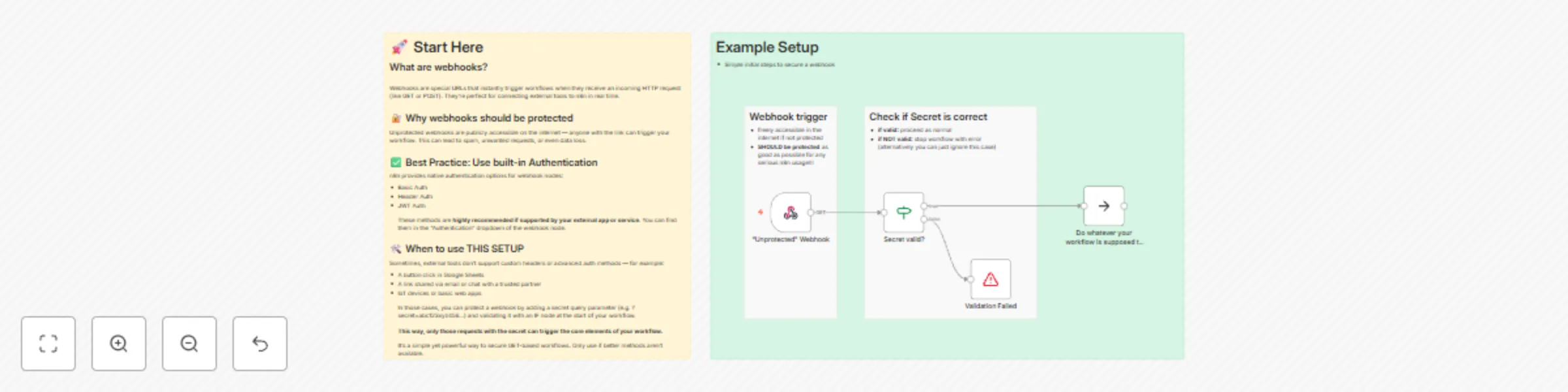
How to secure GET Webhooks?

What are webhooks?

Webhooks are special URLs that instantly trigger workflows when they receive an incoming HTTP request (like GET or POST). They're perfect for connecting external tools to n8n in real time.

🔐 Why webhooks should be protected

Unprotected webhooks are publicly accessible on the internet — anyone with the link can trigger your workflow. This can lead to spam, unwanted requests, or even data loss.

✅ Best Practice: Use built-in Authentication

n8n provides native authentication options for webhook nodes:

  • Basic Auth
  • Header Auth
  • JWT Auth

These methods are highly recommended if supported by your external app or service. You can find them in the “Authentication” dropdown of the webhook node.

🛠️ When to use THIS SETUP

Sometimes, external tools don’t support custom headers or advanced auth methods — for example:

  • A button click in Google Sheets
  • A link shared via email or chat with a trusted partner
  • IoT devices or basic web apps

In those cases, you can protect a webhook by adding a secret query parameter (e.g. ?secret=abc123xyz456...) and validating it with an IF node at the start of your workflow.

This way, only those requests with the secret can trigger the core elements of your workflow.

It's a simple yet powerful way to secure GET-based workflows. Only use if better methods aren't available.

1.2 Logical Blocks

This catalog entry is organized from the workflow JSON. The node-level section below shows the executable blocks available for review before importing the template.

2. Block-by-Block Analysis

Block 1 - Validation Failed

Type / Role
n8n-nodes-base.stopAndError - stopAndError
Config choices
Version 1

Block 2 - Sticky Note

Type / Role
n8n-nodes-base.stickyNote - stickyNote
Config choices
Version 1

Block 3 - Sticky Note7

Type / Role
n8n-nodes-base.stickyNote - stickyNote
Config choices
Version 1

Block 4 - Secret valid?

Type / Role
n8n-nodes-base.if - if
Config choices
Version 2.2

Block 5 - Do whatever your workflow is supposed to do

Type / Role
n8n-nodes-base.noOp - noOp
Config choices
Version 1

Block 6 - Sticky Note1

Type / Role
n8n-nodes-base.stickyNote - stickyNote
Config choices
Version 1

Block 7 - "Unprotected" Webhook

Type / Role
n8n-nodes-base.webhook - webhook
Config choices
Version 2.1

Block 8 - Sticky Note2

Type / Role
n8n-nodes-base.stickyNote - stickyNote
Config choices
Version 1

3. Summary Table

Workflow Secure GET webhooks with query parameter validation for limited authentication cases
Complexity intermediate
Nodes 8
Categories SecOps
Author Kai S. Huxmann
Published 13 Oct 2025

4. Reproducing the Workflow from Scratch

  1. 1. Download the workflow JSON

    Use the JSON export at /data/workflows/9570/9570.json as the source template for this automation.

  2. 2. Import the template into n8n

    Open n8n, import the downloaded JSON, and review each node before activating the workflow.

  3. 3. Configure credentials and variables

    Replace placeholder credentials, API keys, webhook URLs, account IDs, and environment-specific values with your own settings.

  4. 4. Test with sample data

    Run the workflow manually or in a staging workspace, inspect node output, and confirm downstream systems receive the expected data.

  5. 5. Activate and monitor

    Enable the workflow only after testing, then monitor executions, errors, and rate limits during the first production runs.

5. General Notes & Resources

Review imported nodes carefully before activation. This catalog entry is intended to help you inspect the workflow structure, understand required services, and find related templates faster.

Node names, credentials, schedules, webhook paths, and external service limits may need adjustment for your workspace.

Frequently asked questions

What does Secure GET webhooks with query parameter validation for limited authentication cases do?

How to secure GET Webhooks? What are webhooks? Webhooks are special URLs that instantly trigger workflows when they receive an incoming HTTP request (like GET or POST). They're perfect for connecti...

What do I need before importing this workflow?

Review the workflow JSON, configure any required credentials in n8n, and test the automation in a safe workspace before using it in production.

Can I customize this workflow?

Yes. Use the block-by-block analysis and the downloadable JSON to inspect each node, then adjust credentials, prompts, schedules, filters, or destinations for your SecOps use case.



