Block 1 - On clicking 'execute'
- Type / Role
- n8n-nodes-base.manualTrigger - manualTrigger
- Config choices
- Version 1
This workflow is provided as-is. Please review and test before using in production.
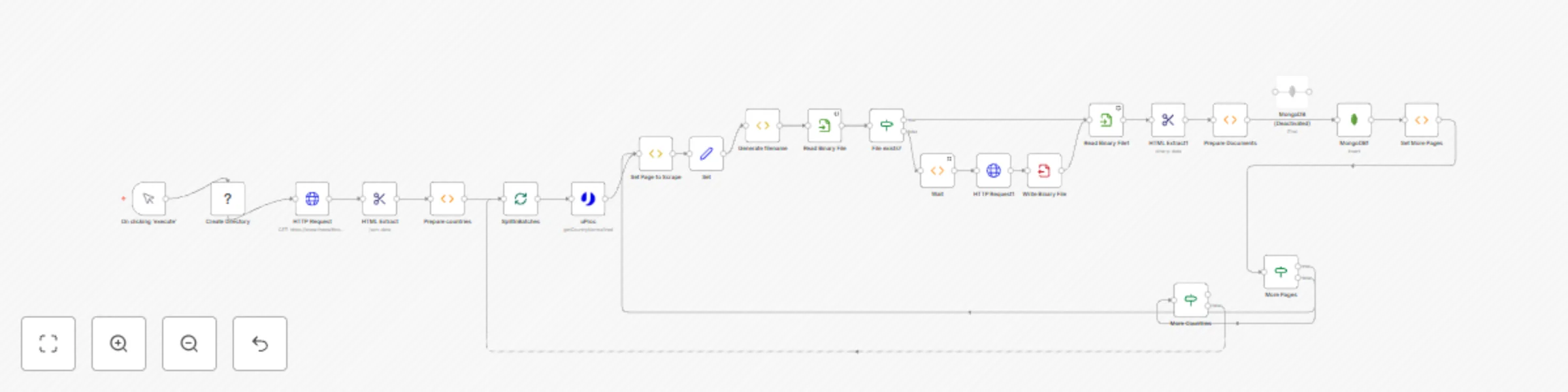
This workflow allows extracting data from multiple pages website. The workflow: 1) Starts in a country list at https://www.theswiftcodes.com/browse by country/. 2) Loads every country page (https:/...
n8n-nodes-base.manualtrigger, n8n-nodes-base.httprequest, n8n-nodes-base.htmlextract, n8n-nodes-base.splitinbatches, n8n-nodes-base.mongodb, n8n-nodes-base.uproc, n8n-nodes-base.function, n8n-nodes-base.if
This workflow is cataloged by N8N Workflows and links back to its original n8n.io source page by Miquel Colomer.
Original n8n.io sourceThis workflow allows extracting data from multiple pages website.
The workflow:
It uses getWorkflowStaticData('global') method to recover the next page (saved from the previous page), and it goes ahead with all the pages.
There is a first section where the countries list is recovered and extracted.
Later, I try to read if a local cache page is available and I recover the cached page from the disk.
Finally, I save data to MongoDB, and we paginate all the pages in the country and for all the countries.
I have applied a cache system to save a visited page to n8n local disk. If I relaunch workflow, we check if a cache file exists to discard non-required requests to the webpage.
If the data present in the website changes, you can apply a Cron node to check the website once per week.
Finally, before inserting data in MongoDB, the best way to avoid duplicates is to check that swift_code (the primary value of the collection) doesn't exist.
I recommend using a proxy for all requests to avoid IP blocks. A good solution for proxy plus IP rotation is scrapoxy.io.
This workflow is perfect for small data requirements. If you need to scrape dynamic data, you can use a Headless browser or any other service.
If you want to scrape huge lists of URIs, I recommend using Scrapy + Scrapoxy.
This catalog entry is organized from the workflow JSON. The node-level section below shows the executable blocks available for review before importing the template.
| Workflow | Scrape and store data from multiple website pages |
|---|---|
| Complexity | advanced |
| Nodes | 23 |
| Categories | Engineering |
| Author | Miquel Colomer |
| Published | 07 May 2021 |
Use the JSON export at /data/workflows/1073/1073.json as the source template for this automation.
Open n8n, import the downloaded JSON, and review each node before activating the workflow.
Replace placeholder credentials, API keys, webhook URLs, account IDs, and environment-specific values with your own settings.
Run the workflow manually or in a staging workspace, inspect node output, and confirm downstream systems receive the expected data.
Enable the workflow only after testing, then monitor executions, errors, and rate limits during the first production runs.
Review imported nodes carefully before activation. This catalog entry is intended to help you inspect the workflow structure, understand required services, and find related templates faster.
Node names, credentials, schedules, webhook paths, and external service limits may need adjustment for your workspace.
This workflow allows extracting data from multiple pages website. The workflow: 1) Starts in a country list at https://www.theswiftcodes.com/browse by country/. 2) Loads every country page (https:/...
Review the workflow JSON, configure any required credentials in n8n, and test the automation in a safe workspace before using it in production.
Yes. Use the block-by-block analysis and the downloadable JSON to inspect each node, then adjust credentials, prompts, schedules, filters, or destinations for your Engineering use case.