Real-time uptime alerts to Jira with smart Slack on-call routing
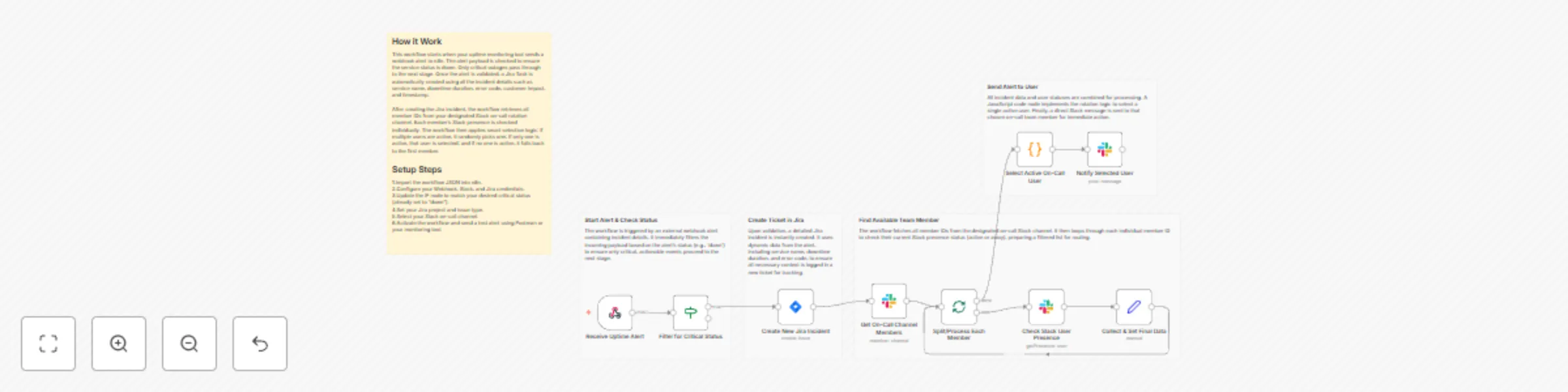
Workflow preview


 Early Deal
DISCOUNT 20%

Important notice
This workflow is provided as-is. Please review and test before using in production.
Overview
Real-Time Uptime Alerts to Jira with Smart Slack On-Call Routing
This workflow automatically converts uptime monitoring alerts received via webhook into Jira incident tasks and intelligently notifies an available on-call team member on Slack based on their real-time presence status. It ensures critical service outages never go unnoticed by selecting an active responder and sending a detailed direct message immediately.
⚡ Quick Implementation Steps
- Import the workflow JSON into n8n.
- Configure your Webhook, Slack, and Jira credentials.
- Update the IF node to filter for
status = down(already configured). - Set the Jira project and issue type as required.
- Connect your Slack on-call channel.
- Activate the workflow and send a test alert using Postman or your monitoring tool.
What It Does
This automation listens for incoming alerts from any uptime monitoring service. When a system or service goes down, the workflow instantly validates whether the alert is critical (status = down). Once validated, it automatically creates a detailed Jira Task containing all relevant service details such as timestamp, downtime duration, error code, customer impact and priority.
After the Jira incident is created, the workflow retrieves a list of all members from a dedicated Slack on-call rotation channel. It checks each member’s Slack presence (active, away, offline) and uses smart selection logic to choose the best person to notify. The selected team member then receives a richly formatted direct Slack message containing all incident details and a link to the Jira ticket.
This ensures the alert is not only logged properly but also reaches the right responder at the right time.
Who’s It For
This workflow is perfect for:
- DevOps teams managing uptime & system reliability.
- Support teams responsible for incident response.
- SRE teams using Jira and Slack.
- Organizations with an on-call rotation setup.
- Teams wanting automated escalation for downtime alerts.
Requirements to Use This Workflow
- n8n installed (self-hosted or cloud)
- Slack API credentials with permission to read user presence and send direct messages
- Jira Software Cloud credentials allowing issue creation
- A monitoring system capable of sending webhook alerts (e.g., UptimeRobot, Uptime Kuma, StatusCake, custom system, etc.)
- Access to a Slack channel that includes your on-call rotation members
How It Works & How to Set Up
Step 1: Receive Alert from Uptime Monitoring Tool
- The workflow starts with the Webhook node (
Receive Uptime Alert). - Your monitoring tool must send a POST request with JSON payload including fields like:
serviceNamestatustimestampcustomerImpacterrorCodepriority- etc.
Step 2: Filter for Critical Status
- The IF node (
Filter for Critical Status) checks: - Only when the service is down does the workflow continue to create a Jira incident.
Step 3: Create Jira Incident Task
- The Create New Jira Incident node generates a Jira Task with:
- Summary:
serviceName + timestamp - Description: dynamic fields based on the alert payload
- Set your Jira Project and Issue Type as needed.
Step 4: Fetch Slack On-Call Channel Members
- The workflow calls Slack API to retrieve all user IDs in a designated channel (e.g.,
#on-call-team).
Step 5: Loop Through Each Member
- Split In Batches Node loops each Slack member individually.
- For each user, their Slack presence is fetched using:
Step 6: Build Final Data for Each User
- The Set node (
Collect & Set Final Data) stores: - presence
- member ID
- service details
- Jira ticket ID
- downtime info
- and more
Step 7: Select the Best On-Call User
A custom Code node uses presence-based logic:
Selection Logic
- If one or more users are active → randomly pick one active user.
- If only one user is active → pick that user.
- If no users are active → default to the first member from the channel.
This ensures you always get a responder.
Step 8: Notify Selected User
- The Slack Notify Node sends a formatted direct message with:
- service status
- downtime duration
- error code
- customer impact
- Jira ticket link
- priority
The selected on-call responder receives everything they need to act immediately.
How to Customize Nodes
Webhook Node
- Change the path to something meaningful (e.g.,
/uptime-alerts). - Customize expected fields based on your monitoring tool's payload.
IF Node
- Modify status condition for:
"critical""error"- or multiple conditions
Jira Node
You can customize:
- Issue type (Incident, Bug, Task)
- Priority field mapping
- Project ID
- Custom fields or labels
Slack Retrieval Node
- Change the channel to your team's actual on-call rotation channel.
Slack Message Node
- Modify message formatting, tone, emojis, or add links.
- Add @mentions or tags.
- Include escalation instructions.
Add-Ons (Optional Extensions)
Enhance the workflow by adding:
1. Escalation Logic
If the selected user doesn’t respond within X minutes, notify next user.
2. PagerDuty / OpsGenie Integration
Trigger paging systems for SEV-1 incidents.
3. Status Page Updates
Automatically update public status pages.
4. Auto-Resolution
When service status returns to up, automatically:
- Update Jira ticket
- Notify the team
- Close the incident
5. Logging & Analytics
Store incidents in Google Sheets, Notion, or a database.
Use Case Examples
This workflow can support multiple real-world scenarios:
Website Uptime Monitoring
If your main website goes down, instantly create a Jira incident and notify your on-call engineer.API Downtime Alerting
When an API endpoint fails health checks, alert active developers only.Microservices Monitoring
Each microservice alert triggers a consistent, automated incident creation and notification.Infrastructure Failure Detection
When servers, containers, or VMs become unreachable, escalate to your infrastructure team.Database Performance Degradation
If DB uptime drops or error rate spikes, create a Jira ticket and ping the database admin.
And many more variations of outage, error, and performance monitoring events.
Troubleshooting Guide
| Issue | Possible Cause | Solution |
|---|---|---|
| Workflow not triggering | Webhook URL not updated in monitoring tool | Copy n8n webhook URL and update in monitoring source |
| No Jira ticket created | Invalid Jira credentials or missing project permissions | Reauthorize Jira credentials and verify permissions |
| Slack users not found | Wrong channel ID or bot not added to channel | Ensure bot is invited to the Slack channel |
| Slack presence not returning | Slack app lacks presence permission (users:read.presence) |
Update Slack API scopes and reinstall |
| No user receives notification | Presence logic always returns empty list | Test Slack presence API and verify real-time presence |
| Wrong user selected | Intended selection logic differs | Update the JS logic in the code node |
| Jira fields not populated | Alert payload fields missing | Verify webhook payload structure and match expected fields |
Need Help?
If you need assistance setting up this workflow, customizing integrations, building escalations or extending the logic with add-ons — WeblineIndia is here to help.
We can assist with:
- Custom Slack/Jira/Monitoring automation
- On-call rotation logic enhancements
- Cloud deployment & workflow optimization
- Any custom n8n automation
- Production-grade monitoring workflows
👉 Contact WeblineIndia for professional support, implementation and custom workflow development.