Production AI Playbook: Deterministic Steps & AI Steps (5 of 5)

Workflow preview

Workflow preview
100%
Production AI Playbook: Deterministic Steps & AI Steps (5 of 5) preview
Open on n8n.io

1. Workflow Overview

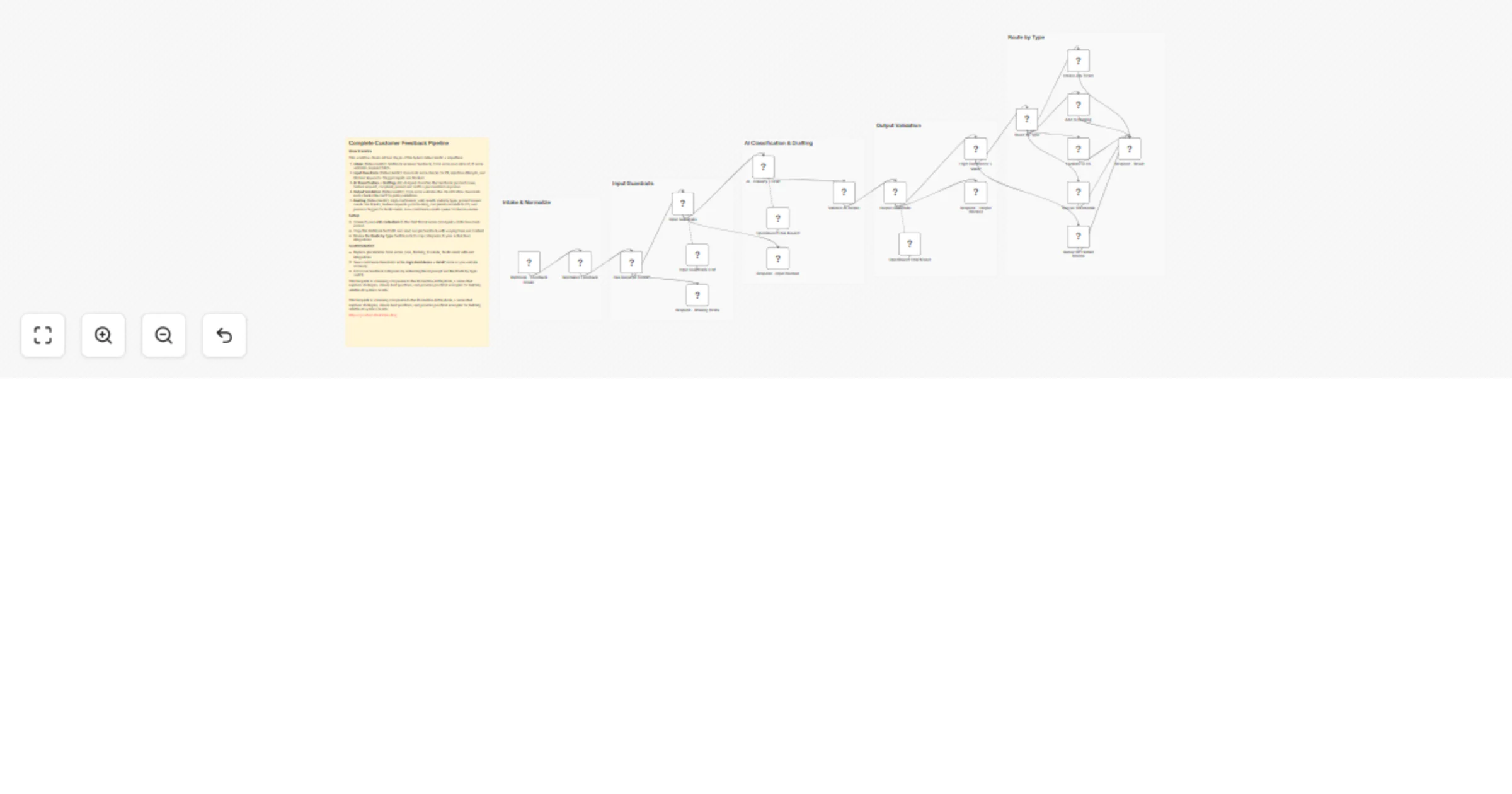
The full end to end workflow that chains all patterns together. This template processes customer feedback from intake to team routing, with normalization, validation, native guardrails, AI classifi...

Best for

  • Ticket Management automation workflows
  • AI Summarization automation workflows
  • advanced n8n builders looking for reusable templates

Tools used

n8n-nodes-base.respondtowebhook, n8n-nodes-base.code, n8n-nodes-base.switch, n8n-nodes-base.if, @n8n/n8n-nodes-langchain.agent, n8n-nodes-base.webhook, @n8n/n8n-nodes-langchain.guardrails, @n8n/n8n-nodes-langchain.lmchatopenai

Source and attribution

This workflow is cataloged by N8N Workflows and links back to its original n8n.io source page by Elvis Sarvia.

Original n8n.io source

1.1 Workflow description

Title
Production AI Playbook: Deterministic Steps & AI Steps (5 of 5)
Workflow name
Production AI Playbook: Deterministic Steps & AI Steps (5 of 5)

The full end-to-end workflow that chains all patterns together. This template processes customer feedback from intake to team routing, with normalization, validation, native guardrails, AI classification, and confidence-based branching at every step.

What you'll do

  • Send customer feedback through a webhook and watch it flow through every stage.
  • See the data get normalized, validated, and scanned by n8n's native Guardrails node for jailbreak attempts and PII.
  • Watch the AI classify feedback (bug report, feature request, praise, complaint, question) with a confidence score and generate a personalized response draft.
  • See AI-generated responses pass through output guardrails that check for NSFW content and secret keys before reaching users.
  • Watch high-confidence results route automatically: bug reports and feature requests to the product team, complaints to customer success, and praise to marketing as testimonial candidates.

What you'll learn

  • How to chain normalization, validation, native guardrails, AI, and routing into a single pipeline
  • How to use n8n's Guardrails node for both input screening (jailbreak, PII, secret keys) and output screening (NSFW, secret keys)
  • How confidence-based branching separates high-confidence results from items that need human review
  • How Switch nodes route classified feedback to the right destination (product team, customer success, or marketing)
  • How every step between AI nodes is deterministic and inspectable
  • How all these patterns work together in a production-ready workflow

Why it matters This is the complete picture. Individual patterns are useful on their own, but the real power comes from combining them into a pipeline where AI handles the judgment calls and everything else follows explicit, testable rules. Import this template as your starting point and connect your own integrations.

This template is a learning companion to the Production AI Playbook, a series that explores strategies, shares best practices, and provides practical examples for building reliable AI systems in n8n.

https://go.n8n.io/PAP-D&A-Blog

1.2 Logical Blocks

This catalog entry is organized from the workflow JSON. The node-level section below shows the executable blocks available for review before importing the template.

2. Block-by-Block Analysis

Block 1 - Respond - Result

Type / Role
n8n-nodes-base.respondToWebhook - respondToWebhook
Config choices
Version 1.1

Block 2 - Queue for Human Review

Type / Role
n8n-nodes-base.code - code
Config choices
Version 2

Block 3 - Flag as Testimonial

Type / Role
n8n-nodes-base.code - code
Config choices
Version 2

Block 4 - Escalate to CS

Type / Role
n8n-nodes-base.code - code
Config choices
Version 2

Block 5 - Add to Backlog

Type / Role
n8n-nodes-base.code - code
Config choices
Version 2

Block 6 - Create Jira Ticket

Type / Role
n8n-nodes-base.code - code
Config choices
Version 2

Block 7 - Route by Type

Type / Role
n8n-nodes-base.switch - switch
Config choices
Version 3.2

Block 8 - High Confidence + Valid?

Type / Role
n8n-nodes-base.if - if
Config choices
Version 2.2

Block 9 - AI - Classify + Draft

Type / Role
@n8n/n8n-nodes-langchain.agent - agent
Config choices
Version 1.7

Block 10 - Respond - Missing Fields

Type / Role
n8n-nodes-base.respondToWebhook - respondToWebhook
Config choices
Version 1.1

Block 11 - Has Required Fields?

Type / Role
n8n-nodes-base.if - if
Config choices
Version 2.2

Block 12 - Normalize Feedback

Type / Role
n8n-nodes-base.code - code
Config choices
Version 2

Block 13 - Webhook - Feedback Intake

Type / Role
n8n-nodes-base.webhook - webhook
Config choices
Version 2

Block 14 - Input Guardrails

Type / Role
@n8n/n8n-nodes-langchain.guardrails - guardrails
Config choices
Version 1

Block 15 - Input Guardrails LLM

Type / Role
@n8n/n8n-nodes-langchain.lmChatOpenAi - lmChatOpenAi
Config choices
Version 1.2

Block 16 - Validate AI Output

Type / Role
n8n-nodes-base.code - code
Config choices
Version 2

Block 17 - Output Guardrails

Type / Role
@n8n/n8n-nodes-langchain.guardrails - guardrails
Config choices
Version 1

Block 18 - Respond - Input Blocked

Type / Role
n8n-nodes-base.respondToWebhook - respondToWebhook
Config choices
Version 1.1

Block 19 - OpenRouter Chat Model

Type / Role
@n8n/n8n-nodes-langchain.lmChatOpenRouter - lmChatOpenRouter
Config choices
Version 1

Block 20 - OpenRouter Chat Model1

Type / Role
@n8n/n8n-nodes-langchain.lmChatOpenRouter - lmChatOpenRouter
Config choices
Version 1

Block 21 - Respond - Output Blocked

Type / Role
n8n-nodes-base.respondToWebhook - respondToWebhook
Config choices
Version 1.1

Block 22 - Sticky Note

Type / Role
n8n-nodes-base.stickyNote - stickyNote
Config choices
Version 1

Block 23 - Sticky Note1

Type / Role
n8n-nodes-base.stickyNote - stickyNote
Config choices
Version 1

Block 24 - Sticky Note2

Type / Role
n8n-nodes-base.stickyNote - stickyNote
Config choices
Version 1

Showing the first 24 of 27 workflow blocks. Download the JSON for the full node graph.

3. Summary Table

Workflow Production AI Playbook: Deterministic Steps & AI Steps (5 of 5)
Complexity advanced
Nodes 27
Categories Ticket Management, AI Summarization
Author Elvis Sarvia
Published 04 Mar 2026

4. Reproducing the Workflow from Scratch

  1. 1. Download the workflow JSON

    Use the JSON export at /data/workflows/13855/13855.json as the source template for this automation.

  2. 2. Import the template into n8n

    Open n8n, import the downloaded JSON, and review each node before activating the workflow.

  3. 3. Configure credentials and variables

    Replace placeholder credentials, API keys, webhook URLs, account IDs, and environment-specific values with your own settings.

  4. 4. Test with sample data

    Run the workflow manually or in a staging workspace, inspect node output, and confirm downstream systems receive the expected data.

  5. 5. Activate and monitor

    Enable the workflow only after testing, then monitor executions, errors, and rate limits during the first production runs.

5. General Notes & Resources

Review imported nodes carefully before activation. This catalog entry is intended to help you inspect the workflow structure, understand required services, and find related templates faster.

Node names, credentials, schedules, webhook paths, and external service limits may need adjustment for your workspace.

Frequently asked questions

What does Production AI Playbook: Deterministic Steps & AI Steps (5 of 5) do?

The full end to end workflow that chains all patterns together. This template processes customer feedback from intake to team routing, with normalization, validation, native guardrails, AI classifi...

What do I need before importing this workflow?

Review the workflow JSON, configure any required credentials in n8n, and test the automation in a safe workspace before using it in production.

Can I customize this workflow?

Yes. Use the block-by-block analysis and the downloadable JSON to inspect each node, then adjust credentials, prompts, schedules, filters, or destinations for your Ticket Management, AI Summarization use case.