
Parse and extract invoice data with Nanonets OCR and export to Excel

Workflow preview
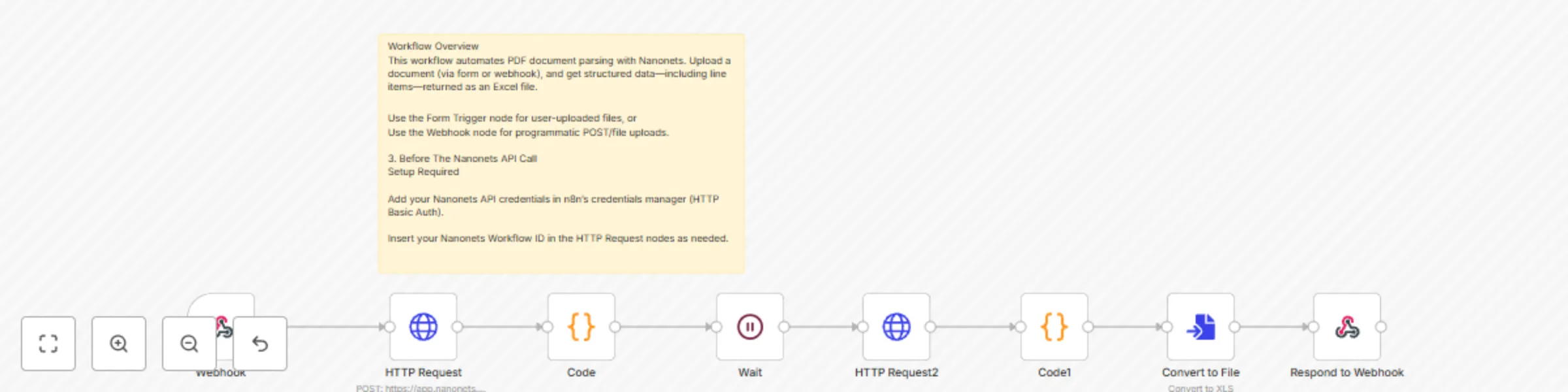
Workflow preview
100%
Parse and extract invoice data with Nanonets OCR and export to Excel preview
Open on n8n.io

Important notice

This workflow is provided as-is. Please review and test before using in production.

1. Workflow Overview

This workflow contains community nodes that are only compatible with the self hosted version of n8n. Description This workflow automates document processing and structured table extraction using th...

Best for

  • Invoice Processing automation workflows
  • AI Summarization automation workflows
  • intermediate n8n builders looking for reusable templates

Tools used

n8n-nodes-base.httprequest, n8n-nodes-base.converttofile, n8n-nodes-base.code, n8n-nodes-base.wait, n8n-nodes-base.webhook, n8n-nodes-base.respondtowebhook, n8n-nodes-base.stickynote

Source and attribution

This workflow is cataloged by N8N Workflows and links back to its original n8n.io source page by Anurag.

Original n8n.io source

1.1 Workflow description

Title
Parse and extract invoice data with Nanonets OCR and export to Excel
Workflow name
Parse and extract invoice data with Nanonets OCR and export to Excel

This workflow contains community nodes that are only compatible with the self-hosted version of n8n.

Description

This workflow automates document processing and structured table extraction using the Nanonets API. You can submit a PDF file via an n8n form trigger or webhook—the workflow then forwards the document to Nanonets, waits for asynchronous parsing to finish, retrieves the results (including header fields and line items/tables), and returns the output as an Excel file. Ideal for automating invoice, receipt, or order data extraction with downstream business use.

How It Works

  • A document is uploaded (via n8n form or webhook).
  • The PDF is sent to the Nanonets Workflow API for parsing.
  • The workflow waits until processing is complete.
  • Parsed results are fetched. Both top-level fields and any table rows/line items are extracted and restructured.
  • Data is exported to Excel format and delivered to the requester.

Setup Steps

  1. Nanonets Account: Register for a Nanonets account and set up a workflow for your specific document type (e.g., invoice, receipt).
  2. Credentials in n8n: Add HTTP Basic Auth credentials in n8n for the Nanonets API (never store credentials directly in node parameters).
  3. Webhook/Form Configuration:
    • Option 1: Configure and enable the included n8n Form Trigger node for document uploads.
    • Option 2: Use the included Webhook node to accept external POSTs with a PDF file.
  4. Adjust Workflow:
    • Update any HTTP nodes to use your credential profile.
    • Insert your Nanonets Workflow ID in all relevant nodes.
  5. Test the Workflow: Enable the workflow and try with a sample document.

Features

  • Accepts documents via n8n Form Trigger or direct webhook POST.
  • Securely sends files to Nanonets for document parsing (credentials stored in n8n credentials manager).
  • Automatically waits for async processing, checking Nanonets until results are ready.
  • Extracts both header data and all table/line items into a tabular format.
  • Exports results as an Excel file download.
  • Modular nodes allow easy customization or extension.

Prerequisites

  • Nanonets account with workflow configured for your document type.
  • n8n instance with HTTP Request, Webhook/Form, Code, and Excel/Spreadsheet nodes enabled.
  • Valid HTTP Basic Auth credentials saved in n8n for API access.

Example Use Cases

Scenario Benefit
Invoice Processing Automated extraction of line items and totals
Receipt Digitization Parse amounts and charges for expense reports
Purchase Orders Convert scanned POs into structured Excel sheets

Notes

  • You must set up credentials in the n8n credentials manager—do not store API keys directly in nodes.
  • All configuration and endpoints are clearly explained with inline sticky notes in the workflow editor.
  • Easily adaptable for other document types or similar APIs—just modify endpoints and result mapping.

1.2 Logical Blocks

This catalog entry is organized from the workflow JSON. The node-level section below shows the executable blocks available for review before importing the template.

2. Block-by-Block Analysis

Block 1 - HTTP Request

Type / Role
n8n-nodes-base.httpRequest - httpRequest
Config choices
Version 4.2

Block 2 - HTTP Request2

Type / Role
n8n-nodes-base.httpRequest - httpRequest
Config choices
Version 4.2

Block 3 - Convert to File

Type / Role
n8n-nodes-base.convertToFile - convertToFile
Config choices
Version 1.1

Block 4 - Code

Type / Role
n8n-nodes-base.code - code
Config choices
Version 2

Block 5 - Code1

Type / Role
n8n-nodes-base.code - code
Config choices
Version 2

Block 6 - Wait

Type / Role
n8n-nodes-base.wait - wait
Config choices
Version 1.1

Block 7 - Webhook

Type / Role
n8n-nodes-base.webhook - webhook
Config choices
Version 2

Block 8 - Respond to Webhook

Type / Role
n8n-nodes-base.respondToWebhook - respondToWebhook
Config choices
Version 1.4

Block 9 - Sticky Note

Type / Role
n8n-nodes-base.stickyNote - stickyNote
Config choices
Version 1

3. Summary Table

Workflow Parse and extract invoice data with Nanonets OCR and export to Excel
Complexity intermediate
Nodes 9
Categories Invoice Processing, AI Summarization
Author Anurag
Published 20 Jul 2025

4. Reproducing the Workflow from Scratch

  1. 1. Download the workflow JSON

    Use the JSON export at /data/workflows/6194/6194.json as the source template for this automation.

  2. 2. Import the template into n8n

    Open n8n, import the downloaded JSON, and review each node before activating the workflow.

  3. 3. Configure credentials and variables

    Replace placeholder credentials, API keys, webhook URLs, account IDs, and environment-specific values with your own settings.

  4. 4. Test with sample data

    Run the workflow manually or in a staging workspace, inspect node output, and confirm downstream systems receive the expected data.

  5. 5. Activate and monitor

    Enable the workflow only after testing, then monitor executions, errors, and rate limits during the first production runs.

5. General Notes & Resources

Review imported nodes carefully before activation. This catalog entry is intended to help you inspect the workflow structure, understand required services, and find related templates faster.

Node names, credentials, schedules, webhook paths, and external service limits may need adjustment for your workspace.

Frequently asked questions

What does Parse and extract invoice data with Nanonets OCR and export to Excel do?

This workflow contains community nodes that are only compatible with the self hosted version of n8n. Description This workflow automates document processing and structured table extraction using th...

What do I need before importing this workflow?

Review the workflow JSON, configure any required credentials in n8n, and test the automation in a safe workspace before using it in production.

Can I customize this workflow?

Yes. Use the block-by-block analysis and the downloadable JSON to inspect each node, then adjust credentials, prompts, schedules, filters, or destinations for your Invoice Processing, AI Summarization use case.



