
Orchestrate security vulnerability remediation with Port, OpenAI, Jira and Slack

Workflow preview
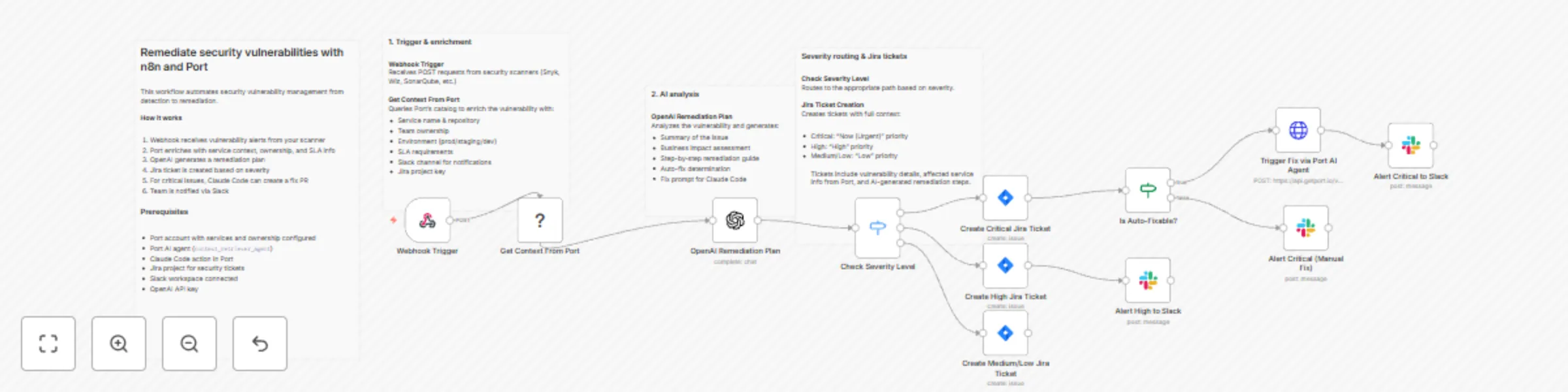
Workflow preview
100%
Orchestrate security vulnerability remediation with Port, OpenAI, Jira and Slack preview
Open on n8n.io

Important notice

This workflow is provided as-is. Please review and test before using in production.

1. Workflow Overview

Complete security workflow from vulnerability detection to automated remediation, with severity based routing and full organizational context from Port's catalog. This template provides end to end ...

Best for

  • SecOps automation workflows
  • AI Summarization automation workflows
  • advanced n8n builders looking for reusable templates

Tools used

n8n-nodes-base.webhook, custom.portapiai, n8n-nodes-base.openai, n8n-nodes-base.switch, n8n-nodes-base.jira, n8n-nodes-base.if, n8n-nodes-base.httprequest, n8n-nodes-base.slack

Source and attribution

This workflow is cataloged by N8N Workflows and links back to its original n8n.io source page by Port IO.

Original n8n.io source

1.1 Workflow description

Title
Orchestrate security vulnerability remediation with Port, OpenAI, Jira and Slack
Workflow name
Orchestrate security vulnerability remediation with Port, OpenAI, Jira and Slack

Complete security workflow from vulnerability detection to automated remediation, with severity-based routing and full organizational context from Port's catalog. This template provides end-to-end lifecycle management including automatic Jira ticket creation with appropriate priority, AI-powered remediation planning, and Claude Code-triggered fixes for critical vulnerabilities.

The full guide is available here.

How it works

The n8n workflow orchestrates the following steps:

  • Webhook trigger: Receives vulnerability alerts from security scanners (Snyk, Wiz, SonarQube, etc.) via POST request.
  • Port context enrichment: Uses Port's n8n node to query your software catalog for service metadata, ownership, environment, SLA requirements, and dependencies related to the vulnerability.
  • AI remediation planning: OpenAI analyzes the vulnerability with Port context and generates a remediation plan, determining if automated fixing is possible.
  • Severity-based routing: Routes vulnerabilities through different paths based on severity level:
    • Critical: Jira ticket (Highest priority) → Check if auto-fixable → Trigger Claude Code fix → Slack alert with fix status
    • High: Jira ticket (High priority) → Slack notification to team channel
    • Medium/Low: Jira ticket only for tracking
  • Jira integration: Creates tickets with full context including vulnerability details, affected service information from Port, and AI-generated remediation steps.
  • Claude Code remediation: For auto-fixable critical vulnerabilities, triggers Claude Code via Port action to create a pull request with the security patch, referencing the Jira ticket.
  • Slack notifications: Sends contextual alerts to the appropriate team channel (retrieved from Port) with Jira ticket reference and remediation status.

Prerequisites

  • You have a Port account and have completed the onboarding process.
  • Services and repositories are cataloged in Port with ownership information.
  • Your security scanner (Snyk, Wiz, SonarQube) can send webhooks.
  • You have a working n8n instance (Cloud or self-hosted) with Port's n8n custom node installed.
  • Jira Cloud account with appropriate project permissions.
  • Slack workspace with bot permissions to post messages.
  • OpenAI API key for remediation planning.

Setup

  • Register for free on Port.io if you haven't already.
  • Create the Context Retriever Agent in Port following the guide.
  • Import the workflow and configure credentials (Port, Jira, Slack, OpenAI, Bearer Auth).
  • Select your Jira project in each Jira node (Critical, High, Medium/Low).
  • Update default-organization/repository with your default repository for Claude Code fixes.
  • Point your security scanner webhook to the workflow URL.
  • Test with a sample vulnerability payload.

⚠️ This template is intended for Self-Hosted instances only.

1.2 Logical Blocks

This catalog entry is organized from the workflow JSON. The node-level section below shows the executable blocks available for review before importing the template.

2. Block-by-Block Analysis

Block 1 - Webhook Trigger

Type / Role
n8n-nodes-base.webhook - webhook
Config choices
Version 1

Block 2 - Get Context From Port

Type / Role
CUSTOM.portApiAi - portApiAi
Config choices
Version 1

Block 3 - OpenAI Remediation Plan

Type / Role
n8n-nodes-base.openAi - openAi
Config choices
Version 1

Block 4 - Check Severity Level

Type / Role
n8n-nodes-base.switch - switch
Config choices
Version 2

Block 5 - Create Critical Jira Ticket

Type / Role
n8n-nodes-base.jira - jira
Config choices
Version 1

Block 6 - Create High Jira Ticket

Type / Role
n8n-nodes-base.jira - jira
Config choices
Version 1

Block 7 - Create Medium/Low Jira Ticket

Type / Role
n8n-nodes-base.jira - jira
Config choices
Version 1

Block 8 - Is Auto-Fixable?

Type / Role
n8n-nodes-base.if - if
Config choices
Version 1

Block 9 - Trigger Fix via Port AI Agent

Type / Role
n8n-nodes-base.httpRequest - httpRequest
Config choices
Version 4.3

Block 10 - Alert Critical to Slack

Type / Role
n8n-nodes-base.slack - slack
Config choices
Version 1

Block 11 - Alert Critical (Manual Fix)

Type / Role
n8n-nodes-base.slack - slack
Config choices
Version 1

Block 12 - Alert High to Slack

Type / Role
n8n-nodes-base.slack - slack
Config choices
Version 1

Block 13 - Sticky Note

Type / Role
n8n-nodes-base.stickyNote - stickyNote
Config choices
Version 1

Block 14 - Sticky Note1

Type / Role
n8n-nodes-base.stickyNote - stickyNote
Config choices
Version 1

Block 15 - Sticky Note4

Type / Role
n8n-nodes-base.stickyNote - stickyNote
Config choices
Version 1

Block 16 - Sticky Note2

Type / Role
n8n-nodes-base.stickyNote - stickyNote
Config choices
Version 1

3. Summary Table

Workflow Orchestrate security vulnerability remediation with Port, OpenAI, Jira and Slack
Complexity advanced
Nodes 16
Categories SecOps, AI Summarization
Author Port IO
Published 12 Dec 2025

4. Reproducing the Workflow from Scratch

  1. 1. Download the workflow JSON

    Use the JSON export at /data/workflows/11726/11726.json as the source template for this automation.

  2. 2. Import the template into n8n

    Open n8n, import the downloaded JSON, and review each node before activating the workflow.

  3. 3. Configure credentials and variables

    Replace placeholder credentials, API keys, webhook URLs, account IDs, and environment-specific values with your own settings.

  4. 4. Test with sample data

    Run the workflow manually or in a staging workspace, inspect node output, and confirm downstream systems receive the expected data.

  5. 5. Activate and monitor

    Enable the workflow only after testing, then monitor executions, errors, and rate limits during the first production runs.

5. General Notes & Resources

Review imported nodes carefully before activation. This catalog entry is intended to help you inspect the workflow structure, understand required services, and find related templates faster.

Node names, credentials, schedules, webhook paths, and external service limits may need adjustment for your workspace.

Frequently asked questions

What does Orchestrate security vulnerability remediation with Port, OpenAI, Jira and Slack do?

Complete security workflow from vulnerability detection to automated remediation, with severity based routing and full organizational context from Port's catalog. This template provides end to end ...

What do I need before importing this workflow?

Review the workflow JSON, configure any required credentials in n8n, and test the automation in a safe workspace before using it in production.

Can I customize this workflow?

Yes. Use the block-by-block analysis and the downloadable JSON to inspect each node, then adjust credentials, prompts, schedules, filters, or destinations for your SecOps, AI Summarization use case.



