On-demand email newsletter summaries from Gmail to Telegram with GPT-4.1-mini
Workflow preview

$20/month : Unlimited workflows
2500 executions/month

THE #1 IN WEB SCRAPING
Scrape any website without limits
HOSTINGER  Early Deal
DISCOUNT 20% Try free
Early DealDISCOUNT 20%
Self-hosted n8n
Unlimited workflows - from $4.99/mo

#1 hub for scraping, AI & automation
6000+ actors - $5 credits/mo
Important notice
This workflow is provided as-is. Please review and test before using in production.
Overview
Summary
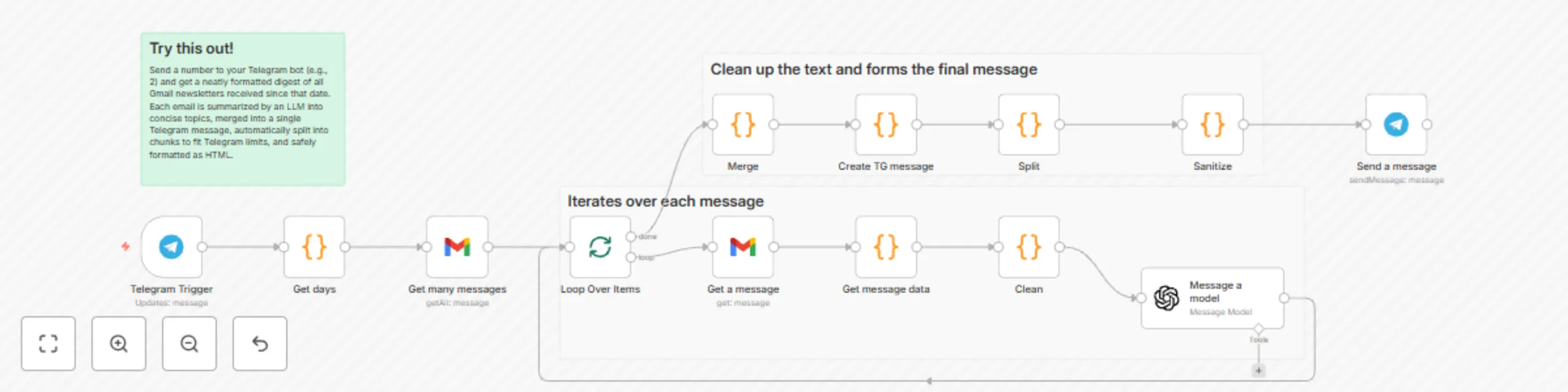
Send a number to your Telegram bot (e.g., 2) and get a neatly formatted digest of all Gmail newsletters received since that date. Each email is summarized by an LLM into concise topics, merged into a single Telegram message, automatically split into chunks to fit Telegram limits, and safely formatted as HTML.
What this workflow does
- Triggers on your Telegram message containing a number of days, e.g., 1, 2, 7
- Fetches all Gmail messages since that date using a custom search query, optionally filtered by senders
- Retrieves and decodes each email’s HTML, subject, sender name, date
- Prompts an LLM (GPT‑4.1‑mini) to produce a consistent JSON summary of topics per email
- Merges topics from all emails into a single digest
- Builds a readable, enumerated message (with bold titles)
- Splits it into 3 500‑char parts and sanitizes Markdown to Telegram‑safe HTML
- Sends the digest to your Telegram chat with preview disabled
Apps and credentials
- Gmail OAuth2: Gmail account
- Telegram: Telegram account (bot)
- OpenAI: OpenAi account
Typical use cases
- Personal or team daily/weekly newsletter digests in Telegram
- Curated feeds from selected senders compiled on demand
- Lightweight knowledge briefings without leaving Telegram
How it works (node-by-node)
- Telegram Trigger
- Waits for your message (e.g., "2"). Chat ID is restricted to your Telegram ID for safety.
- Get days (Code)
- Takes the numeric daysAgo from the Telegram message text
- Computes YYYY/MM/DD for Gmail’s after: filter
- Get many messages (Gmail → getAll, returnAll: true)
- Uses a custom q filter like: =(from:@.com) OR (from:@.com) OR (from:@.com -"____") after:{{ $json.dateString }}
- Returns a list of message IDs
- Loop Over Items (Split in Batches)
- Iterates through each message ID
- Get a message (Gmail → get)
- Retrieves the full message/payload for the current email
- Get message data (Code)
- Extracts HTML from Gmail’s payload (body/parts)
- Normalizes sender to just the name
- Formats the date as DD.MM.YYYY
- Passes html, subject, from, date forward
- Clean (Code)
- Converts DD.MM.YYYY → MM.DD (for prompt brevity)
- Passes html, subject, from, date to the LLM
- Message a model (OpenAI, model: gpt‑4.1‑mini, JSON output)
- Prompt instructs:
- Produce JSON: { "topics": [ { "title", "descr", "subject", "from", "date" } ] }
- Split multi-news blocks into separate topics
- Combine or ignore specific blocks for particular senders (placeholders ____)
- Keep subject untranslated; other values in ____ language
- Injects subject/from/date/html from the current email
- Prompt instructs:
- Produce JSON: { "topics": [ { "title", "descr", "subject", "from", "date" } ] }
- Loop Over Items (continues)
- After all iterations complete, the aggregated per-email results are available
- Merge (Code)
- Flattens the topics arrays from all processed emails into one combined topics list
- Create TG message (Code)
- Renders an enumerated list:
- Title (bold)
- Short description
- Original subject
- From — Date
- Renders an enumerated list:
- Split (Code)
- Splits into 3 500‑character chunks to stay below Telegram’s 4 096 limit with HTML overhead
- Sanitize (Code)
- Escapes &, <, >
- Fixes unbalanced * and _
- Converts basic Markdown markers to Telegram HTML
- Send a message (Telegram)
- Sends each part with parse_mode=HTML, previews disabled
Node map
| Node | Type | Purpose |
|---|---|---|
| Telegram Trigger | Trigger | Receive daysAgo command from Telegram |
| Get days | Code | Compute Gmail after:YYYY/MM/DD from daysAgo |
| Get many messages | Gmail (getAll) | Search emails since date with custom from: filters |
| Loop Over Items | Split in Batches | Iterate messages one-by-one |
| Get a message | Gmail (get) | Fetch full message payload |
| Get message data | Code | Extract HTML/subject/from/date; normalize sender and date |
| Clean | Code | Reformat date and forward fields to LLM |
| Message a model | OpenAI | Summarize email into JSON topics |
| Merge | Code | Merge topics from all emails |
| Create TG message | Code | Build human-friendly digest text |
| Split | Code | Chunk into 3 500‑char parts |
| Sanitize | Code | Escape HTML and map Markdown to Telegram HTML |
| Send a message | Telegram | Deliver digest to Telegram chat |
Before you start
- Create a Telegram bot and get its token (via @BotFather)
- Get your Telegram user ID to restrict access
- Connect Gmail OAuth2 in n8n
- Add your OpenAI API key
- Import the provided workflow JSON into n8n
Setup instructions
- Telegram
- Telegram Trigger node:
- additionalFields.chatIds = your Telegram user ID
- Send a message node:
- chatId = your Telegram user ID
- parse_mode = HTML
- disable_web_page_preview = true
- Gmail
- Connect a Gmail OAuth2 credential (Gmail account)
- In Get many messages, adjust filters.q to your senders and rules:
- Example: =(from:[email protected]) OR (from:[email protected] -"promo") after:{{ $json.dateString }}
- If needed, add label: or category: filters
- OpenAI
- Message a model:
- Model: gpt‑4.1‑mini (can swap to gpt‑4o‑mini or your preferred)
- Update the prompt placeholders: - ____ language → your target language - ____ sender rules → your special cases (combine blocks, ignore sections)
- Safety and formatting
- Keep parse_mode=HTML in Telegram
- The Sanitize node is designed for
<b>and<i>only; avoid other HTML tags - The Split node uses 3 500 chars per part to stay safe under Telegram limits
How to use
- In Telegram, send a number indicating “days ago”
- Example: 2 → will query Gmail after the date 2 days ago
- The workflow compiles and returns a digest in your chat
- Rerun anytime with a new number
Customization ideas
- Labels instead of global search: q = label:Newsletters after:{{ $json.dateString }}
- Time window control: add before: or exact date ranges
- Different language: set the ____ language in the LLM prompt
- Model choice: swap to cheaper/faster models if volume is high
- Chunk size: adjust from 3 500 to your needs
- Formatting: tweak Create TG message to include links parsed from HTML (if you add an HTML parser step)
Limits and notes
- Telegram messages are limited to ~4 096 characters; we chunk to 3 500 per part
- Gmail “after:” uses YYYY/MM/DD and Google’s interpretation of dates; your n8n server time influences the computed date
- LLM usage incurs cost and latency proportional to email size and count
- HTML extraction is robust for typical Gmail structures but may need tweaks for exotic MIME layouts
Privacy and safety
- Emails are sent to OpenAI for summarization—ensure that’s acceptable for your data policies
- The Telegram Trigger restricts chat access; keep your chatIds locked down
- Avoid sending raw HTML to Telegram; rely on the Sanitize node
Sample output format (Telegram)
- Bold topic title
One-sentence description
Original Subject Line → Sender Name — DD.MM.YYYY
- Next topic title
...
Tips and troubleshooting
- Got empty digests? Check Gmail filters.q and make sure there really are emails after the computed date
- Model errors or empty JSON? Lower prompt complexity or switch model
- HTML formatting issues in Telegram? Ensure parse_mode=HTML and keep only
<b>,<i> - Long messages not fully delivered? Reduce chunk size from 3 500
Tags
- gmail, telegram, openai, llm, newsletters, digest, summarization, automation
Changelog
- v1: Initial release with sender filters, topic merging, Telegram HTML sanitization, and on-demand time window via Telegram message