
Normalize and validate CSV data with Anthropic/OpenAI, Postgres, Slack and Sheets

Workflow preview
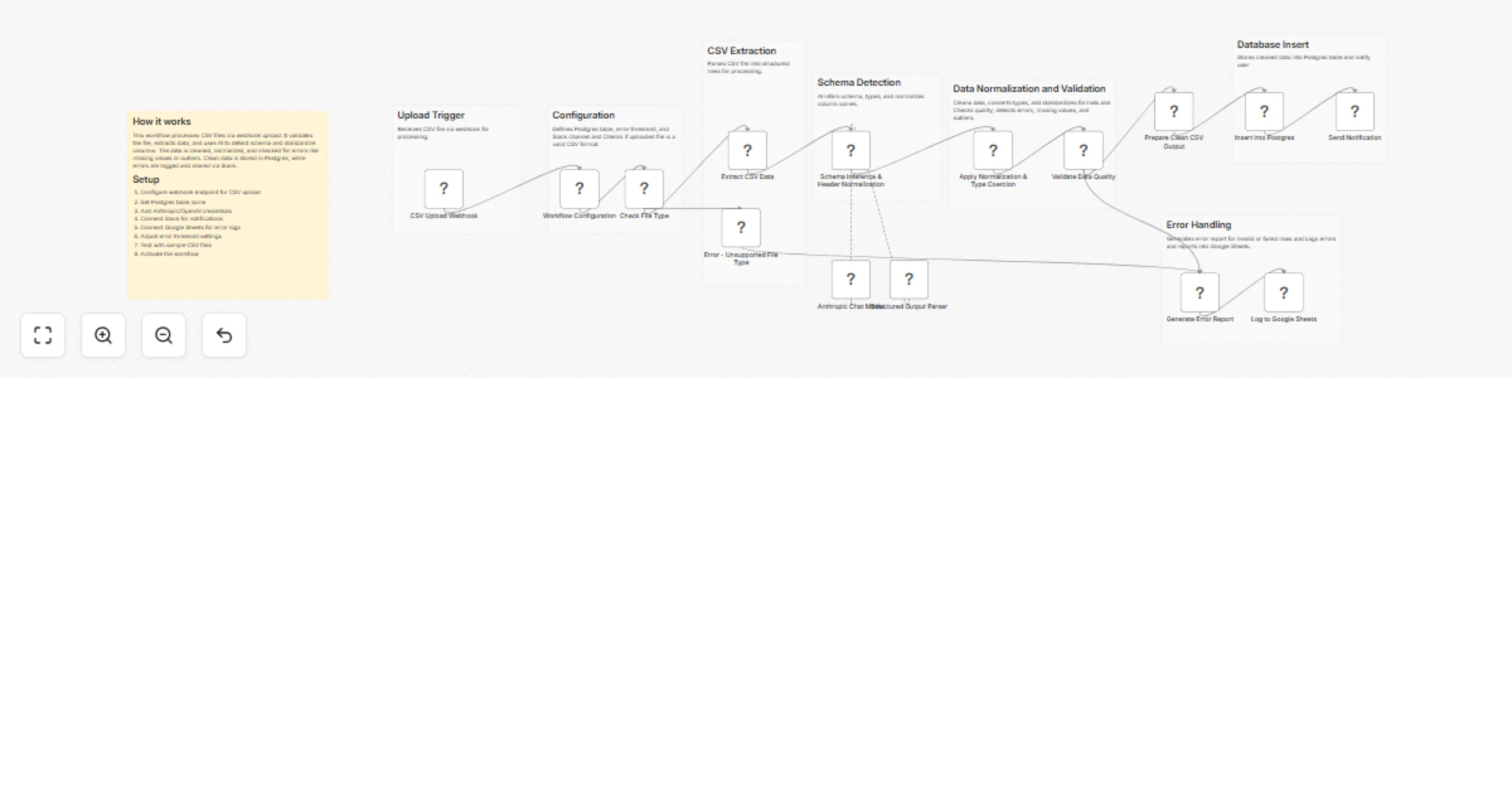
Workflow preview
100%
Normalize and validate CSV data with Anthropic/OpenAI, Postgres, Slack and Sheets preview
Open on n8n.io

1. Workflow Overview

Overview This workflow automates CSV data processing from upload to database insertion. It accepts CSV files via webhook, uses AI to detect schema and standardize columns, cleans and validates the ...

Best for

  • Document Extraction automation workflows
  • AI Summarization automation workflows
  • advanced n8n builders looking for reusable templates

Tools used

n8n-nodes-base.webhook, n8n-nodes-base.set, n8n-nodes-base.if, n8n-nodes-base.extractfromfile, @n8n/n8n-nodes-langchain.agent, @n8n/n8n-nodes-langchain.lmchatanthropic, @n8n/n8n-nodes-langchain.outputparserstructured, n8n-nodes-base.code

Source and attribution

This workflow is cataloged by N8N Workflows and links back to its original n8n.io source page by ResilNext.

Original n8n.io source

1.1 Workflow description

Title
Normalize and validate CSV data with Anthropic/OpenAI, Postgres, Slack and Sheets
Workflow name
Normalize and validate CSV data with Anthropic/OpenAI, Postgres, Slack and Sheets

Overview

This workflow automates CSV data processing from upload to database insertion.

It accepts CSV files via webhook, uses AI to detect schema and standardize columns, cleans and validates the data, and stores it in Postgres. Errors are logged separately, and notifications are sent for visibility.


How It Works

  1. CSV Upload A webhook receives CSV files for processing.

  2. Validation The workflow checks if the uploaded file is a valid CSV format. Invalid files are rejected with an error report.

  3. Data Extraction The CSV is parsed into structured rows for further processing.

  4. Schema Detection AI analyzes the data to:

  • Infer column types
  • Normalize column names
  • Detect inconsistencies
  1. Data Normalization Values are cleaned and converted into proper formats (numbers, dates, booleans), with optional unit standardization.

  2. Data Quality Validation The workflow checks:

  • Type mismatches
  • Missing values
  • Statistical outliers
  1. Conditional Processing
  • Clean data → prepared and inserted into Postgres
  • Errors → detailed report generated
  1. Database Insert Valid data is stored in the configured Postgres table.

  2. Error Logging Errors are logged into Google Sheets for tracking and debugging.

  3. Notifications A Slack message is sent with processing results.


Setup Instructions

  1. Configure the webhook endpoint for CSV uploads
  2. Set your Postgres table name in the configuration node
  3. Add Anthropic/OpenAI credentials for schema detection
  4. Connect Slack for notifications
  5. Connect Google Sheets for error logging
  6. Configure error threshold settings
  7. Test with sample CSV files
  8. Activate the workflow

Use Cases

  • Cleaning and standardizing messy CSV data
  • Automating ETL pipelines
  • Preparing data for analytics or dashboards
  • Validating incoming data before database storage
  • Monitoring data quality with error reporting

Requirements

  • n8n instance with webhook access
  • Postgres database
  • OpenAI or Anthropic API access
  • Slack workspace
  • Google Sheets account

Notes

  • You can customize schema rules and normalization logic in the Code node.
  • Adjust error thresholds based on your data tolerance.
  • Extend validation rules for domain-specific requirements.
  • Replace Postgres or Sheets with other storage systems if needed.

1.2 Logical Blocks

This catalog entry is organized from the workflow JSON. The node-level section below shows the executable blocks available for review before importing the template.

2. Block-by-Block Analysis

Block 1 - CSV Upload Webhook

Type / Role
n8n-nodes-base.webhook - webhook
Config choices
Version 2.1

Block 2 - Workflow Configuration

Type / Role
n8n-nodes-base.set - set
Config choices
Version 3.4

Block 3 - Check File Type

Type / Role
n8n-nodes-base.if - if
Config choices
Version 2.3

Block 4 - Extract CSV Data

Type / Role
n8n-nodes-base.extractFromFile - extractFromFile
Config choices
Version 1.1

Block 5 - Error - Unsupported File Type

Type / Role
n8n-nodes-base.set - set
Config choices
Version 3.4

Block 6 - Schema Inference & Header Normalization

Type / Role
@n8n/n8n-nodes-langchain.agent - agent
Config choices
Version 3

Block 7 - Anthropic Chat Model

Type / Role
@n8n/n8n-nodes-langchain.lmChatAnthropic - lmChatAnthropic
Config choices
Version 1.3

Block 8 - Structured Output Parser

Type / Role
@n8n/n8n-nodes-langchain.outputParserStructured - outputParserStructured
Config choices
Version 1.3

Block 9 - Apply Normalization & Type Coercion

Type / Role
n8n-nodes-base.code - code
Config choices
Version 2

Block 10 - Validate Data Quality

Type / Role
n8n-nodes-base.code - code
Config choices
Version 2

Block 11 - Prepare Clean CSV Output

Type / Role
n8n-nodes-base.set - set
Config choices
Version 3.4

Block 12 - Insert into Postgres

Type / Role
n8n-nodes-base.postgres - postgres
Config choices
Version 2.6

Block 13 - Generate Error Report

Type / Role
n8n-nodes-base.set - set
Config choices
Version 3.4

Block 14 - Send Notification

Type / Role
n8n-nodes-base.slack - slack
Config choices
Version 2.4

Block 15 - Log to Google Sheets

Type / Role
n8n-nodes-base.googleSheets - googleSheets
Config choices
Version 4.7

Block 16 - Sticky Note1

Type / Role
n8n-nodes-base.stickyNote - stickyNote
Config choices
Version 1

Block 17 - Sticky Note

Type / Role
n8n-nodes-base.stickyNote - stickyNote
Config choices
Version 1

Block 18 - Sticky Note2

Type / Role
n8n-nodes-base.stickyNote - stickyNote
Config choices
Version 1

Block 19 - Sticky Note3

Type / Role
n8n-nodes-base.stickyNote - stickyNote
Config choices
Version 1

Block 20 - Sticky Note4

Type / Role
n8n-nodes-base.stickyNote - stickyNote
Config choices
Version 1

Block 21 - Sticky Note5

Type / Role
n8n-nodes-base.stickyNote - stickyNote
Config choices
Version 1

Block 22 - Sticky Note6

Type / Role
n8n-nodes-base.stickyNote - stickyNote
Config choices
Version 1

Block 23 - Sticky Note7

Type / Role
n8n-nodes-base.stickyNote - stickyNote
Config choices
Version 1

3. Summary Table

Workflow Normalize and validate CSV data with Anthropic/OpenAI, Postgres, Slack and Sheets
Complexity advanced
Nodes 23
Categories Document Extraction, AI Summarization
Author ResilNext
Published 23 Mar 2026

4. Reproducing the Workflow from Scratch

  1. 1. Download the workflow JSON

    Use the JSON export at /data/workflows/14273/14273.json as the source template for this automation.

  2. 2. Import the template into n8n

    Open n8n, import the downloaded JSON, and review each node before activating the workflow.

  3. 3. Configure credentials and variables

    Replace placeholder credentials, API keys, webhook URLs, account IDs, and environment-specific values with your own settings.

  4. 4. Test with sample data

    Run the workflow manually or in a staging workspace, inspect node output, and confirm downstream systems receive the expected data.

  5. 5. Activate and monitor

    Enable the workflow only after testing, then monitor executions, errors, and rate limits during the first production runs.

5. General Notes & Resources

Review imported nodes carefully before activation. This catalog entry is intended to help you inspect the workflow structure, understand required services, and find related templates faster.

Node names, credentials, schedules, webhook paths, and external service limits may need adjustment for your workspace.

Frequently asked questions

What does Normalize and validate CSV data with Anthropic/OpenAI, Postgres, Slack and Sheets do?

Overview This workflow automates CSV data processing from upload to database insertion. It accepts CSV files via webhook, uses AI to detect schema and standardize columns, cleans and validates the ...

What do I need before importing this workflow?

Review the workflow JSON, configure any required credentials in n8n, and test the automation in a safe workspace before using it in production.

Can I customize this workflow?

Yes. Use the block-by-block analysis and the downloadable JSON to inspect each node, then adjust credentials, prompts, schedules, filters, or destinations for your Document Extraction, AI Summarization use case.



