Block 1 - Schedule Trigger - Poll Data Sources
- Type / Role
- n8n-nodes-base.scheduleTrigger - scheduleTrigger
- Config choices
- Version 1.2
This workflow is provided as-is. Please review and test before using in production.
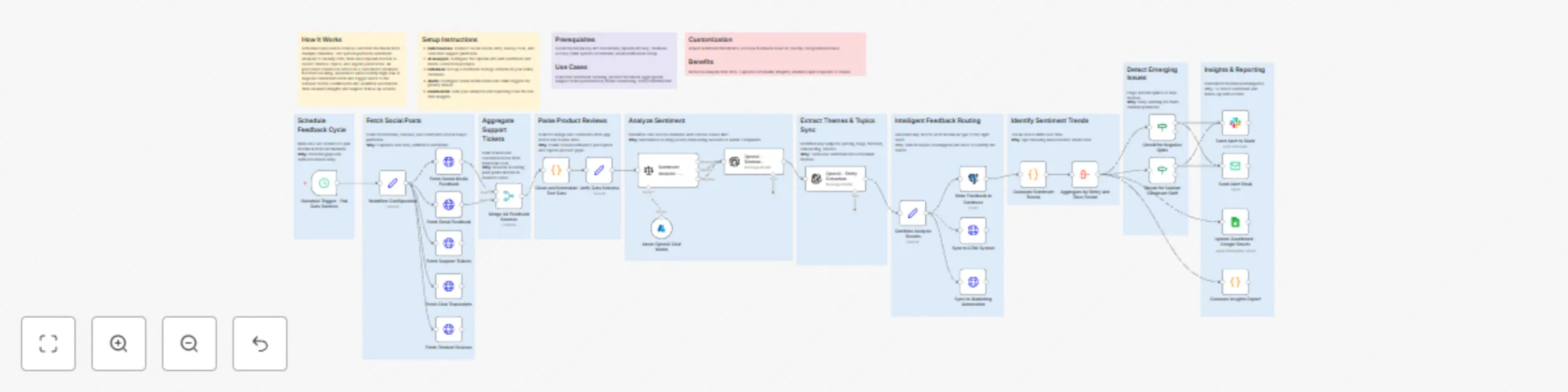
How It Works Scheduled processes retrieve customer feedback from multiple channels. The system performs sentiment analysis to classify tone, then uses OpenAI models to extract themes, topics, and u...
n8n-nodes-base.scheduletrigger, n8n-nodes-base.set, n8n-nodes-base.httprequest, n8n-nodes-base.merge, n8n-nodes-base.code, @n8n/n8n-nodes-langchain.lmchatazureopenai, @n8n/n8n-nodes-langchain.sentimentanalysis, @n8n/n8n-nodes-langchain.openai
This workflow is cataloged by N8N Workflows and links back to its original n8n.io source page by Cheng Siong Chin.
Original n8n.io sourceScheduled processes retrieve customer feedback from multiple channels. The system performs sentiment analysis to classify tone, then uses OpenAI models to extract themes, topics, and urgency indicators. All processed results are stored in a centralized database for trend tracking. Automated rules identify high-risk or negative sentiment items and trigger alerts to the relevant teams. Dashboards and workflow automation then visualize insights and support follow-up actions.
Social media/survey API credentials; OpenAI API key; database access; CRM system credentials; email notification setup
Customer sentiment tracking; product feedback aggregation; support ticket prioritization; brand monitoring; trend identification
Adjust sentiment thresholds; add new feedback sources; modify categorization rules
Reduces analysis time 85%; captures actionable insights; enables rapid response to issues
This catalog entry is organized from the workflow JSON. The node-level section below shows the executable blocks available for review before importing the template.
Showing the first 24 of 40 workflow blocks. Download the JSON for the full node graph.
| Workflow | Multi-channel customer sentiment tracker with real-time analytics and alerting |
|---|---|
| Complexity | advanced |
| Nodes | 40 |
| Categories | Market Research, AI Summarization |
| Author | Cheng Siong Chin |
| Published | 12 Nov 2025 |
Use the JSON export at /data/workflows/10762/10762.json as the source template for this automation.
Open n8n, import the downloaded JSON, and review each node before activating the workflow.
Replace placeholder credentials, API keys, webhook URLs, account IDs, and environment-specific values with your own settings.
Run the workflow manually or in a staging workspace, inspect node output, and confirm downstream systems receive the expected data.
Enable the workflow only after testing, then monitor executions, errors, and rate limits during the first production runs.
Review imported nodes carefully before activation. This catalog entry is intended to help you inspect the workflow structure, understand required services, and find related templates faster.
Node names, credentials, schedules, webhook paths, and external service limits may need adjustment for your workspace.
How It Works Scheduled processes retrieve customer feedback from multiple channels. The system performs sentiment analysis to classify tone, then uses OpenAI models to extract themes, topics, and u...
Review the workflow JSON, configure any required credentials in n8n, and test the automation in a safe workspace before using it in production.
Yes. Use the block-by-block analysis and the downloadable JSON to inspect each node, then adjust credentials, prompts, schedules, filters, or destinations for your Market Research, AI Summarization use case.