
Monitor RSS feeds, extract full articles with Jina AI, and save to Supabase

Workflow preview
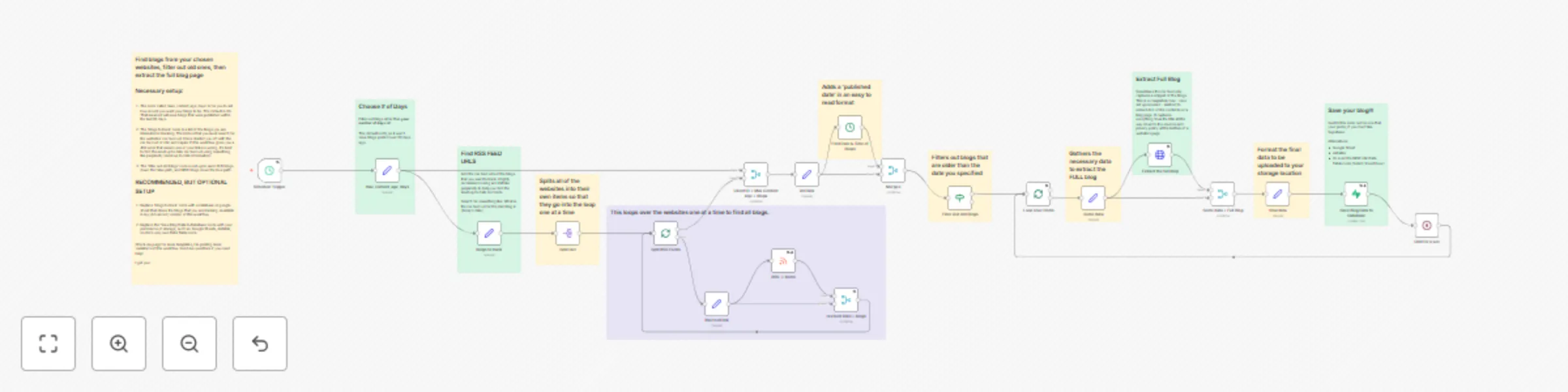
Workflow preview
100%
Monitor RSS feeds, extract full articles with Jina AI, and save to Supabase preview
Open on n8n.io

Important notice

This workflow is provided as-is. Please review and test before using in production.

1. Workflow Overview

Monitor RSS Feeds, Extract Full Articles, and Save to Supabase Overview This workflow solves a common problem with RSS feeds: they often only provide a short summary or snippet of the full article....

Best for

  • Document Extraction automation workflows
  • AI RAG automation workflows
  • advanced n8n builders looking for reusable templates

Tools used

n8n-nodes-base.splitinbatches, n8n-nodes-base.httprequest, n8n-nodes-base.rssfeedread, n8n-nodes-base.wait, n8n-nodes-base.merge, n8n-nodes-base.set, n8n-nodes-base.datetime, n8n-nodes-base.scheduletrigger

Source and attribution

This workflow is cataloged by N8N Workflows and links back to its original n8n.io source page by automedia.

Original n8n.io source

1.1 Workflow description

Title
Monitor RSS feeds, extract full articles with Jina AI, and save to Supabase
Workflow name
Monitor RSS feeds, extract full articles with Jina AI, and save to Supabase

Monitor RSS Feeds, Extract Full Articles, and Save to Supabase

Overview

This workflow solves a common problem with RSS feeds: they often only provide a short summary or snippet of the full article. This template automatically monitors a list of your favorite blog RSS feeds, filters for new content, visits the article page to extract the entire blog post, and then saves the structured data into a Supabase database.

It's designed for content creators, marketers, researchers, and anyone who needs to build a personal knowledge base, conduct competitive analysis, or power a content aggregation system without manual copy-pasting.


Use Cases

  • Content Curation: Automatically gather full-text articles for a newsletter or social media content.
  • Personal Knowledge Base: Create a searchable archive of articles from experts in your field.
  • Competitive Analysis: Track what competitors are publishing without visiting their blogs every day.
  • AI Model Training: Collect a clean, structured dataset of full-text articles to fine-tune an AI model.

How It Works

  1. Scheduled Trigger: The workflow runs automatically on a set schedule (default is once per day).
  2. Fetch RSS Feeds: It takes a list of RSS feed URLs you provide in the "blogs to track" node.
  3. Filter for New Posts: It checks the publication date of each article and only continues if the article is newer than a specified age (e.g., published within the last 60 days).
  4. Extract Full Content: For each new article, the workflow uses the Jina AI Reader URL (https://r.jina.ai/) to scrape the full, clean text from the blog post's webpage. This is a free and powerful way to get past the RSS snippet limit.
  5. Save to Supabase: Finally, it organizes the extracted data and saves it to your chosen Supabase table. The following data is saved by default:
    • title
    • source_url (the link to the original article)
    • content_snippet (the full extracted article text)
    • published_date
    • creator (the author)
    • status (a static value you can set, e.g., "new")
    • content_type (a static value you can set, e.g., "blog")

Setup Instructions

You can get this template running in about 10-15 minutes.

  1. Set Up Your RSS Feed List:

    • Navigate to the "blogs to track" Set node.
    • In the source_identifier field, replace the example URLs with the RSS feed URLs for the blogs you want to monitor. You can add as many as you like.
    • Tip: The best way to find a site's RSS feed is to use a tool like Perplexity or a web-browsing enabled LLM.
    // Example list of RSS feeds
    ['https://blog.n8n.io/rss', 'https://zapier.com/blog/feeds/latest/']
    
  2. Configure the Content Age Filter:

    • Go to the "max_content_age_days" Set node.
    • Change the value from the default 60 to your desired timeframe (e.g., 7 to only get articles from the last week).
  3. Connect Your Storage Destination:

    • The template uses the "Save Blog Data to Database" Supabase node.
    • First, ensure you have a table in your Supabase project with columns to match the data (e.g., title, source_url, content_snippet, published_date, creator, etc.).
    • In the n8n node, create new credentials using your Supabase Project URL and Service Role Key.
    • Select your table from the list and map the data fields from the workflow to your table columns.
    • Want to use something else? You can easily replace the Supabase node with a Google Sheets, Airtable, or the built-in n8n Table node. Just drag the final connection to your new node and configure the field mapping.
  4. Set Your Schedule:

    • Click on the first node, "Schedule Trigger".
    • Adjust the trigger interval to your needs. The default is every day at noon.
  5. Activate Workflow:

    • Click the "Save" button, then toggle the workflow to Active. You're all set!

1.2 Logical Blocks

This catalog entry is organized from the workflow JSON. The node-level section below shows the executable blocks available for review before importing the template.

2. Block-by-Block Analysis

Block 1 - Split RSS Feeds

Type / Role
n8n-nodes-base.splitInBatches - splitInBatches
Config choices
Version 3

Block 2 - Extract the full blog

Type / Role
n8n-nodes-base.httpRequest - httpRequest
Config choices
Version 4.2

Block 3 - RSS → Items

Type / Role
n8n-nodes-base.rssFeedRead - rssFeedRead
Config choices
Version 1.1

Block 4 - Loop Over Items

Type / Role
n8n-nodes-base.splitInBatches - splitInBatches
Config choices
Version 3

Block 5 - Chill for a sec

Type / Role
n8n-nodes-base.wait - wait
Config choices
Version 1.1

Block 6 - Merge3

Type / Role
n8n-nodes-base.merge - merge
Config choices
Version 3.2

Block 7 - Client ID + Max Content Age + Blogs

Type / Role
n8n-nodes-base.merge - merge
Config choices
Version 3.2

Block 8 - All Data

Type / Role
n8n-nodes-base.set - set
Config choices
Version 3.4

Block 9 - Find Date & Time of Blogs

Type / Role
n8n-nodes-base.dateTime - dateTime
Config choices
Version 2

Block 10 - Some data

Type / Role
n8n-nodes-base.set - set
Config choices
Version 3.4

Block 11 - Some data + Full Blog

Type / Role
n8n-nodes-base.merge - merge
Config choices
Version 3.2

Block 12 - Schedule Trigger

Type / Role
n8n-nodes-base.scheduleTrigger - scheduleTrigger
Config choices
Version 1.2

Block 13 - max_content_age_days

Type / Role
n8n-nodes-base.set - set
Config choices
Version 3.4

Block 14 - Split Out

Type / Role
n8n-nodes-base.splitOut - splitOut
Config choices
Version 1

Block 15 - blogs to track

Type / Role
n8n-nodes-base.set - set
Config choices
Version 3.4

Block 16 - Rss feed link

Type / Role
n8n-nodes-base.set - set
Config choices
Version 3.4

Block 17 - rss feed links + blogs

Type / Role
n8n-nodes-base.merge - merge
Config choices
Version 3.2

Block 18 - Filter Out Old Blogs

Type / Role
n8n-nodes-base.if - if
Config choices
Version 2.2

Block 19 - Sticky Note

Type / Role
n8n-nodes-base.stickyNote - stickyNote
Config choices
Version 1

Block 20 - final data

Type / Role
n8n-nodes-base.set - set
Config choices
Version 3.4

Block 21 - Sticky Note1

Type / Role
n8n-nodes-base.stickyNote - stickyNote
Config choices
Version 1

Block 22 - Sticky Note2

Type / Role
n8n-nodes-base.stickyNote - stickyNote
Config choices
Version 1

Block 23 - Sticky Note6

Type / Role
n8n-nodes-base.stickyNote - stickyNote
Config choices
Version 1

Block 24 - Sticky Note3

Type / Role
n8n-nodes-base.stickyNote - stickyNote
Config choices
Version 1

Showing the first 24 of 31 workflow blocks. Download the JSON for the full node graph.

3. Summary Table

Workflow Monitor RSS feeds, extract full articles with Jina AI, and save to Supabase
Complexity advanced
Nodes 31
Categories Document Extraction, AI RAG
Author automedia
Published 14 Oct 2025

4. Reproducing the Workflow from Scratch

  1. 1. Download the workflow JSON

    Use the JSON export at /data/workflows/9599/9599.json as the source template for this automation.

  2. 2. Import the template into n8n

    Open n8n, import the downloaded JSON, and review each node before activating the workflow.

  3. 3. Configure credentials and variables

    Replace placeholder credentials, API keys, webhook URLs, account IDs, and environment-specific values with your own settings.

  4. 4. Test with sample data

    Run the workflow manually or in a staging workspace, inspect node output, and confirm downstream systems receive the expected data.

  5. 5. Activate and monitor

    Enable the workflow only after testing, then monitor executions, errors, and rate limits during the first production runs.

5. General Notes & Resources

Review imported nodes carefully before activation. This catalog entry is intended to help you inspect the workflow structure, understand required services, and find related templates faster.

Node names, credentials, schedules, webhook paths, and external service limits may need adjustment for your workspace.

Frequently asked questions

What does Monitor RSS feeds, extract full articles with Jina AI, and save to Supabase do?

Monitor RSS Feeds, Extract Full Articles, and Save to Supabase Overview This workflow solves a common problem with RSS feeds: they often only provide a short summary or snippet of the full article....

What do I need before importing this workflow?

Review the workflow JSON, configure any required credentials in n8n, and test the automation in a safe workspace before using it in production.

Can I customize this workflow?

Yes. Use the block-by-block analysis and the downloadable JSON to inspect each node, then adjust credentials, prompts, schedules, filters, or destinations for your Document Extraction, AI RAG use case.



