
Monitor PostgreSQL data quality and generate remediation alerts with Slack

Workflow preview
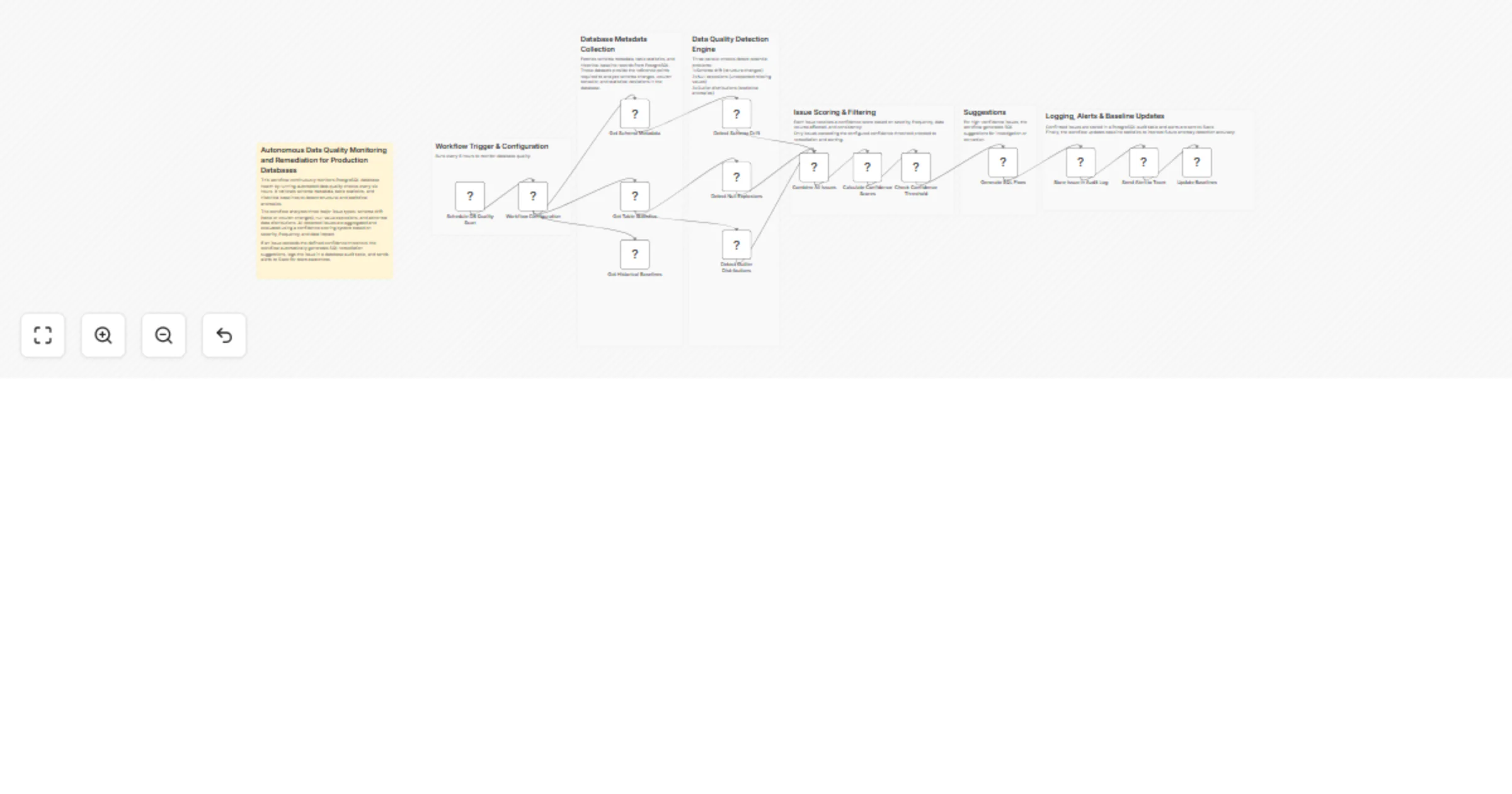
Workflow preview
100%
Monitor PostgreSQL data quality and generate remediation alerts with Slack preview
Open on n8n.io

1. Workflow Overview

Autonomous PostgreSQL Data Quality Monitoring & Remediation Overview This workflow automatically monitors PostgreSQL database data quality and detects structural or statistical anomalies before the...

Best for

  • Engineering automation workflows
  • AI Summarization automation workflows
  • advanced n8n builders looking for reusable templates

Tools used

n8n-nodes-base.scheduletrigger, n8n-nodes-base.set, n8n-nodes-base.postgres, n8n-nodes-base.code, n8n-nodes-base.aggregate, n8n-nodes-base.if, n8n-nodes-base.slack, n8n-nodes-base.stickynote

Source and attribution

This workflow is cataloged by N8N Workflows and links back to its original n8n.io source page by ResilNext.

Original n8n.io source

1.1 Workflow description

Title
Monitor PostgreSQL data quality and generate remediation alerts with Slack
Workflow name
Monitor PostgreSQL data quality and generate remediation alerts with Slack

Autonomous PostgreSQL Data Quality Monitoring & Remediation

Overview

This workflow automatically monitors PostgreSQL database data quality and detects structural or statistical anomalies before they impact analytics, pipelines, or applications.

Running every 6 hours, it scans database metadata, table statistics, and historical baselines to identify:

  • Schema drift
  • Null value explosions
  • Abnormal data distributions

Detected issues are evaluated using a confidence scoring system that considers severity, frequency, and affected data volume. When issues exceed the defined threshold, the workflow generates SQL remediation suggestions, logs the issue to an audit table, and sends alerts to Slack.

This automation enables teams to proactively maintain database reliability, detect unexpected schema changes, and quickly respond to data quality problems.


How It Works

1. Scheduled Monitoring

A Schedule Trigger starts the workflow every 6 hours to run automated database quality checks.

2. Metadata & Statistics Collection

The workflow retrieves important metadata from PostgreSQL:

  • Schema metadata from information_schema.columns
  • Table statistics from pg_stat_user_tables
  • Historical baselines from a baseline tracking table

These datasets allow the workflow to compare current database conditions against historical norms.

3. Data Quality Detection Engine

Three parallel detection checks analyze the database:

Schema Drift Detection

  • Identifies new tables or columns
  • Detects removed columns or tables
  • Detects datatype or nullability changes

Null Explosion Detection

  • Calculates null percentage per column
  • Flags columns exceeding configured null thresholds

Outlier Distribution Detection

  • Compares current column statistics against historical baselines
  • Uses statistical deviation (z-score) to detect abnormal distributions

4. Issue Aggregation & Confidence Scoring

All detected issues are aggregated and evaluated using a confidence scoring system based on:

  • Severity of the issue
  • Data volume affected
  • Historical frequency
  • Consistency of detection

Only issues above the configured confidence threshold proceed to remediation.

5. SQL Remediation Suggestions

For high-confidence issues, the workflow automatically generates SQL investigation or remediation queries, such as:

  • ALTER TABLE fixes
  • NULL cleanup queries
  • Outlier review queries

6. Logging & Alerting

Confirmed issues are:

  • Stored in a PostgreSQL audit table
  • Sent as alerts to Slack

7. Baseline Updates

Finally, the workflow updates the data quality baseline table, improving anomaly detection accuracy in future runs.


Setup Instructions

  1. Configure a PostgreSQL credential in n8n.
  2. Replace <target schema name> in the SQL queries with your database schema.
  3. Create the following tables in PostgreSQL:

Audit Table

data_quality_audit

Stores detected data quality issues and remediation suggestions.

Baseline Table

data_quality_baselines

Stores historical statistics used for anomaly detection.

  1. Configure your Slack credential.
  2. Replace the placeholder Slack channel ID in the Send Alert to Team node.

Optional configuration parameters can be modified in the Workflow Configuration node:

  • confidenceThreshold
  • maxNullPercentage
  • outlierStdDevThreshold
  • auditTableName
  • baselineTableName

Use Cases

Database Reliability Monitoring

Detect unexpected schema changes or structural modifications in production databases.

Data Pipeline Validation

Identify anomalies in datasets used by ETL pipelines before they propagate errors downstream.

Analytics Data Quality Monitoring

Prevent reporting inaccuracies caused by missing data or abnormal values.

Production Database Observability

Provide automated alerts when critical database quality issues occur.

Data Governance & Compliance

Maintain a historical audit log of database quality issues and remediation actions.


Requirements

This workflow requires the following services:

  • PostgreSQL Database
  • Slack Workspace
  • n8n

Nodes used:

  • Schedule Trigger
  • Set
  • Postgres
  • Code (Python)
  • Aggregate
  • IF
  • Slack

Key Features

  • Automated database health monitoring
  • Schema drift detection
  • Null explosion detection
  • Statistical anomaly detection
  • Confidence-based issue filtering
  • Automated SQL remediation suggestions
  • Slack alerting
  • Historical baseline learning system

Summary

This workflow provides an automated data quality monitoring system for PostgreSQL. It continuously analyzes schema structure, column statistics, and historical baselines to detect anomalies, generate remediation suggestions, and notify teams in real time.

By automating database quality checks, teams can identify issues early, reduce debugging time, and maintain reliable data pipelines.

1.2 Logical Blocks

This catalog entry is organized from the workflow JSON. The node-level section below shows the executable blocks available for review before importing the template.

2. Block-by-Block Analysis

Block 1 - Schedule DB Quality Scan

Type / Role
n8n-nodes-base.scheduleTrigger - scheduleTrigger
Config choices
Version 1.3

Block 2 - Workflow Configuration

Type / Role
n8n-nodes-base.set - set
Config choices
Version 3.4

Block 3 - Get Schema Metadata

Type / Role
n8n-nodes-base.postgres - postgres
Config choices
Version 2.6

Block 4 - Get Table Statistics

Type / Role
n8n-nodes-base.postgres - postgres
Config choices
Version 2.6

Block 5 - Get Historical Baselines

Type / Role
n8n-nodes-base.postgres - postgres
Config choices
Version 2.6

Block 6 - Detect Schema Drift

Type / Role
n8n-nodes-base.code - code
Config choices
Version 2

Block 7 - Detect Null Explosions

Type / Role
n8n-nodes-base.code - code
Config choices
Version 2

Block 8 - Detect Outlier Distributions

Type / Role
n8n-nodes-base.code - code
Config choices
Version 2

Block 9 - Combine All Issues

Type / Role
n8n-nodes-base.aggregate - aggregate
Config choices
Version 1

Block 10 - Calculate Confidence Scores

Type / Role
n8n-nodes-base.code - code
Config choices
Version 2

Block 11 - Check Confidence Threshold

Type / Role
n8n-nodes-base.if - if
Config choices
Version 2.3

Block 12 - Generate SQL Fixes

Type / Role
n8n-nodes-base.code - code
Config choices
Version 2

Block 13 - Store Issue in Audit Log

Type / Role
n8n-nodes-base.postgres - postgres
Config choices
Version 2.6

Block 14 - Send Alert to Team

Type / Role
n8n-nodes-base.slack - slack
Config choices
Version 2.4

Block 15 - Update Baselines

Type / Role
n8n-nodes-base.postgres - postgres
Config choices
Version 2.6

Block 16 - Sticky Note4

Type / Role
n8n-nodes-base.stickyNote - stickyNote
Config choices
Version 1

Block 17 - Sticky Note6

Type / Role
n8n-nodes-base.stickyNote - stickyNote
Config choices
Version 1

Block 18 - Sticky Note8

Type / Role
n8n-nodes-base.stickyNote - stickyNote
Config choices
Version 1

Block 19 - Sticky Note10

Type / Role
n8n-nodes-base.stickyNote - stickyNote
Config choices
Version 1

Block 20 - Sticky Note11

Type / Role
n8n-nodes-base.stickyNote - stickyNote
Config choices
Version 1

Block 21 - Sticky Note12

Type / Role
n8n-nodes-base.stickyNote - stickyNote
Config choices
Version 1

Block 22 - Sticky Note13

Type / Role
n8n-nodes-base.stickyNote - stickyNote
Config choices
Version 1

3. Summary Table

Workflow Monitor PostgreSQL data quality and generate remediation alerts with Slack
Complexity advanced
Nodes 22
Categories Engineering, AI Summarization
Author ResilNext
Published 14 Mar 2026

4. Reproducing the Workflow from Scratch

  1. 1. Download the workflow JSON

    Use the JSON export at /data/workflows/14035/14035.json as the source template for this automation.

  2. 2. Import the template into n8n

    Open n8n, import the downloaded JSON, and review each node before activating the workflow.

  3. 3. Configure credentials and variables

    Replace placeholder credentials, API keys, webhook URLs, account IDs, and environment-specific values with your own settings.

  4. 4. Test with sample data

    Run the workflow manually or in a staging workspace, inspect node output, and confirm downstream systems receive the expected data.

  5. 5. Activate and monitor

    Enable the workflow only after testing, then monitor executions, errors, and rate limits during the first production runs.

5. General Notes & Resources

Review imported nodes carefully before activation. This catalog entry is intended to help you inspect the workflow structure, understand required services, and find related templates faster.

Node names, credentials, schedules, webhook paths, and external service limits may need adjustment for your workspace.

Frequently asked questions

What does Monitor PostgreSQL data quality and generate remediation alerts with Slack do?

Autonomous PostgreSQL Data Quality Monitoring & Remediation Overview This workflow automatically monitors PostgreSQL database data quality and detects structural or statistical anomalies before the...

What do I need before importing this workflow?

Review the workflow JSON, configure any required credentials in n8n, and test the automation in a safe workspace before using it in production.

Can I customize this workflow?

Yes. Use the block-by-block analysis and the downloadable JSON to inspect each node, then adjust credentials, prompts, schedules, filters, or destinations for your Engineering, AI Summarization use case.



