
Monitor GitHub releases with Gemini AI Chinese translation & Slack notifications

Workflow preview
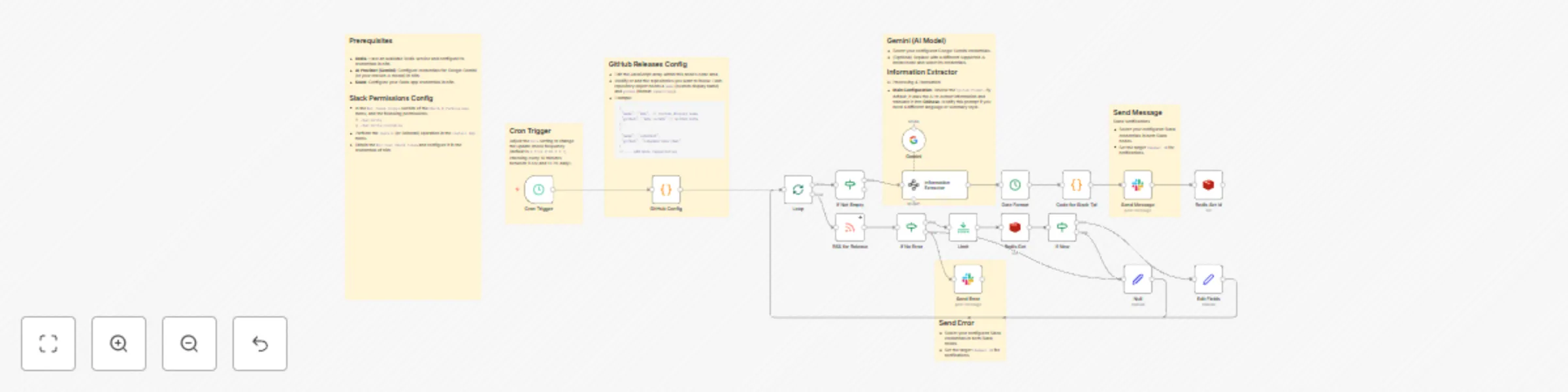
Workflow preview
100%
Monitor GitHub releases with Gemini AI Chinese translation & Slack notifications preview
Open on n8n.io

Important notice

This workflow is provided as-is. Please review and test before using in production.

1. Workflow Overview

Overview This n8n template monitors specified GitHub repositories. When a new release is published, it automatically fetches the information, uses AI (Google Gemini by default) to summarize and tra...

Best for

  • DevOps automation workflows
  • AI Summarization automation workflows
  • advanced n8n builders looking for reusable templates

Tools used

n8n-nodes-base.limit, n8n-nodes-base.splitinbatches, n8n-nodes-base.set, n8n-nodes-base.scheduletrigger, n8n-nodes-base.code, n8n-nodes-base.if, n8n-nodes-base.slack, n8n-nodes-base.datetime

Source and attribution

This workflow is cataloged by N8N Workflows and links back to its original n8n.io source page by tbphp.

Original n8n.io source

1.1 Workflow description

Title
Monitor GitHub releases with Gemini AI Chinese translation & Slack notifications
Workflow name
Monitor GitHub releases with Gemini AI Chinese translation & Slack notifications

Overview

This n8n template monitors specified GitHub repositories. When a new release is published, it automatically fetches the information, uses AI (Google Gemini by default) to summarize and translate it into Chinese, and sends a formatted notification to a designated Slack channel.

Core Features:

  • Automated Monitoring: Checks for updates on a predefined schedule.
  • Intelligent Processing: Uses AI to extract key information and translate.
  • Error Handling: Sends an error notification if fetching RSS for a single repository fails, without affecting others.
  • Duplicate Prevention: Remembers the last processed release ID using Redis to ensure only new content is pushed.

Prerequisites

  • Slack: Configure your Slack app credentials in n8n.
  • Redis: Have an available Redis service and configure its credentials in n8n.
  • AI Provider (Gemini): Configure credentials for Google Gemini (or your chosen AI model) in n8n.

Configuration Instructions

After importing the template, you need to modify the following key nodes:

  1. Cron Trigger:
    • Adjust the Rule setting to change the update check frequency (default is 0 */10 9-23 * * *, checking every 10 minutes between 9 AM and 11 PM daily).
  2. GitHub Config (Repository List - Code Node):
    • Edit the JavaScript array within this node's code area.
    • Modify or add the repositories you want to follow. Each repository object needs a name (custom display name) and github (format: owner/repo).
    • Example:
      {
        "name": "n8n", // Custom display name
        "github": "n8n-io/n8n" // GitHub path
      },
      {
        "name": "LobeChat",
        "github": "lobehub/lobe-chat"
      }
      // ... add more repositories
      
  3. Redis and Redis2 (Redis Connection):
    • Select your configured Redis credentials in both nodes.
  4. Gemini (AI Model):
    • Select your configured Google Gemini credentials.
    • (Optional) Replace with a different supported AI model node and select its credentials.
  5. Information Extractor (AI Processing & Translation):
    • Main Configuration: Review the System Prompt. By default, it asks the AI to extract information and translate it into Chinese. Modify this prompt if you need a different language or summary style.
  6. Send Message and Send Error (Slack Notifications):
    • Select your configured Slack credentials in both Slack nodes.
    • Set the target Channel ID for notifications.

Workflow Overview

  1. Start: Cron Trigger initiates the workflow on schedule.
  2. Load Config: GitHub Config provides the list of repositories to monitor.
  3. Loop: The Loop node iterates through each repository.
  4. Fetch & Check:
    • The RSS node attempts to fetch the repository's releases feed.
    • If No Error checks for success:
      • Failure: Send Error posts an error to Slack, skips this repository.
      • Success: Continues.
  5. Check for New Release:
    • The Redis node retrieves the last recorded Release ID for this repository.
    • The If New node compares the latest Release ID with the recorded ID:
      • Different IDs (New Release): Proceeds to processing.
      • Same ID (Already Processed): Skips this repository.
  6. Process & Notify (Only for New Releases):
    • Information Extractor (with Gemini) extracts, summarizes, and translates the content.
    • The Code node formats the information into Slack Block Kit.
    • Send Message sends the formatted message to Slack.
    • The Redis2 node stores the current Release ID in Redis.
  7. End: The workflow finishes after processing all repositories.

Conclusion

Once configured, this template automates GitHub release monitoring, uses AI to distill key information, and delivers it efficiently to your Slack workspace.

1.2 Logical Blocks

This catalog entry is organized from the workflow JSON. The node-level section below shows the executable blocks available for review before importing the template.

2. Block-by-Block Analysis

Block 1 - Limit

Type / Role
n8n-nodes-base.limit - limit
Config choices
Version 1

Block 2 - Loop

Type / Role
n8n-nodes-base.splitInBatches - splitInBatches
Config choices
Version 3

Block 3 - Edit Fields

Type / Role
n8n-nodes-base.set - set
Config choices
Version 3.4

Block 4 - Cron Trigger

Type / Role
n8n-nodes-base.scheduleTrigger - scheduleTrigger
Config choices
Version 1.2

Block 5 - GitHub Config

Type / Role
n8n-nodes-base.code - code
Config choices
Version 2

Block 6 - If No Error

Type / Role
n8n-nodes-base.if - if
Config choices
Version 2.2

Block 7 - If New

Type / Role
n8n-nodes-base.if - if
Config choices
Version 2.2

Block 8 - Null

Type / Role
n8n-nodes-base.set - set
Config choices
Version 3.4

Block 9 - Send Error

Type / Role
n8n-nodes-base.slack - slack
Config choices
Version 2.2

Block 10 - If Not Empty

Type / Role
n8n-nodes-base.if - if
Config choices
Version 2.2

Block 11 - Date Format

Type / Role
n8n-nodes-base.dateTime - dateTime
Config choices
Version 2

Block 12 - Information Extractor

Type / Role
@n8n/n8n-nodes-langchain.informationExtractor - informationExtractor
Config choices
Version 1

Block 13 - Send Message

Type / Role
n8n-nodes-base.slack - slack
Config choices
Version 2.2

Block 14 - Gemini

Type / Role
@n8n/n8n-nodes-langchain.lmChatGoogleGemini - lmChatGoogleGemini
Config choices
Version 1

Block 15 - Sticky Note

Type / Role
n8n-nodes-base.stickyNote - stickyNote
Config choices
Version 1

Block 16 - Sticky Note1

Type / Role
n8n-nodes-base.stickyNote - stickyNote
Config choices
Version 1

Block 17 - Sticky Note2

Type / Role
n8n-nodes-base.stickyNote - stickyNote
Config choices
Version 1

Block 18 - Sticky Note3

Type / Role
n8n-nodes-base.stickyNote - stickyNote
Config choices
Version 1

Block 19 - Sticky Note4

Type / Role
n8n-nodes-base.stickyNote - stickyNote
Config choices
Version 1

Block 20 - Sticky Note5

Type / Role
n8n-nodes-base.stickyNote - stickyNote
Config choices
Version 1

Block 21 - Redis Set Id

Type / Role
n8n-nodes-base.redis - redis
Config choices
Version 1

Block 22 - Code for Slack Tpl

Type / Role
n8n-nodes-base.code - code
Config choices
Version 2

Block 23 - RSS for Release

Type / Role
n8n-nodes-base.rssFeedRead - rssFeedRead
Config choices
Version 1.1

Block 24 - Redis Get

Type / Role
n8n-nodes-base.redis - redis
Config choices
Version 1

3. Summary Table

Workflow Monitor GitHub releases with Gemini AI Chinese translation & Slack notifications
Complexity advanced
Nodes 24
Categories DevOps, AI Summarization
Author tbphp
Published 07 Apr 2025

4. Reproducing the Workflow from Scratch

  1. 1. Download the workflow JSON

    Use the JSON export at /data/workflows/3452/3452.json as the source template for this automation.

  2. 2. Import the template into n8n

    Open n8n, import the downloaded JSON, and review each node before activating the workflow.

  3. 3. Configure credentials and variables

    Replace placeholder credentials, API keys, webhook URLs, account IDs, and environment-specific values with your own settings.

  4. 4. Test with sample data

    Run the workflow manually or in a staging workspace, inspect node output, and confirm downstream systems receive the expected data.

  5. 5. Activate and monitor

    Enable the workflow only after testing, then monitor executions, errors, and rate limits during the first production runs.

5. General Notes & Resources

Review imported nodes carefully before activation. This catalog entry is intended to help you inspect the workflow structure, understand required services, and find related templates faster.

Node names, credentials, schedules, webhook paths, and external service limits may need adjustment for your workspace.

Frequently asked questions

What does Monitor GitHub releases with Gemini AI Chinese translation & Slack notifications do?

Overview This n8n template monitors specified GitHub repositories. When a new release is published, it automatically fetches the information, uses AI (Google Gemini by default) to summarize and tra...

What do I need before importing this workflow?

Review the workflow JSON, configure any required credentials in n8n, and test the automation in a safe workspace before using it in production.

Can I customize this workflow?

Yes. Use the block-by-block analysis and the downloadable JSON to inspect each node, then adjust credentials, prompts, schedules, filters, or destinations for your DevOps, AI Summarization use case.



