
Marketing analytics reports with Google Analytics, Sheets, Slides & email alerts

Workflow preview
Workflow preview
100%
Marketing analytics reports with Google Analytics, Sheets, Slides & email alerts preview
Open on n8n.io

Important notice

This workflow is provided as-is. Please review and test before using in production.

1. Workflow Overview

Automate and Distribute Weekly and Monthly Marketing Analytics Reports Who's it for? This workflow is designed for marketing teams, data analysts, and business owners who need to consistently track...

Best for

  • Document Extraction automation workflows
  • advanced n8n builders looking for reusable templates

Tools used

n8n-nodes-base.scheduletrigger, n8n-nodes-base.set, n8n-nodes-base.googleanalytics, n8n-nodes-base.httprequest, n8n-nodes-base.code, n8n-nodes-base.googlesheets, n8n-nodes-base.googleslides, n8n-nodes-base.if

Source and attribution

This workflow is cataloged by N8N Workflows and links back to its original n8n.io source page by 對馬 瑠斗.

Original n8n.io source

1.1 Workflow description

Title
Marketing analytics reports with Google Analytics, Sheets, Slides & email alerts
Workflow name
Marketing analytics reports with Google Analytics, Sheets, Slides & email alerts

Automate and Distribute Weekly and Monthly Marketing Analytics Reports

Who's it for?

This workflow is designed for marketing teams, data analysts, and business owners who need to consistently track key performance indicators (KPIs). It saves hours of manual data collection and reporting, ensuring stakeholders receive timely updates automatically.

What it does

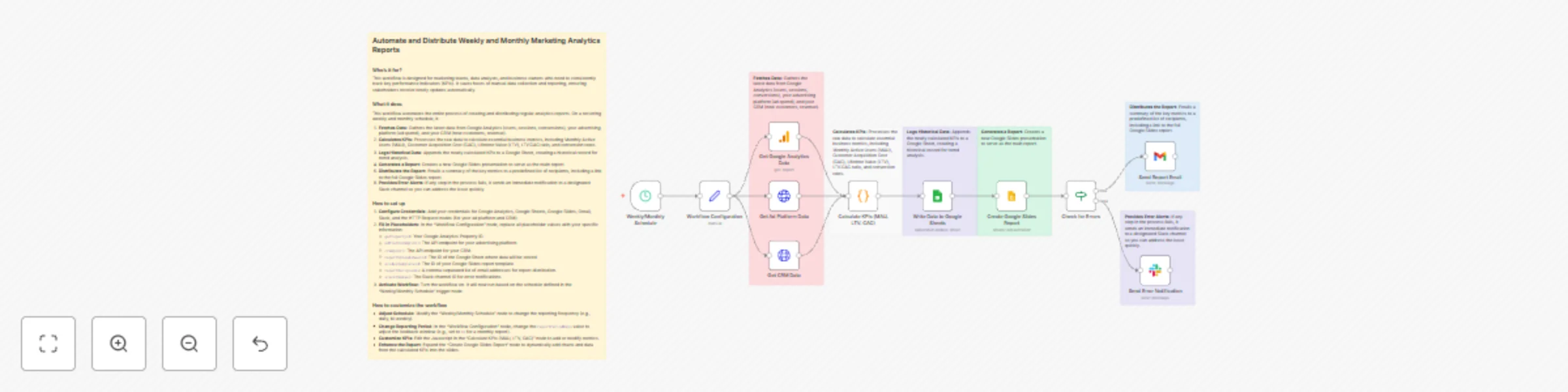
This workflow automates the entire process of creating and distributing regular analytics reports. On a recurring weekly and monthly schedule, it:

  1. Fetches Data: Gathers the latest data from Google Analytics (users, sessions, conversions), your advertising platform (ad spend), and your CRM (new customers, revenue).
  2. Calculates KPIs: Processes the raw data to calculate essential business metrics, including Monthly Active Users (MAU), Customer Acquisition Cost (CAC), Lifetime Value (LTV), LTV:CAC ratio, and conversion rates.
  3. Logs Historical Data: Appends the newly calculated KPIs to a Google Sheet, creating a historical record for trend analysis.
  4. Generates a Report: Creates a new Google Slides presentation to serve as the main report.
  5. Distributes the Report: Emails a summary of the key metrics to a predefined list of recipients, including a link to the full Google Slides report.
  6. Provides Error Alerts: If any step in the process fails, it sends an immediate notification to a designated Slack channel so you can address the issue quickly.

How to set up

  1. Configure Credentials: Add your credentials for Google Analytics, Google Sheets, Google Slides, Gmail, Slack, and the HTTP Request nodes (for your ad platform and CRM).
  2. Fill in Placeholders: In the "Workflow Configuration" node, replace all placeholder values with your specific information:
    • gaPropertyId: Your Google Analytics Property ID.
    • adPlatformApiUrl: The API endpoint for your advertising platform.
    • crmApiUrl: The API endpoint for your CRM.
    • reportSpreadsheetId: The ID of the Google Sheet where data will be stored.
    • slidesTemplateId: The ID of your Google Slides report template.
    • reportRecipients: A comma-separated list of email addresses for report distribution.
    • slackChannel: The Slack channel ID for error notifications.
  3. Activate Workflow: Turn the workflow on. It will now run based on the schedule defined in the "Weekly/Monthly Schedule" trigger node.

How to customize the workflow

  • Adjust Schedule: Modify the "Weekly/Monthly Schedule" node to change the reporting frequency (e.g., daily, bi-weekly).
  • Change Reporting Period: In the "Workflow Configuration" node, change the reportPeriodDays value to adjust the lookback window (e.g., set to 30 for a monthly report).
  • Customize KPIs: Edit the Javascript in the "Calculate KPIs (MAU, LTV, CAC)" node to add or modify metrics.
  • Enhance the Report: Expand the "Create Google Slides Report" node to dynamically add charts and data from the calculated KPIs into the slides.

1.2 Logical Blocks

This catalog entry is organized from the workflow JSON. The node-level section below shows the executable blocks available for review before importing the template.

2. Block-by-Block Analysis

Block 1 - Weekly/Monthly Schedule

Type / Role
n8n-nodes-base.scheduleTrigger - scheduleTrigger
Config choices
Version 1.2

Block 2 - Workflow Configuration

Type / Role
n8n-nodes-base.set - set
Config choices
Version 3.4

Block 3 - Get Google Analytics Data

Type / Role
n8n-nodes-base.googleAnalytics - googleAnalytics
Config choices
Version 2

Block 4 - Get Ad Platform Data

Type / Role
n8n-nodes-base.httpRequest - httpRequest
Config choices
Version 4.3

Block 5 - Get CRM Data

Type / Role
n8n-nodes-base.httpRequest - httpRequest
Config choices
Version 4.3

Block 6 - Calculate KPIs (MAU, LTV, CAC)

Type / Role
n8n-nodes-base.code - code
Config choices
Version 2

Block 7 - Write Data to Google Sheets

Type / Role
n8n-nodes-base.googleSheets - googleSheets
Config choices
Version 4.7

Block 8 - Create Google Slides Report

Type / Role
n8n-nodes-base.googleSlides - googleSlides
Config choices
Version 2

Block 9 - Check for Errors

Type / Role
n8n-nodes-base.if - if
Config choices
Version 2.2

Block 10 - Send Report Email

Type / Role
n8n-nodes-base.gmail - gmail
Config choices
Version 2.1

Block 11 - Send Error Notification

Type / Role
n8n-nodes-base.slack - slack
Config choices
Version 2.3

Block 12 - Sticky Note

Type / Role
n8n-nodes-base.stickyNote - stickyNote
Config choices
Version 1

Block 13 - Sticky Note1

Type / Role
n8n-nodes-base.stickyNote - stickyNote
Config choices
Version 1

Block 14 - Sticky Note2

Type / Role
n8n-nodes-base.stickyNote - stickyNote
Config choices
Version 1

Block 15 - Sticky Note3

Type / Role
n8n-nodes-base.stickyNote - stickyNote
Config choices
Version 1

Block 16 - Sticky Note4

Type / Role
n8n-nodes-base.stickyNote - stickyNote
Config choices
Version 1

Block 17 - Sticky Note5

Type / Role
n8n-nodes-base.stickyNote - stickyNote
Config choices
Version 1

Block 18 - Sticky Note6

Type / Role
n8n-nodes-base.stickyNote - stickyNote
Config choices
Version 1

3. Summary Table

Workflow Marketing analytics reports with Google Analytics, Sheets, Slides & email alerts
Complexity advanced
Nodes 18
Categories Document Extraction
Author 對馬 瑠斗
Published 11 Nov 2025

4. Reproducing the Workflow from Scratch

  1. 1. Download the workflow JSON

    Use the JSON export at /data/workflows/10715/10715.json as the source template for this automation.

  2. 2. Import the template into n8n

    Open n8n, import the downloaded JSON, and review each node before activating the workflow.

  3. 3. Configure credentials and variables

    Replace placeholder credentials, API keys, webhook URLs, account IDs, and environment-specific values with your own settings.

  4. 4. Test with sample data

    Run the workflow manually or in a staging workspace, inspect node output, and confirm downstream systems receive the expected data.

  5. 5. Activate and monitor

    Enable the workflow only after testing, then monitor executions, errors, and rate limits during the first production runs.

5. General Notes & Resources

Review imported nodes carefully before activation. This catalog entry is intended to help you inspect the workflow structure, understand required services, and find related templates faster.

Node names, credentials, schedules, webhook paths, and external service limits may need adjustment for your workspace.

Frequently asked questions

What does Marketing analytics reports with Google Analytics, Sheets, Slides & email alerts do?

Automate and Distribute Weekly and Monthly Marketing Analytics Reports Who's it for? This workflow is designed for marketing teams, data analysts, and business owners who need to consistently track...

What do I need before importing this workflow?

Review the workflow JSON, configure any required credentials in n8n, and test the automation in a safe workspace before using it in production.

Can I customize this workflow?

Yes. Use the block-by-block analysis and the downloadable JSON to inspect each node, then adjust credentials, prompts, schedules, filters, or destinations for your Document Extraction use case.



