Block 1 - When clicking ‘Test workflow’
- Type / Role
- n8n-nodes-base.manualTrigger - manualTrigger
- Config choices
- Version 1
This workflow is provided as-is. Please review and test before using in production.
Adobe developer API Did you know that Adobe provides an API to perform all sort of manipulation on PDF files : Split PDF, Combine PDF OCR Insert page, delete page, replace page, reorder page Conten...
n8n-nodes-base.manualtrigger, n8n-nodes-base.httprequest, n8n-nodes-base.executeworkflowtrigger, n8n-nodes-base.stickynote, n8n-nodes-base.set, n8n-nodes-base.dropbox, n8n-nodes-base.merge, n8n-nodes-base.wait
This workflow is cataloged by N8N Workflows and links back to its original n8n.io source page by digi-stud.io.
Original n8n.io sourceDid you know that Adobe provides an API to perform all sort of manipulation on PDF files :
The free tier allows up to 500 PDF operation / month. As it comes directly from Adobe, it works often better than other alternatives.
Adobe documentation:
The API is a bit painful to use. To perform a transformation on a PDF it requires to
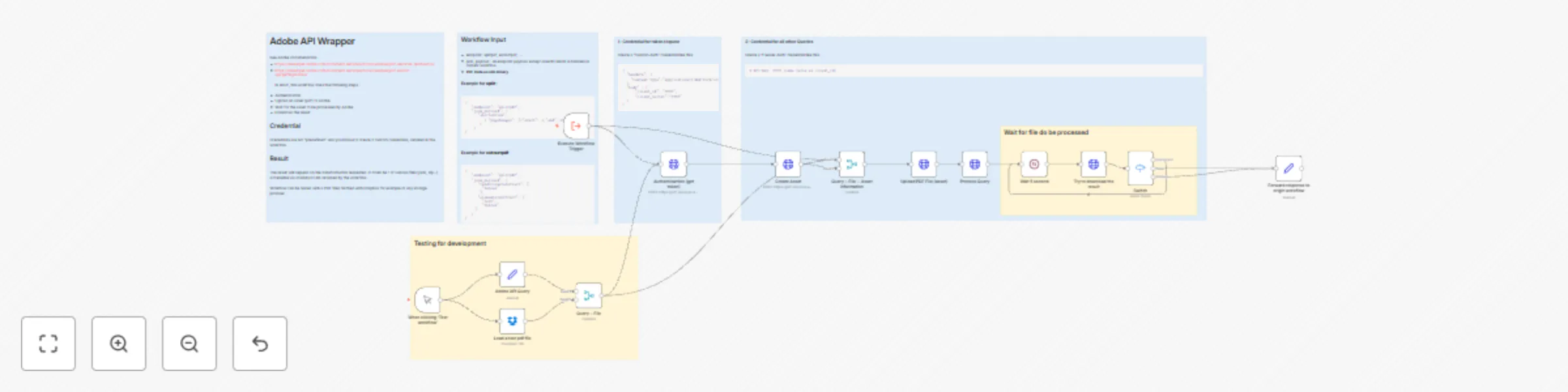
This workflow is a generic wrapper to perform all these steps for any transformation endpoint. I usually use it from other workflow with an Execute Workflow node.
Examples are given in the workflow.
This service is useful for example to clean PDF data for an AI / RAG system.
My favorite use-case is to extract table as images and forward images to an AI for image recognition / description which is often more accuarate than feedind raw tabular data to a LLM.
This catalog entry is organized from the workflow JSON. The node-level section below shows the executable blocks available for review before importing the template.
| Workflow | Manipulate PDF with Adobe developer API |
|---|---|
| Complexity | advanced |
| Nodes | 20 |
| Categories | Document Extraction |
| Author | digi-stud.io |
| Published | 23 Sept 2024 |
Use the JSON export at /data/workflows/2424/2424.json as the source template for this automation.
Open n8n, import the downloaded JSON, and review each node before activating the workflow.
Replace placeholder credentials, API keys, webhook URLs, account IDs, and environment-specific values with your own settings.
Run the workflow manually or in a staging workspace, inspect node output, and confirm downstream systems receive the expected data.
Enable the workflow only after testing, then monitor executions, errors, and rate limits during the first production runs.
Review imported nodes carefully before activation. This catalog entry is intended to help you inspect the workflow structure, understand required services, and find related templates faster.
Node names, credentials, schedules, webhook paths, and external service limits may need adjustment for your workspace.
Adobe developer API Did you know that Adobe provides an API to perform all sort of manipulation on PDF files : Split PDF, Combine PDF OCR Insert page, delete page, replace page, reorder page Conten...
Review the workflow JSON, configure any required credentials in n8n, and test the automation in a safe workspace before using it in production.
Yes. Use the block-by-block analysis and the downloadable JSON to inspect each node, then adjust credentials, prompts, schedules, filters, or destinations for your Document Extraction use case.