
Import Google Keep notes to Google Sheets using OpenAI and Google Drive

Workflow preview
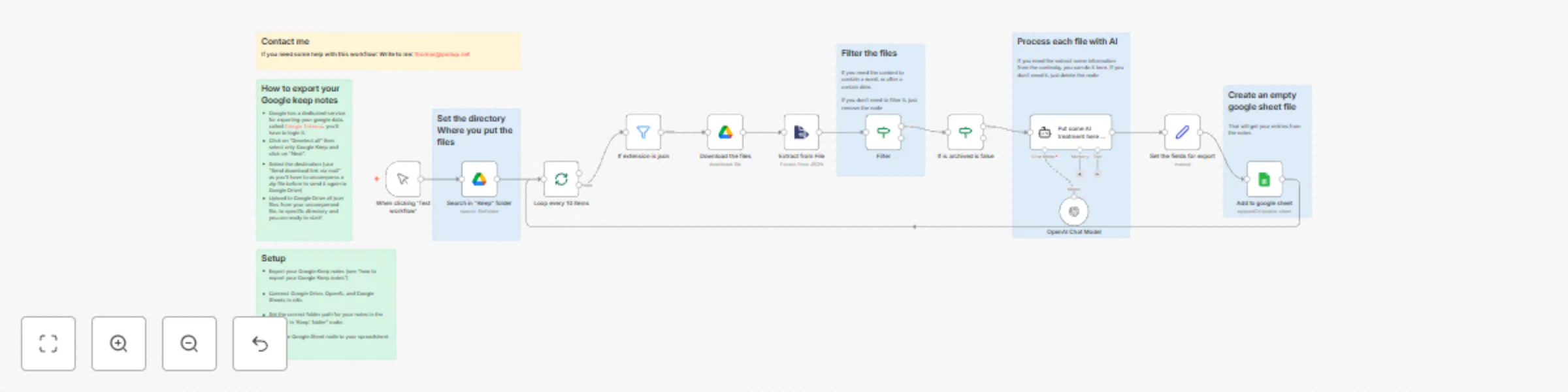
Workflow preview
100%
Import Google Keep notes to Google Sheets using OpenAI and Google Drive preview
Open on n8n.io

Important notice

This workflow is provided as-is. Please review and test before using in production.

1. Workflow Overview

This n8n workflow automates the import of your Google Keep notes into a structured Google Sheet, using Google Drive, OpenAI for AI powered processing, and JSON file extraction. It's perfect for use...

Best for

  • Document Extraction automation workflows
  • AI Summarization automation workflows
  • advanced n8n builders looking for reusable templates

Tools used

n8n-nodes-base.manualtrigger, n8n-nodes-base.extractfromfile, n8n-nodes-base.if, @n8n/n8n-nodes-langchain.lmchatopenai, n8n-nodes-base.filter, n8n-nodes-base.stickynote, n8n-nodes-base.googledrive, n8n-nodes-base.splitinbatches

Source and attribution

This workflow is cataloged by N8N Workflows and links back to its original n8n.io source page by PollupAI.

Original n8n.io source

1.1 Workflow description

Title
Import Google Keep notes to Google Sheets using OpenAI and Google Drive
Workflow name
Import Google Keep notes to Google Sheets using OpenAI and Google Drive

This n8n workflow automates the import of your Google Keep notes into a structured Google Sheet, using Google Drive, OpenAI for AI-powered processing, and JSON file extraction. It's perfect for users who want to turn exported Keep notes into a searchable, filterable spreadsheet – optionally enhanced by AI summarization or transformation.

Who is this for?

  • Researchers, knowledge workers, and digital minimalists who rely on Google Keep and want to better organize or analyze their notes.

  • Anyone who regularly exports Google Keep notes and wants a clean, automated workflow to store them in Google Sheets.

  • Users looking to apply AI to process, summarize, or extract insights from raw notes.

What problem is this workflow solving?

Exporting Google Keep notes via Google Takeout gives you unstructured .json files that are hard to read and manage. This workflow solves that by:

  • Filtering relevant .json files
  • Extracting note content
  • (Optionally) applying AI to analyze or summarize each note
  • Writing the result into a structured Google Sheet

What this workflow does

  1. Google Drive Search: Looks for .json files inside a specified "Keep" folder.

  2. Loop: Processes files in batches of 10.

  3. File Filtering: Filters by .json extension.

  4. Download + Extract: Downloads each file and extracts note content from JSON.

  5. Optional Filtering: Only keeps non-archived notes or those meeting content criteria.

  6. AI Processing (optional): Uses OpenAI to summarize or transform the note content.

  7. Prepare for Export: Maps note fields to be written.

  8. Google Sheets: Appends or updates the target sheet with the note data.

Setup

  • Export your Google Keep notes using Google Takeout:

  • Deselect all, then choose only Google Keep.

  • Choose “Send download link via email”.

  • Unzip the downloaded archive and upload the .json files to your Google Drive.

  • Connect Google Drive, OpenAI, and Google Sheets in n8n.

  • Set the correct folder path for your notes in the “Search in ‘Keep’ folder” node.

  • Point the Google Sheet node to your spreadsheet

How to customize this workflow to your needs

Skip AI processing: If you don't need summaries or transformations, remove or disable the OpenAI Chat Model node.

Filter criteria: Customize the Filter node to extract only recent notes, or those containing specific keywords.

AI prompts: Edit the Tools Agent or Chat Model node to instruct the AI to summarize, extract tasks, categorize notes, etc.

Field mapping: Adjust the “Set fields for export” node to control what gets written to the spreadsheet.

Use this template to build a powerful knowledge extraction tool from your Google Keep archive – ideal for backups, audits, or data-driven insights.

1.2 Logical Blocks

This catalog entry is organized from the workflow JSON. The node-level section below shows the executable blocks available for review before importing the template.

2. Block-by-Block Analysis

Block 1 - When clicking ‘Test workflow’

Type / Role
n8n-nodes-base.manualTrigger - manualTrigger
Config choices
Version 1

Block 2 - Extract from File

Type / Role
n8n-nodes-base.extractFromFile - extractFromFile
Config choices
Version 1

Block 3 - If is archived is false

Type / Role
n8n-nodes-base.if - if
Config choices
Version 2.2

Block 4 - OpenAI Chat Model

Type / Role
@n8n/n8n-nodes-langchain.lmChatOpenAi - lmChatOpenAi
Config choices
Version 1.2

Block 5 - If extension is json

Type / Role
n8n-nodes-base.filter - filter
Config choices
Version 2.2

Block 6 - Sticky Note

Type / Role
n8n-nodes-base.stickyNote - stickyNote
Config choices
Version 1

Block 7 - Search in "Keep" folder

Type / Role
n8n-nodes-base.googleDrive - googleDrive
Config choices
Version 3

Block 8 - Loop every 10 items

Type / Role
n8n-nodes-base.splitInBatches - splitInBatches
Config choices
Version 3

Block 9 - Download the files

Type / Role
n8n-nodes-base.googleDrive - googleDrive
Config choices
Version 3

Block 10 - Put some AI treatment here if you need it

Type / Role
@n8n/n8n-nodes-langchain.agent - agent
Config choices
Version 1.8

Block 11 - Set the fields for export

Type / Role
n8n-nodes-base.set - set
Config choices
Version 3.4

Block 12 - Add to google sheet

Type / Role
n8n-nodes-base.googleSheets - googleSheets
Config choices
Version 4.5

Block 13 - Filter

Type / Role
n8n-nodes-base.if - if
Config choices
Version 2.2

Block 14 - Sticky Note1

Type / Role
n8n-nodes-base.stickyNote - stickyNote
Config choices
Version 1

Block 15 - Sticky Note2

Type / Role
n8n-nodes-base.stickyNote - stickyNote
Config choices
Version 1

Block 16 - Sticky Note3

Type / Role
n8n-nodes-base.stickyNote - stickyNote
Config choices
Version 1

Block 17 - Sticky Note4

Type / Role
n8n-nodes-base.stickyNote - stickyNote
Config choices
Version 1

Block 18 - Sticky Note5

Type / Role
n8n-nodes-base.stickyNote - stickyNote
Config choices
Version 1

Block 19 - Sticky Note6

Type / Role
n8n-nodes-base.stickyNote - stickyNote
Config choices
Version 1

3. Summary Table

Workflow Import Google Keep notes to Google Sheets using OpenAI and Google Drive
Complexity advanced
Nodes 19
Categories Document Extraction, AI Summarization
Author PollupAI
Published 11 Apr 2025

4. Reproducing the Workflow from Scratch

  1. 1. Download the workflow JSON

    Use the JSON export at /data/workflows/3517/3517.json as the source template for this automation.

  2. 2. Import the template into n8n

    Open n8n, import the downloaded JSON, and review each node before activating the workflow.

  3. 3. Configure credentials and variables

    Replace placeholder credentials, API keys, webhook URLs, account IDs, and environment-specific values with your own settings.

  4. 4. Test with sample data

    Run the workflow manually or in a staging workspace, inspect node output, and confirm downstream systems receive the expected data.

  5. 5. Activate and monitor

    Enable the workflow only after testing, then monitor executions, errors, and rate limits during the first production runs.

5. General Notes & Resources

Review imported nodes carefully before activation. This catalog entry is intended to help you inspect the workflow structure, understand required services, and find related templates faster.

Node names, credentials, schedules, webhook paths, and external service limits may need adjustment for your workspace.

Frequently asked questions

What does Import Google Keep notes to Google Sheets using OpenAI and Google Drive do?

This n8n workflow automates the import of your Google Keep notes into a structured Google Sheet, using Google Drive, OpenAI for AI powered processing, and JSON file extraction. It's perfect for use...

What do I need before importing this workflow?

Review the workflow JSON, configure any required credentials in n8n, and test the automation in a safe workspace before using it in production.

Can I customize this workflow?

Yes. Use the block-by-block analysis and the downloadable JSON to inspect each node, then adjust credentials, prompts, schedules, filters, or destinations for your Document Extraction, AI Summarization use case.



