
Host a static HTML KPI dashboard from Google Sheets with CustomJS

Workflow preview
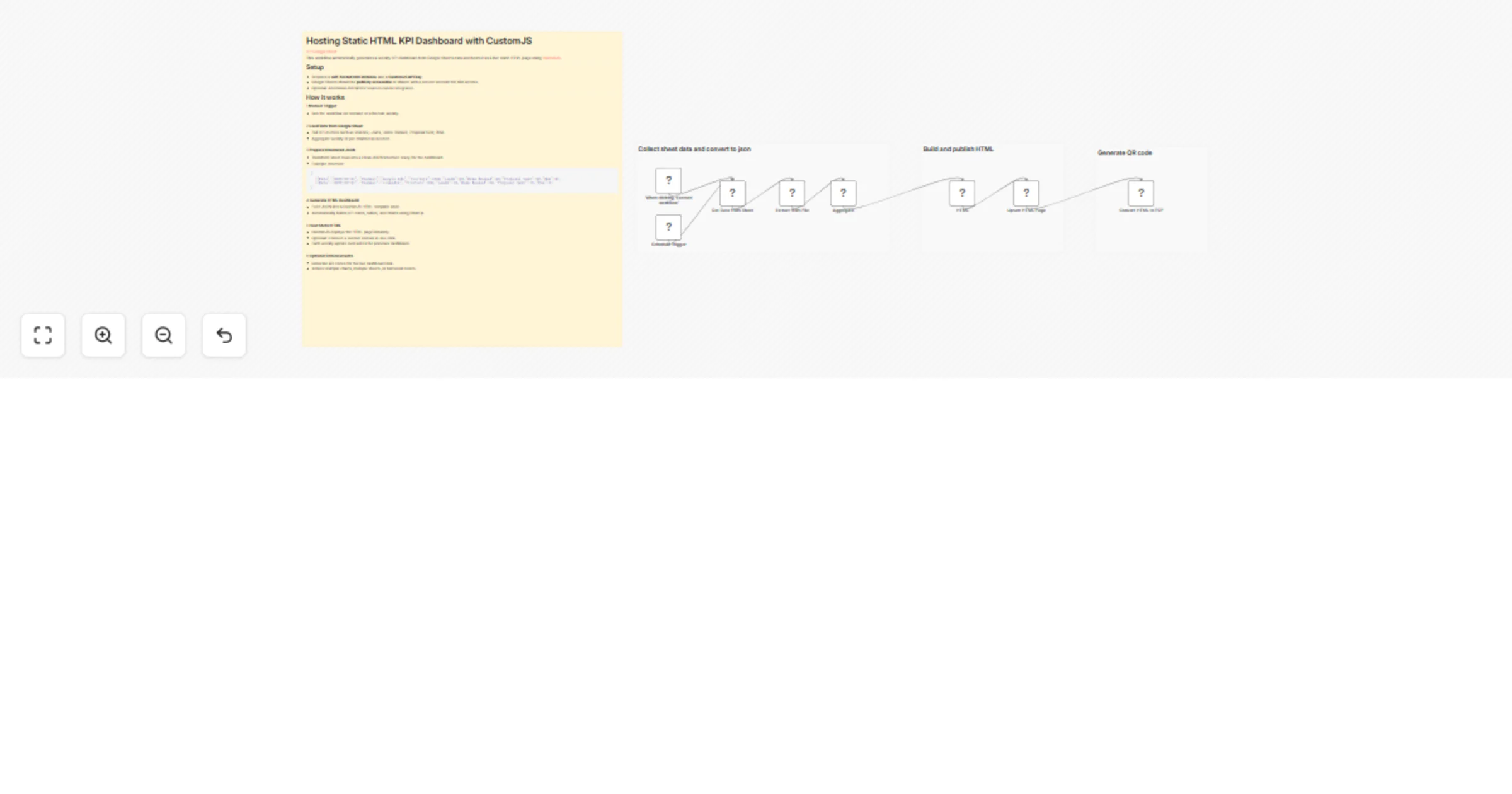
Workflow preview
100%
Host a static HTML KPI dashboard from Google Sheets with CustomJS preview
Open on n8n.io

1. Workflow Overview

Hosting a static HTML KPI dashboard with CustomJS This workflow demonstrates how to automatically generate a weekly KPI dashboard from Google Sheets and host it as a live static HTML page using [Cu...

Best for

  • Document Extraction automation workflows
  • intermediate n8n builders looking for reusable templates

Tools used

n8n-nodes-base.manualtrigger, n8n-nodes-base.stickynote, n8n-nodes-base.html, n8n-nodes-base.httprequest, @custom-js/n8n-nodes-pdf-toolkit-v2.pdftoolkit, n8n-nodes-base.extractfromfile, n8n-nodes-base.aggregate, n8n-nodes-base.scheduletrigger

Source and attribution

This workflow is cataloged by N8N Workflows and links back to its original n8n.io source page by CustomJS.

Original n8n.io source

1.1 Workflow description

Title
Host a static HTML KPI dashboard from Google Sheets with CustomJS
Workflow name
Host a static HTML KPI dashboard from Google Sheets with CustomJS

Hosting a static HTML KPI dashboard with CustomJS

This workflow demonstrates how to automatically generate a weekly KPI dashboard from Google Sheets and host it as a live static HTML page using CustomJS.

Instead of manually building and updating dashboards, the workflow fetches KPI data, transforms it into JSON, and generates charts, tables, and KPI cards automatically. The hosted HTML page can be connected to a custom domain with one click.

The result is a fully interactive, production-ready KPI dashboard that updates weekly with minimal effort.


Why This Workflow?

Creating dashboards manually or passing raw sheet data to visualization tools is:

  • time-consuming
  • error-prone
  • hard to automate

This workflow automates the process by converting sheet data into structured JSON and feeding it directly into a CustomJS HTML template, generating charts and tables automatically.


What This Workflow Does

  • Fetches KPI metrics (Visitors, Leads, Demo Booked, Proposal Sent, Won) from Google Sheets
  • Aggregates metrics by week and channel
  • Converts the structured data into JSON for dashboard consumption
  • Generates a static HTML page with KPI cards, charts, and tables
  • Hosts the HTML page on CustomJS, optionally connected to a custom domain

All without manual intervention.


Key Features

  • Automated KPI Dashboards Generate charts, tables, and KPI cards from Google Sheets data

  • Static HTML Hosting Live dashboards are instantly deployable and accessible anywhere

  • Custom Domains Connect your own domain with a single click

  • Interactive Charts Uses Chart.js for bar and line charts, fully responsive

  • QR Code Ready Optional QR code generation for sharing dashboard links

  • Token-Efficient Only structured JSON is processed, no large unnecessary payloads


How It Works

  1. Manual or Scheduled Trigger Run the workflow on demand or weekly

  2. Load Data from Google Sheets

  • Pull metrics for the desired period
  • Aggregate weekly or by channel
  1. Prepare Structured JSON Format sheet rows into structured JSON for the dashboard

  2. Generate HTML Dashboard Feed JSON into a CustomJS HTML template node Automatically builds KPI cards, charts, and tables

  3. Host Static HTML

  • Deploy instantly via CustomJS
  • Optional: connect a custom domain
  • Each update overwrites the previous dashboard
  1. Optional Enhancements
  • Generate QR codes for the dashboard link
  • Include multiple charts, historical trends, or multiple sheets

1.2 Logical Blocks

This catalog entry is organized from the workflow JSON. The node-level section below shows the executable blocks available for review before importing the template.

2. Block-by-Block Analysis

Block 1 - When clicking ‘Execute workflow’

Type / Role
n8n-nodes-base.manualTrigger - manualTrigger
Config choices
Version 1

Block 2 - Sticky Note

Type / Role
n8n-nodes-base.stickyNote - stickyNote
Config choices
Version 1

Block 3 - Sticky Note1

Type / Role
n8n-nodes-base.stickyNote - stickyNote
Config choices
Version 1

Block 4 - Sticky Note2

Type / Role
n8n-nodes-base.stickyNote - stickyNote
Config choices
Version 1

Block 5 - Sticky Note3

Type / Role
n8n-nodes-base.stickyNote - stickyNote
Config choices
Version 1

Block 6 - HTML

Type / Role
n8n-nodes-base.html - html
Config choices
Version 1.2

Block 7 - Get Data From Sheet

Type / Role
n8n-nodes-base.httpRequest - httpRequest
Config choices
Version 4.4

Block 8 - Convert HTML to PDF

Type / Role
@custom-js/n8n-nodes-pdf-toolkit-v2.pdfToolkit - pdfToolkit
Config choices
Version 1

Block 9 - Extract from File

Type / Role
n8n-nodes-base.extractFromFile - extractFromFile
Config choices
Version 1.1

Block 10 - Aggregate

Type / Role
n8n-nodes-base.aggregate - aggregate
Config choices
Version 1

Block 11 - Schedule Trigger

Type / Role
n8n-nodes-base.scheduleTrigger - scheduleTrigger
Config choices
Version 1.3

Block 12 - Upsert HTML Page

Type / Role
@custom-js/n8n-nodes-pdf-toolkit-v2.pdfToolkit - pdfToolkit
Config choices
Version 1

3. Summary Table

Workflow Host a static HTML KPI dashboard from Google Sheets with CustomJS
Complexity intermediate
Nodes 12
Categories Document Extraction
Author CustomJS
Published 20 Feb 2026

4. Reproducing the Workflow from Scratch

  1. 1. Download the workflow JSON

    Use the JSON export at /data/workflows/13545/13545.json as the source template for this automation.

  2. 2. Import the template into n8n

    Open n8n, import the downloaded JSON, and review each node before activating the workflow.

  3. 3. Configure credentials and variables

    Replace placeholder credentials, API keys, webhook URLs, account IDs, and environment-specific values with your own settings.

  4. 4. Test with sample data

    Run the workflow manually or in a staging workspace, inspect node output, and confirm downstream systems receive the expected data.

  5. 5. Activate and monitor

    Enable the workflow only after testing, then monitor executions, errors, and rate limits during the first production runs.

5. General Notes & Resources

Review imported nodes carefully before activation. This catalog entry is intended to help you inspect the workflow structure, understand required services, and find related templates faster.

Node names, credentials, schedules, webhook paths, and external service limits may need adjustment for your workspace.

Frequently asked questions

What does Host a static HTML KPI dashboard from Google Sheets with CustomJS do?

Hosting a static HTML KPI dashboard with CustomJS This workflow demonstrates how to automatically generate a weekly KPI dashboard from Google Sheets and host it as a live static HTML page using [Cu...

What do I need before importing this workflow?

Review the workflow JSON, configure any required credentials in n8n, and test the automation in a safe workspace before using it in production.

Can I customize this workflow?

Yes. Use the block-by-block analysis and the downloadable JSON to inspect each node, then adjust credentials, prompts, schedules, filters, or destinations for your Document Extraction use case.



