
Google SERP + trends and recommendations with Bright Data & Google Gemini

Workflow preview
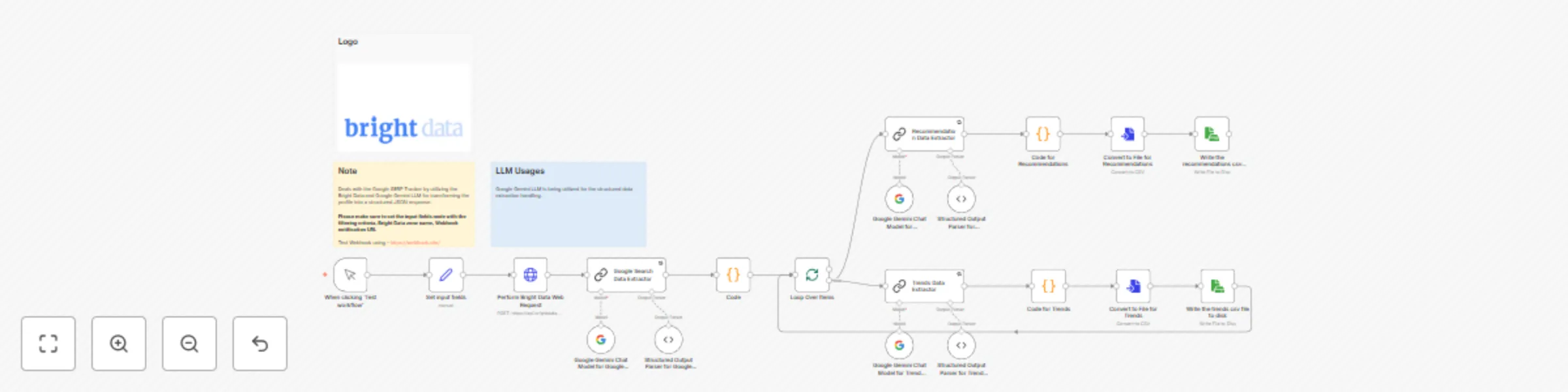
Workflow preview
100%
Google SERP + trends and recommendations with Bright Data & Google Gemini preview
Open on n8n.io

Important notice

This workflow is provided as-is. Please review and test before using in production.

1. Workflow Overview

Who this is for? Google SERP Tracker + Trends and Recommendations is an AI powered n8n workflow that extracts Google search results via Bright Data, parses them into structured JSON using Google Ge...

Best for

  • Market Research automation workflows
  • AI Summarization automation workflows
  • advanced n8n builders looking for reusable templates

Tools used

n8n-nodes-base.manualtrigger, n8n-nodes-base.set, n8n-nodes-base.httprequest, n8n-nodes-base.stickynote, @n8n/n8n-nodes-langchain.chainllm, n8n-nodes-base.code, n8n-nodes-base.splitinbatches, @n8n/n8n-nodes-langchain.lmchatgooglegemini

Source and attribution

This workflow is cataloged by N8N Workflows and links back to its original n8n.io source page by Ranjan Dailata.

Original n8n.io source

1.1 Workflow description

Title
Google SERP + trends and recommendations with Bright Data & Google Gemini
Workflow name
Google SERP + trends and recommendations with Bright Data & Google Gemini

Who this is for?

Google SERP Tracker + Trends and Recommendations is an AI-powered n8n workflow that extracts Google search results via Bright Data, parses them into structured JSON using Google Gemini, and generates actionable recommendations and search trends. It outputs CSV reports and sends real-time Webhook notifications.

This workflow is ideal for:

  • SEO Agencies needing automated rank & trend tracking

  • Growth Marketers seeking daily/weekly search-based insights

  • Product Teams monitoring brand or competitor visibility

  • Market Researchers performing search behavior analysis

  • No-code Builders automating search intelligence workflows

What problem is this workflow solving?

Traditional tracking of search engine rankings and search trends is often fragmented and manual. Analyzing SERP changes and trends requires:

  • Manual extraction or using unstable scrapers

  • Unstructured or cluttered HTML data

  • Lack of actionable insights or recommendations

This workflow solves the problem by:

  • Automating real-time Google SERP data extraction using Bright Data

  • Structuring unstructured search data using Google Gemini LLM

  • Generating actionable recommendations and trends

  • Exporting both CSV reports automatically to disk for downstream use

  • Notifying external systems via Webhook

What this workflow does

  • Accepts search input, zone name, and webhook notification URL

  • Uses Bright Data to extract Google Search Results

  • Uses Google Gemini LLM to parse the SERP data into structured JSON

  • Loops over structured results to:

  • Extract recommendations

  • Extract trends

  • Saves both as .csv files (example below):

    • Google_SERP_Recommendations_Response_2025-06-10T23-01-50-650Z.csv

    • Google_SERP_Trends_Response_2025-06-10T23-01-38-915Z.csv

  • Sends a Webhook with the summary or file reference

LLM Usage

Google Gemini LLM handles:

  • Parsing Google Search HTML into structured JSON

  • Summarizing recommendation data

  • Deriving trends from the extracted SERP metadata

Setup

  • Sign up at Bright Data.
  • Navigate to Proxies & Scraping and create a new Web Unlocker zone by selecting Web Unlocker API under Scraping Solutions.
  • In n8n, configure the Header Auth account under Credentials (Generic Auth Type: Header Authentication).

The Value field should be set with the Bearer XXXXXXXXXXXXXX. The XXXXXXXXXXXXXX should be replaced by the Web Unlocker Token.

  • A Google Gemini API key (or access through Vertex AI or proxy).
  • Update the Set input fields with the search criteria, Bright Data Zone name, Webhook notification URL.

How to customize this workflow to your needs

Input Customization

  • Set your target keyword/phrase in the search field

  • Add your webhook_notification_url for external triggers or notifications

SERP Source

You can extend the Bright Data search logic to include other engines like Bing or DuckDuckGo.

Output Format

Edit the .csv structure in the Convert to File nodes if you want to include/exclude specific columns.

LLM Prompt Tuning

The Gemini LLM prompt inside the Recommendation or Trends extractor nodes can be fine-tuned for domain-specific insight (e.g., SEO vs eCommerce focus).

1.2 Logical Blocks

This catalog entry is organized from the workflow JSON. The node-level section below shows the executable blocks available for review before importing the template.

2. Block-by-Block Analysis

Block 1 - When clicking ‘Test workflow’

Type / Role
n8n-nodes-base.manualTrigger - manualTrigger
Config choices
Version 1

Block 2 - Set input fields

Type / Role
n8n-nodes-base.set - set
Config choices
Version 3.4

Block 3 - Perform Bright Data Web Request

Type / Role
n8n-nodes-base.httpRequest - httpRequest
Config choices
Version 4.2

Block 4 - Sticky Note4

Type / Role
n8n-nodes-base.stickyNote - stickyNote
Config choices
Version 1

Block 5 - Sticky Note5

Type / Role
n8n-nodes-base.stickyNote - stickyNote
Config choices
Version 1

Block 6 - Sticky Note1

Type / Role
n8n-nodes-base.stickyNote - stickyNote
Config choices
Version 1

Block 7 - Google Search Data Extractor

Type / Role
@n8n/n8n-nodes-langchain.chainLlm - chainLlm
Config choices
Version 1.7

Block 8 - Code

Type / Role
n8n-nodes-base.code - code
Config choices
Version 2

Block 9 - Loop Over Items

Type / Role
n8n-nodes-base.splitInBatches - splitInBatches
Config choices
Version 3

Block 10 - Trends Data Extractor

Type / Role
@n8n/n8n-nodes-langchain.chainLlm - chainLlm
Config choices
Version 1.7

Block 11 - Google Gemini Chat Model for Google Search

Type / Role
@n8n/n8n-nodes-langchain.lmChatGoogleGemini - lmChatGoogleGemini
Config choices
Version 1

Block 12 - Structured Output Parser for Google Search

Type / Role
@n8n/n8n-nodes-langchain.outputParserStructured - outputParserStructured
Config choices
Version 1.2

Block 13 - Google Gemini Chat Model for Trend Data

Type / Role
@n8n/n8n-nodes-langchain.lmChatGoogleGemini - lmChatGoogleGemini
Config choices
Version 1

Block 14 - Recommendation Data Extractor

Type / Role
@n8n/n8n-nodes-langchain.chainLlm - chainLlm
Config choices
Version 1.7

Block 15 - Google Gemini Chat Model for Recommendation

Type / Role
@n8n/n8n-nodes-langchain.lmChatGoogleGemini - lmChatGoogleGemini
Config choices
Version 1

Block 16 - Structured Output Parser for Recommendation

Type / Role
@n8n/n8n-nodes-langchain.outputParserStructured - outputParserStructured
Config choices
Version 1.2

Block 17 - Structured Output Parser for Trend Data

Type / Role
@n8n/n8n-nodes-langchain.outputParserStructured - outputParserStructured
Config choices
Version 1.2

Block 18 - Code for Recommendations

Type / Role
n8n-nodes-base.code - code
Config choices
Version 2

Block 19 - Code for Trends

Type / Role
n8n-nodes-base.code - code
Config choices
Version 2

Block 20 - Convert to File for Trends

Type / Role
n8n-nodes-base.convertToFile - convertToFile
Config choices
Version 1.1

Block 21 - Convert to File for Recommendations

Type / Role
n8n-nodes-base.convertToFile - convertToFile
Config choices
Version 1.1

Block 22 - Write the trends csv file to disk

Type / Role
n8n-nodes-base.readWriteFile - readWriteFile
Config choices
Version 1

Block 23 - Write the recommendations csv file to disk

Type / Role
n8n-nodes-base.readWriteFile - readWriteFile
Config choices
Version 1

3. Summary Table

Workflow Google SERP + trends and recommendations with Bright Data & Google Gemini
Complexity advanced
Nodes 23
Categories Market Research, AI Summarization
Author Ranjan Dailata
Published 10 Jun 2025

4. Reproducing the Workflow from Scratch

  1. 1. Download the workflow JSON

    Use the JSON export at /data/workflows/4861/4861.json as the source template for this automation.

  2. 2. Import the template into n8n

    Open n8n, import the downloaded JSON, and review each node before activating the workflow.

  3. 3. Configure credentials and variables

    Replace placeholder credentials, API keys, webhook URLs, account IDs, and environment-specific values with your own settings.

  4. 4. Test with sample data

    Run the workflow manually or in a staging workspace, inspect node output, and confirm downstream systems receive the expected data.

  5. 5. Activate and monitor

    Enable the workflow only after testing, then monitor executions, errors, and rate limits during the first production runs.

5. General Notes & Resources

Review imported nodes carefully before activation. This catalog entry is intended to help you inspect the workflow structure, understand required services, and find related templates faster.

Node names, credentials, schedules, webhook paths, and external service limits may need adjustment for your workspace.

Frequently asked questions

What does Google SERP + trends and recommendations with Bright Data & Google Gemini do?

Who this is for? Google SERP Tracker + Trends and Recommendations is an AI powered n8n workflow that extracts Google search results via Bright Data, parses them into structured JSON using Google Ge...

What do I need before importing this workflow?

Review the workflow JSON, configure any required credentials in n8n, and test the automation in a safe workspace before using it in production.

Can I customize this workflow?

Yes. Use the block-by-block analysis and the downloadable JSON to inspect each node, then adjust credentials, prompts, schedules, filters, or destinations for your Market Research, AI Summarization use case.



