
Get Gmail alerts for dropped top 10 keyword rankings with DataForSEO

Workflow preview
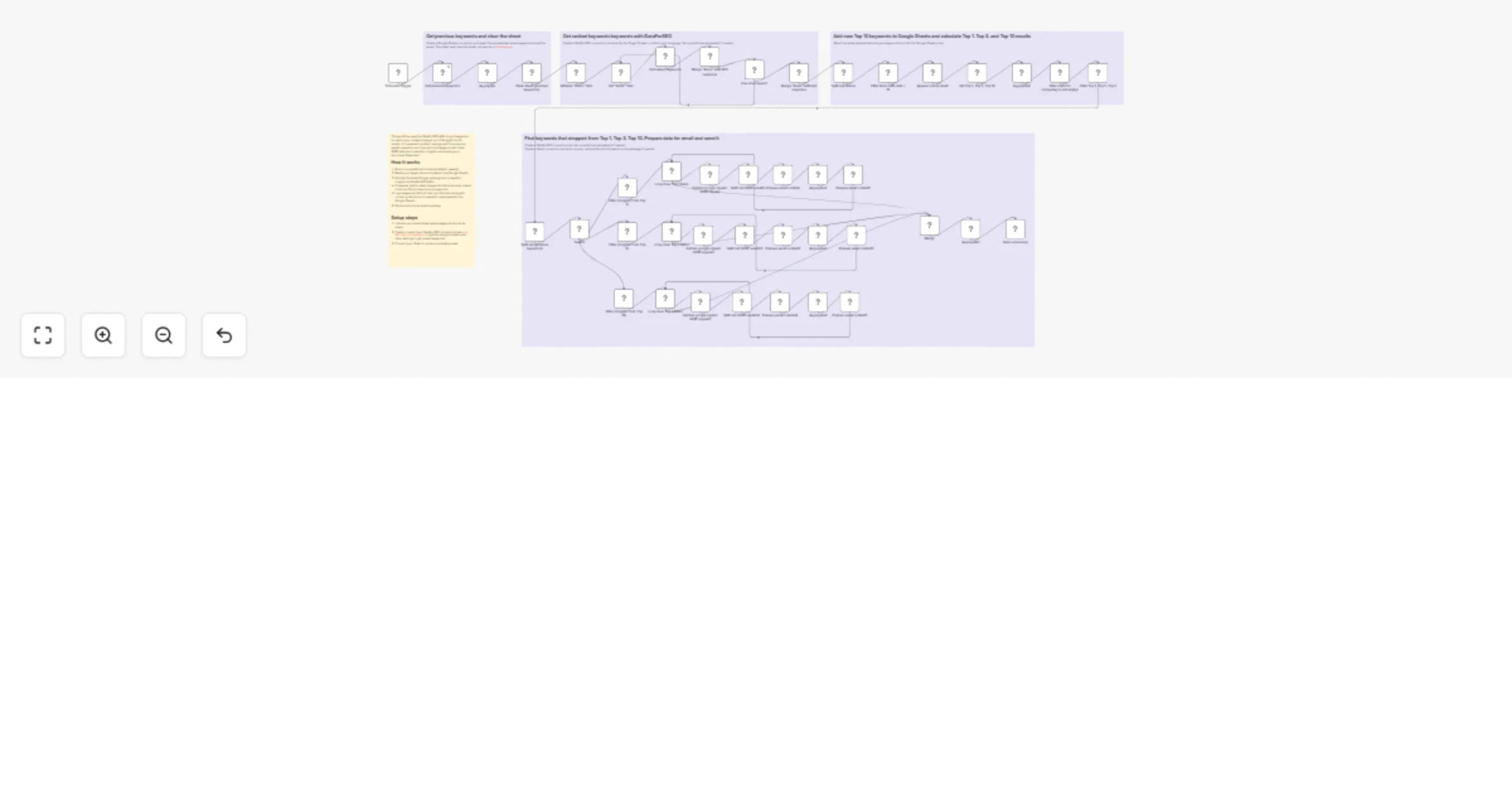
Workflow preview
100%
Get Gmail alerts for dropped top 10 keyword rankings with DataForSEO preview
Open on n8n.io

1. Workflow Overview

This weekly workflow helps you stay on top of SEO visibility losses by automatically detecting when your pre...

Best for

  • Market Research automation workflows
  • AI Summarization automation workflows
  • advanced n8n builders looking for reusable templates

Tools used

n8n-nodes-base.scheduletrigger, n8n-nodes-dataforseo.dataforseolabsapi, n8n-nodes-base.aggregate, n8n-nodes-base.googlesheets, n8n-nodes-base.filter, n8n-nodes-base.switch, n8n-nodes-dataforseo.dataforseoserpapi, n8n-nodes-base.merge

Source and attribution

This workflow is cataloged by N8N Workflows and links back to its original n8n.io source page by DataForSEO.

Original n8n.io source

1.1 Workflow description

Title
Get Gmail alerts for dropped top 10 keyword rankings with DataForSEO
Workflow name
Get Gmail alerts for dropped top 10 keyword rankings with DataForSEO

This weekly workflow helps you stay on top of SEO visibility losses by automatically detecting when your previously strong keywords fall out of Google’s top 10 results.

On each run, the workflow pulls your most recent ranking dataset for the selected domain(s) using the DataForSEO Labs API and compares it to the snapshot stored in Google Sheets from the previous run. It then finds keywords that ranked in positions 1–10 before, but are no longer present in the top results.

For every lost keyword (i.e., no longer in the top 10), the workflow adds useful context to speed up troubleshooting: previous position, current rank, and an updated SERP snapshot pulled with the DataForSEO SERP API. Finally, the workflow sends you a Gmail notification with a clean list of dropped keywords and competitor insights, helping you investigate issues and prioritize fixes.

Who’s it for

SEO specialists, marketers, and site owners who want an automated weekly alert when important keywords for their domain(s) lose top-10 visibility on Google.

What it does

This workflow automatically detects when your domain loses important keywords from the top 10 Google results, stores them in Google Sheets, and emails a weekly summary.

How it works

Runs on a predefined schedule (default: weekly). Reads your keywords and target domains from Google Sheets. Fetches the latest Google rankings and competitor insights via DataForSEO APIs. Compares results with previous entries to find keywords that were top-10 and now are not. Logs keywords that lost their top-10 ranks, along with current positions and competitor replacements, into Google Sheets. Sends a Gmail alert with a structured summary.

Requirements

  • DataForSEO account and API credentials
  • Google Sheets table with your keywords, following the required column structure (as in the example).
  • Gmail account

Customization

You can easily customize this workflow by adjusting the run schedule, changing the minimum ranking threshold (e.g., top 5 or top 20), including extra metrics, exporting results to other tools, and tailoring message content or sending an alert to Slack instead of Gmail.

1.2 Logical Blocks

This catalog entry is organized from the workflow JSON. The node-level section below shows the executable blocks available for review before importing the template.

2. Block-by-Block Analysis

Block 1 - Schedule Trigger

Type / Role
n8n-nodes-base.scheduleTrigger - scheduleTrigger
Config choices
Version 1.3

Block 2 - Get ranked keywords

Type / Role
n8n-nodes-dataforseo.dataForSeoLabsApi - dataForSeoLabsApi
Config choices
Version 1

Block 3 - Aggregate

Type / Role
n8n-nodes-base.aggregate - aggregate
Config choices
Version 1

Block 4 - Append row in sheet

Type / Role
n8n-nodes-base.googleSheets - googleSheets
Config choices
Version 4.7

Block 5 - Aggregate1

Type / Role
n8n-nodes-base.aggregate - aggregate
Config choices
Version 1

Block 6 - Filter items with rank > 10

Type / Role
n8n-nodes-base.filter - filter
Config choices
Version 2.3

Block 7 - Switch

Type / Role
n8n-nodes-base.switch - switch
Config choices
Version 3.4

Block 8 - Get live google organic SERP regular

Type / Role
n8n-nodes-dataforseo.dataForSeoSerpApi - dataForSeoSerpApi
Config choices
Version 1

Block 9 - Get live google organic SERP regular1

Type / Role
n8n-nodes-dataforseo.dataForSeoSerpApi - dataForSeoSerpApi
Config choices
Version 1

Block 10 - Get live google organic SERP regular2

Type / Role
n8n-nodes-dataforseo.dataForSeoSerpApi - dataForSeoSerpApi
Config choices
Version 1

Block 11 - Aggregate2

Type / Role
n8n-nodes-base.aggregate - aggregate
Config choices
Version 1

Block 12 - Aggregate3

Type / Role
n8n-nodes-base.aggregate - aggregate
Config choices
Version 1

Block 13 - Aggregate4

Type / Role
n8n-nodes-base.aggregate - aggregate
Config choices
Version 1

Block 14 - Merge

Type / Role
n8n-nodes-base.merge - merge
Config choices
Version 3.2

Block 15 - Aggregate5

Type / Role
n8n-nodes-base.aggregate - aggregate
Config choices
Version 1

Block 16 - Get previous keywords

Type / Role
n8n-nodes-base.googleSheets - googleSheets
Config choices
Version 4.7

Block 17 - Clear sheet (previous keywords)

Type / Role
n8n-nodes-base.googleSheets - googleSheets
Config choices
Version 4.7

Block 18 - Sticky Note

Type / Role
n8n-nodes-base.stickyNote - stickyNote
Config choices
Version 1

Block 19 - Sticky Note1

Type / Role
n8n-nodes-base.stickyNote - stickyNote
Config choices
Version 1

Block 20 - Sticky Note3

Type / Role
n8n-nodes-base.stickyNote - stickyNote
Config choices
Version 1

Block 21 - Sticky Note4

Type / Role
n8n-nodes-base.stickyNote - stickyNote
Config choices
Version 1

Block 22 - Sticky Note5

Type / Role
n8n-nodes-base.stickyNote - stickyNote
Config choices
Version 1

Block 23 - Initialize "items" field

Type / Role
n8n-nodes-base.set - set
Config choices
Version 3.4

Block 24 - Set "items" field

Type / Role
n8n-nodes-base.set - set
Config choices
Version 3.4

Showing the first 24 of 48 workflow blocks. Download the JSON for the full node graph.

3. Summary Table

Workflow Get Gmail alerts for dropped top 10 keyword rankings with DataForSEO
Complexity advanced
Nodes 48
Categories Market Research, AI Summarization
Author DataForSEO
Published 20 Feb 2026

4. Reproducing the Workflow from Scratch

  1. 1. Download the workflow JSON

    Use the JSON export at /data/workflows/13537/13537.json as the source template for this automation.

  2. 2. Import the template into n8n

    Open n8n, import the downloaded JSON, and review each node before activating the workflow.

  3. 3. Configure credentials and variables

    Replace placeholder credentials, API keys, webhook URLs, account IDs, and environment-specific values with your own settings.

  4. 4. Test with sample data

    Run the workflow manually or in a staging workspace, inspect node output, and confirm downstream systems receive the expected data.

  5. 5. Activate and monitor

    Enable the workflow only after testing, then monitor executions, errors, and rate limits during the first production runs.

5. General Notes & Resources

Review imported nodes carefully before activation. This catalog entry is intended to help you inspect the workflow structure, understand required services, and find related templates faster.

Node names, credentials, schedules, webhook paths, and external service limits may need adjustment for your workspace.

Frequently asked questions

What does Get Gmail alerts for dropped top 10 keyword rankings with DataForSEO do?

This weekly workflow helps you stay on top of SEO visibility losses by automatically detecting when your pre...

What do I need before importing this workflow?

Review the workflow JSON, configure any required credentials in n8n, and test the automation in a safe workspace before using it in production.

Can I customize this workflow?

Yes. Use the block-by-block analysis and the downloadable JSON to inspect each node, then adjust credentials, prompts, schedules, filters, or destinations for your Market Research, AI Summarization use case.



