Block 1 - HTTP Request
- Type / Role
- n8n-nodes-base.httpRequest - httpRequest
- Config choices
- Version 4.3
How it works: This workflow fetches sent campaign data from Brevo on a schedule, calculates key metrics (open rate, click rate, bounce rate), and stores results in Google Sheets. It then filters to...
n8n-nodes-base.httprequest, n8n-nodes-base.googlesheets, @n8n/n8n-nodes-langchain.agent, @n8n/n8n-nodes-langchain.lmchatgroq, n8n-nodes-base.set, n8n-nodes-base.gmail, n8n-nodes-base.aggregate, n8n-nodes-base.code
This workflow is cataloged by N8N Workflows and links back to its original n8n.io source page by Avkash Kakdiya.
Original n8n.io sourceHow it works:
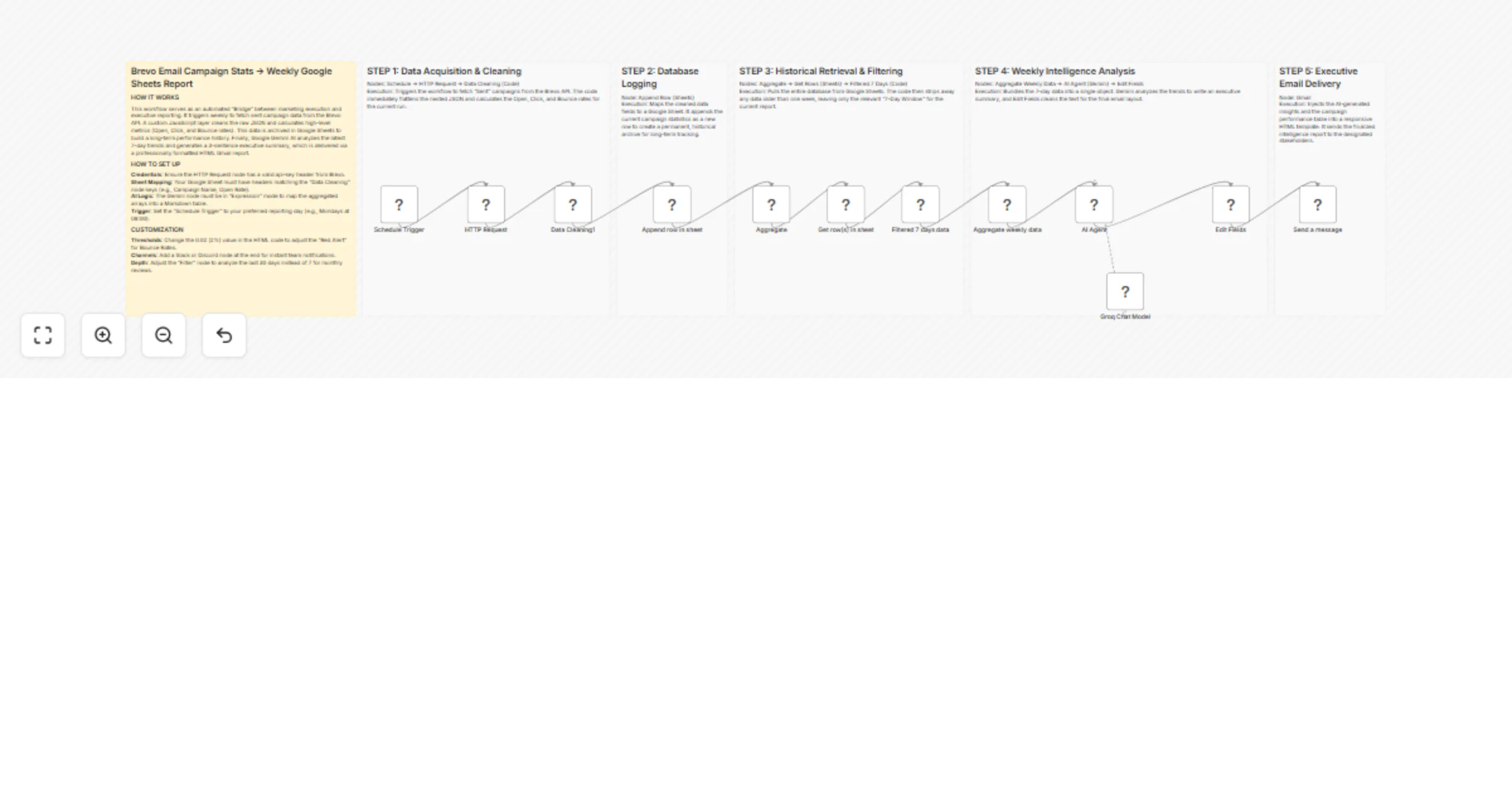
This workflow fetches sent campaign data from Brevo on a schedule, calculates key metrics (open rate, click rate, bounce rate), and stores results in Google Sheets. It then filters to a rolling 7-day window, runs an AI analysis to generate an executive summary with performance highlights and recommendations, and delivers a structured HTML report by email to stakeholders.
Step-by-step:
Data collection
Schedule Trigger – Fires the workflow on your chosen day and time.
HTTP Request (Brevo) – Fetches sent campaign data via the Brevo API.
Transform Data – Calculates open rate, click rate, and bounce rate per campaign.
Write to Google Sheets – Appends processed results to the historical database.
Data preparation
Read from Google Sheets – Retrieves the latest stored campaign records.
Filter to 7-day window – Narrows data to the last 7 days for trend analysis.
Aggregate Results – Summarises campaign performance across the window.
AI analysis
AI Summary Engine – Evaluates trends and generates an executive summary.
LLM (Groq or alternative) – Provides the AI model for analysis.
Format AI Output – Structures the summary for use in the report.
Report delivery
Build HTML Report – Compiles metrics, highlights, and recommendations into a styled email.
Send via Gmail – Delivers the final report to stakeholder recipients.
Why use this?
This catalog entry is organized from the workflow JSON. The node-level section below shows the executable blocks available for review before importing the template.
| Workflow | Generate weekly Brevo campaign analytics reports with Groq and Google Sheets |
|---|---|
| Complexity | advanced |
| Nodes | 18 |
| Categories | Social Media, AI Summarization |
| Author | Avkash Kakdiya |
| Published | 03 Apr 2026 |
Use the JSON export at /data/workflows/14671/14671.json as the source template for this automation.
Open n8n, import the downloaded JSON, and review each node before activating the workflow.
Replace placeholder credentials, API keys, webhook URLs, account IDs, and environment-specific values with your own settings.
Run the workflow manually or in a staging workspace, inspect node output, and confirm downstream systems receive the expected data.
Enable the workflow only after testing, then monitor executions, errors, and rate limits during the first production runs.
Review imported nodes carefully before activation. This catalog entry is intended to help you inspect the workflow structure, understand required services, and find related templates faster.
Node names, credentials, schedules, webhook paths, and external service limits may need adjustment for your workspace.
How it works: This workflow fetches sent campaign data from Brevo on a schedule, calculates key metrics (open rate, click rate, bounce rate), and stores results in Google Sheets. It then filters to...
Review the workflow JSON, configure any required credentials in n8n, and test the automation in a safe workspace before using it in production.
Yes. Use the block-by-block analysis and the downloadable JSON to inspect each node, then adjust credentials, prompts, schedules, filters, or destinations for your Social Media, AI Summarization use case.