Generate Upwork SEO proposals with GPT-4, DeepSeek, Claude and Google Docs
Workflow preview


 Early Deal
DISCOUNT 20%

Overview
Description
Automatically analyze Upwork SEO job posts, detect hidden screening questions, generate personalized cover letters with portfolio examples using GPT-4 Turbo, DeepSeek & Claude AI — all saved to Google Docs instantly.
Auto-Generate Winning Upwork SEO Proposals with GPT-4, DeepSeek & Claude AI
Automate the entire Upwork proposal process — from analyzing a job post and detecting hidden screening questions, to generating a personalized cover letter backed by your real portfolio data, running it through a 10-point quality check, and saving the final polished version to Google Docs — all without writing a single word manually.
Perfect for SEO freelancers, agencies, and Upwork consultants who want to send high-quality, personalized proposals at scale without spending 45–60 minutes on each one.
What This Workflow Does
This automation handles five key tasks:
Analyzes job posts — GPT-4 Turbo extracts structured job data including title, industry, client history, budget, required skills, and client's SEO pain points from raw Upwork job text
Detects hidden screening questions — Automatically identifies and highlights any hidden verification tests clients embed in job descriptions (e.g., "Start your proposal with the word Avocado"), which most freelancers miss
Generates cover letters with portfolio proof — DeepSeek writes a 150–250 word personalized cover letter, then pulls relevant ranking keyword examples and industry case studies from your Pinecone vector database to add real proof
Runs a 10-point quality check — Another DeepSeek agent evaluates the cover against a strict checklist and flags only the missing or weak elements for improvement
Polishes and saves to Google Docs — Claude 3.7 Sonnet applies QC feedback with minimal changes and saves both the final cover letter and screening Q&A answers to your Google Doc, ready to copy-paste
How It Works
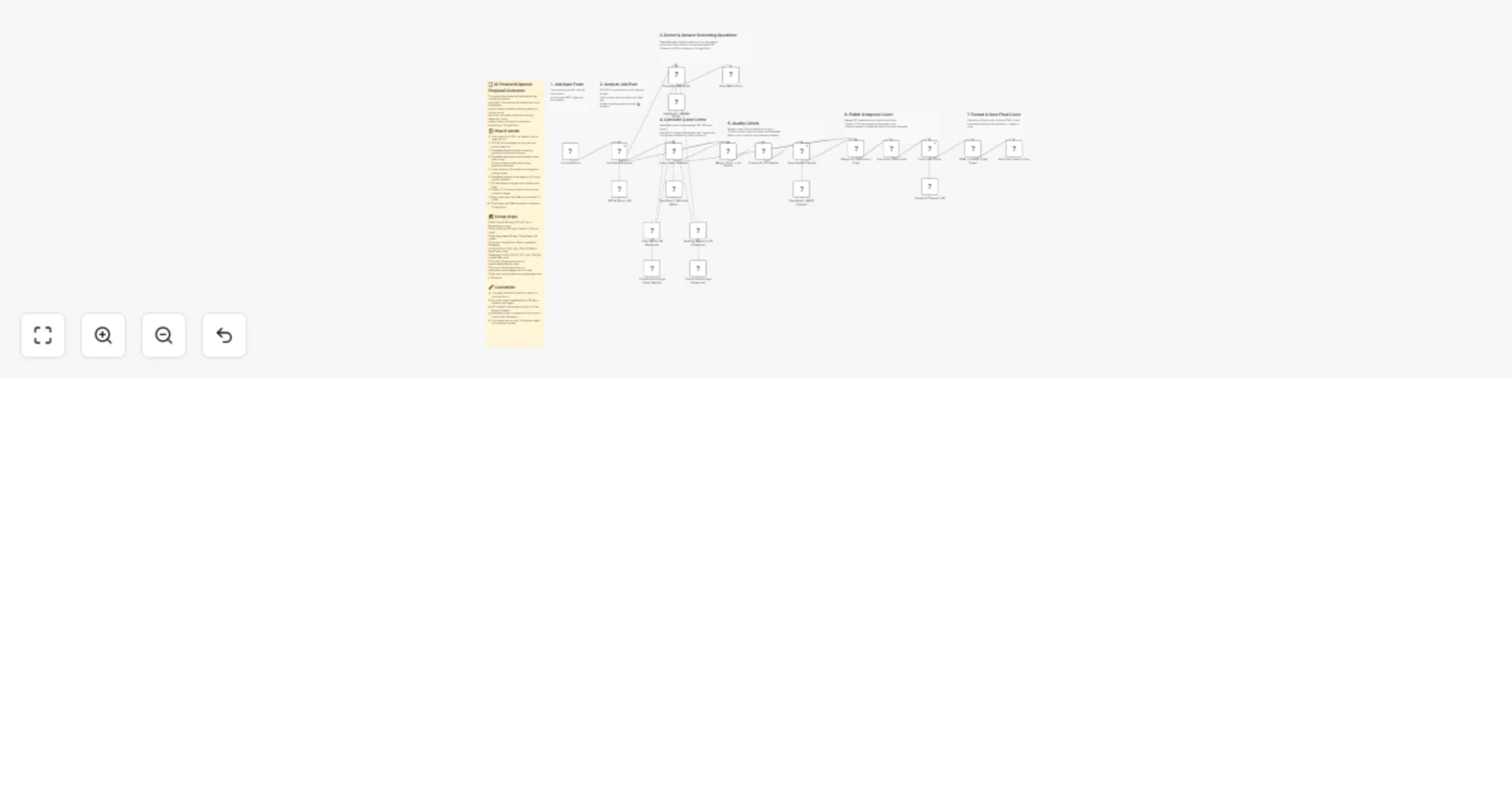
The workflow begins when you submit a job through a simple form — paste the Upwork job URL, copy-paste the raw job post text, and select the job type (SEO, Agency, or Automation).
GPT-4 Turbo analyzes the job post and outputs a fully structured breakdown: job title, industry focus, primary SEO problems, client's current SEO status, required skills, client history patterns, and strategic notes. It also detects any hidden screening questions and marks them prominently with ⚠️ ATTENTION markers.
Once analysis is complete, the workflow splits into three parallel branches that run simultaneously:
Branch A — Screening Q&A Writer: DeepSeek reads the detected screening questions and writes direct, concise answers (under 200 words each). It pulls up to 3 relevant examples from your Pinecone databases when helpful. The answers are formatted in clean HTML and saved immediately to your Google Doc.
Branch B — Cover Letter Generator: DeepSeek generates a personalized 150–250 word cover letter that mirrors the client's exact language, tone, and terminology. It searches your Pinecone vector databases — one holding case studies with Google Doc URLs, one holding portfolio websites with their ranking keywords — and adds 2 portfolio examples plus 1 industry-matched case study in a structured format. All URLs are validated to ensure no angle brackets or broken formatting.
Both the job analysis output and the generated cover then flow into the Quality Control pipeline. A Merge node combines them, an Aggregate node bundles everything into a single input, and DeepSeek's Cover Quality Checker evaluates the proposal against a 10-point checklist covering client name, job terminology, opening strength, keyword usage, industry relevance, skills match, process outline, and call to action. It outputs only the specific changes needed.
Finally, the QC feedback and original cover are merged again and passed to Claude 3.7 Sonnet for the final polish. Claude applies the suggestions with minimal edits — preserving the client's vocabulary and tone — formats the output in clean HTML, and the workflow saves it to your Google Doc. A 1-minute read-ready cover letter, complete with real portfolio proof, is waiting for you.
Setup Requirements
Accounts needed:
- n8n instance (self-hosted or cloud)
- OpenAI account with GPT-4 Turbo API access (for Job Analysis + Embeddings)
- DeepSeek account with API access (for Cover Writing, Q&A, and QC)
- Anthropic API key for Claude 3.7 Sonnet (for Final Polish)
- Pinecone account with two indexes:
casestudiesdatabaseandwebsitewithrankingkeywords-v2 - Google account with Google Docs access
Estimated setup time: 15–20 minutes
Setup Steps
1. Import Workflow
Copy the workflow JSON Open n8n → Workflows → Import from JSON Paste and import Verify all nodes are properly connected across the three parallel branches
2. Configure OpenAI (GPT-4 Turbo + Embeddings)
Add OpenAI API credential in n8n Enter your API key Credential is used by three nodes: GPT-4 Turbo LLM (Job Analyzer), OpenAI Embeddings (Case Studies), and OpenAI Embeddings (Keywords) Test the connection before proceeding
3. Configure DeepSeek
Add DeepSeek API credential in n8n Enter your DeepSeek API key Credential is used by three nodes: DeepSeek LLM (Cover Writer), DeepSeek LLM (Q&A Writer), and DeepSeek LLM (QC Checker) Test the connection
4. Configure Anthropic (Claude 3.7 Sonnet)
Add Anthropic API credential in n8n
Enter your Anthropic API key
Model is set to claude-3-7-sonnet-20250219
Credential is used by: Claude 3.7 Sonnet LLM (Final Cover Polish node)
Test the connection
5. Set Up Pinecone Vector Databases
Create two Pinecone indexes: casestudiesdatabase and websitewithrankingkeywords-v2
Add your Pinecone API credential in n8n
Case Studies DB: Upload your industry case studies with Google Doc URLs — do NOT modify these URLs or the links will break
Ranking Keywords DB: Upload your portfolio websites with their ranking keywords (the workflow retrieves top 20 results per query)
Verify both indexes appear in the Case Studies DB (Pinecone) and Ranking Keywords DB (Pinecone) nodes
6. Connect Google Docs
Create two Google Docs — one for cover letters, one for Q&A answers Add Google Docs OAuth2 credential in n8n and complete the OAuth flow Paste your Cover Letter Google Doc URL in the Save Final Cover to Docs node Paste your Q&A Google Doc URL in the Save Q&A to Docs node Test by triggering the workflow and verifying content appears in both documents
7. Test and Activate
Open the Job Input Form webhook URL in your browser Paste a real Upwork SEO job post text and submit Check execution logs for all three parallel branches Verify your Google Doc shows both the final cover letter and the Q&A answers Activate the workflow once output is confirmed correct
What Gets Analyzed and Generated
From the Upwork job post:
- Job title, industry focus, and niche
- Primary SEO problems the client wants solved
- Client's current SEO status and gaps
- Required skills ranked by importance
- Client country (for regional SEO approach)
- Client hiring history and industry patterns with confidence scores
- Budget and preferred engagement model
- Hidden screening questions (with ⚠️ ATTENTION markers)
- Strategic SEO project type (technical / content / link building)
AI-generated outputs:
- Structured job analysis with industry pattern matching
- 150–250 word personalized cover letter with portfolio examples
- 2 portfolio website examples with 3 ranking keywords each
- 1 industry-matched case study with metrics and Google Doc link
- Direct answers to all screening questions (under 200 words each)
- 10-point QC evaluation with specific improvement suggestions
- Final HTML-formatted cover letter ready to copy-paste
Use Cases
High-volume Upwork freelancers: Send 5–10 personalized, data-backed proposals daily without manual writing — each one tailored to the client's exact industry and pain points
SEO agencies on Upwork: Scale proposal output across multiple team members using a shared workflow — everyone gets consistent, on-brand proposals
New Upwork SEO freelancers: Never miss a hidden screening question again and always include relevant portfolio proof that matches the client's industry
Freelance business automation: Eliminate the most time-consuming part of freelancing — proposal writing — and redirect that time to client work
Important Notes
Replace all placeholder API keys and credential IDs before activating the workflow Ensure all five credential types are tested successfully: OpenAI, DeepSeek, Anthropic, Pinecone, and Google Docs Case study Google Doc URLs in Pinecone must never be modified — the workflow uses them as-is The Pinecone databases must be populated with your own portfolio data before the workflow produces accurate examples DeepSeek handles the majority of AI tasks for cost efficiency; Claude 3.7 Sonnet is used only for the final polish step Each job submission generates one complete proposal set (cover letter + Q&A) in your Google Doc Processing time is typically 60–120 seconds depending on Pinecone retrieval speed and AI response time
Form Access
Access the workflow via the built-in n8n form at:
https://your-n8n-instance.com/webhook/upwork-proposal-generator
Paste any Upwork job post text and submit to start the automation instantly.
Support
For questions or assistance:
Email: [email protected] Contact: https://www.incrementors.com/contact-us/