
Generate production database schemas from Excel and CSV with OpenAI and LangChain

Workflow preview
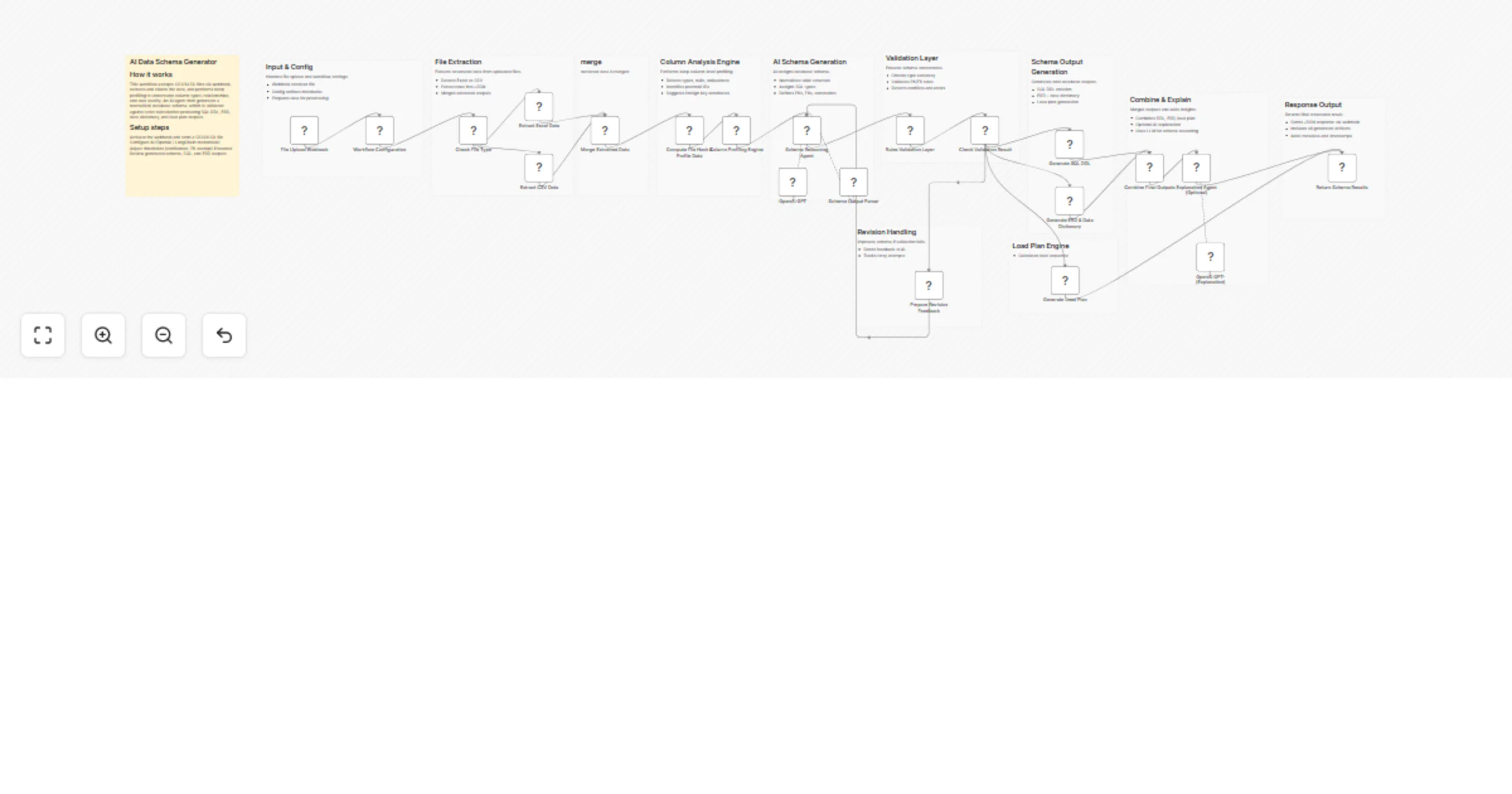
Workflow preview
100%
Generate production database schemas from Excel and CSV with OpenAI and LangChain preview
Open on n8n.io

1. Workflow Overview

Overview This workflow automatically converts CSV or Excel files into a production ready database schema using AI and rule based validation. It analyzes uploaded data, detects column types, relatio...

Best for

  • Document Extraction automation workflows
  • AI Summarization automation workflows
  • advanced n8n builders looking for reusable templates

Tools used

n8n-nodes-base.webhook, n8n-nodes-base.set, n8n-nodes-base.if, n8n-nodes-base.extractfromfile, n8n-nodes-base.merge, n8n-nodes-base.code, @n8n/n8n-nodes-langchain.agent, @n8n/n8n-nodes-langchain.outputparserstructured

Source and attribution

This workflow is cataloged by N8N Workflows and links back to its original n8n.io source page by ResilNext.

Original n8n.io source

1.1 Workflow description

Title
Generate production database schemas from Excel and CSV with OpenAI and LangChain
Workflow name
Generate production database schemas from Excel and CSV with OpenAI and LangChain

Overview

This workflow automatically converts CSV or Excel files into a production-ready database schema using AI and rule-based validation.

It analyzes uploaded data, detects column types, relationships, and data quality, then generates a normalized schema. The output includes SQL DDL scripts, ERD diagrams, a data dictionary, and a load plan.

This eliminates manual schema design and accelerates database setup from raw data.


How It Works

  1. File Upload (Webhook)
  • Accepts CSV or XLSX files via webhook endpoint
  • Initializes workflow configuration (thresholds, retry limits)
  1. File Extraction
  • Detects file format (CSV or Excel)
  • Extracts rows into structured JSON
  • Merges extracted datasets
  1. Data Cleaning & Profiling
  • Removes duplicates and normalizes values
  • Detects data types (integer, float, date, boolean, string)
  • Computes column statistics (nulls, uniqueness, distributions)
  • Generates file hash and sample dataset
  1. Column Profiling Engine
  • Identifies potential primary keys
  • Detects cardinality and uniqueness levels
  • Suggests foreign key relationships based on value overlap
  1. AI Schema Generation
  • Uses an AI agent to design normalized tables
  • Assigns SQL data types based on real data
  • Defines primary keys, foreign keys, constraints, and indexes
  1. Validation Layer
  • Ensures schema matches actual data
  • Validates:
  • Data types
  • Primary key uniqueness
  • Foreign key overlap (>70%)
  • Constraint consistency
  • Detects circular dependencies
  1. Revision Loop
  • If validation fails:
  • Sends feedback to AI agent
  • Regenerates schema
  • Retries up to configured limit
  1. Schema Output Generation
  • Generates:
  • SQL DDL scripts
  • ERD (Mermaid format)
  • Data dictionary
  • Load plan with dependency graph
  1. Load Plan Engine
  • Computes optimal table insertion order
  • Detects circular dependencies
  • Suggests batching strategy
  1. Combine & Explain
  • Merges all outputs
  • Optional AI explanation of schema decisions
  1. Response Output
  • Returns structured JSON via webhook:
  • SQL schema
  • ERD summary
  • Data dictionary
  • Load plan
  • Optional explanation

Setup Instructions

  1. Activate the workflow and copy the webhook URL
  2. Send a POST request with a CSV or XLSX file
  3. Configure OpenAI credentials (used by AI agent)
  4. Adjust thresholds if needed (FK overlap, retries, confidence)
  5. Execute workflow and review generated outputs

Use Cases

  • Auto-generate database schema from CSV/Excel files
  • Data migration and onboarding pipelines
  • Rapid database prototyping
  • Reverse engineering datasets
  • AI-assisted data modeling

Requirements

  • n8n (latest version recommended)
  • OpenAI API credentials
  • LangChain nodes enabled
  • CSV or XLSX input file

1.2 Logical Blocks

This catalog entry is organized from the workflow JSON. The node-level section below shows the executable blocks available for review before importing the template.

2. Block-by-Block Analysis

Block 1 - File Upload Webhook

Type / Role
n8n-nodes-base.webhook - webhook
Config choices
Version 2.1

Block 2 - Workflow Configuration

Type / Role
n8n-nodes-base.set - set
Config choices
Version 3.4

Block 3 - Check File Type

Type / Role
n8n-nodes-base.if - if
Config choices
Version 2.3

Block 4 - Extract Excel Data

Type / Role
n8n-nodes-base.extractFromFile - extractFromFile
Config choices
Version 1.1

Block 5 - Extract CSV Data

Type / Role
n8n-nodes-base.extractFromFile - extractFromFile
Config choices
Version 1.1

Block 6 - Merge Extracted Data

Type / Role
n8n-nodes-base.merge - merge
Config choices
Version 3.2

Block 7 - Compute File Hash & Profile Data

Type / Role
n8n-nodes-base.code - code
Config choices
Version 2

Block 8 - Column Profiling Engine

Type / Role
n8n-nodes-base.code - code
Config choices
Version 2

Block 9 - Schema Reasoning Agent

Type / Role
@n8n/n8n-nodes-langchain.agent - agent
Config choices
Version 3

Block 10 - Schema Output Parser

Type / Role
@n8n/n8n-nodes-langchain.outputParserStructured - outputParserStructured
Config choices
Version 1.3

Block 11 - Rules Validation Layer

Type / Role
n8n-nodes-base.code - code
Config choices
Version 2

Block 12 - Check Validation Result

Type / Role
n8n-nodes-base.if - if
Config choices
Version 2.3

Block 13 - Prepare Revision Feedback

Type / Role
n8n-nodes-base.set - set
Config choices
Version 3.4

Block 14 - Generate SQL DDL

Type / Role
n8n-nodes-base.code - code
Config choices
Version 2

Block 15 - Generate ERD & Data Dictionary

Type / Role
n8n-nodes-base.code - code
Config choices
Version 2

Block 16 - Generate Load Plan

Type / Role
n8n-nodes-base.code - code
Config choices
Version 2

Block 17 - Combine Final Outputs

Type / Role
n8n-nodes-base.merge - merge
Config choices
Version 3.2

Block 18 - Explanation Agent (Optional)

Type / Role
@n8n/n8n-nodes-langchain.agent - agent
Config choices
Version 3

Block 19 - Return Schema Results

Type / Role
n8n-nodes-base.respondToWebhook - respondToWebhook
Config choices
Version 1.5

Block 20 - Sticky Note

Type / Role
n8n-nodes-base.stickyNote - stickyNote
Config choices
Version 1

Block 21 - Sticky Note1

Type / Role
n8n-nodes-base.stickyNote - stickyNote
Config choices
Version 1

Block 22 - Sticky Note3

Type / Role
n8n-nodes-base.stickyNote - stickyNote
Config choices
Version 1

Block 23 - Sticky Note5

Type / Role
n8n-nodes-base.stickyNote - stickyNote
Config choices
Version 1

Block 24 - Sticky Note6

Type / Role
n8n-nodes-base.stickyNote - stickyNote
Config choices
Version 1

Showing the first 24 of 33 workflow blocks. Download the JSON for the full node graph.

3. Summary Table

Workflow Generate production database schemas from Excel and CSV with OpenAI and LangChain
Complexity advanced
Nodes 33
Categories Document Extraction, AI Summarization
Author ResilNext
Published 25 Mar 2026

4. Reproducing the Workflow from Scratch

  1. 1. Download the workflow JSON

    Use the JSON export at /data/workflows/14317/14317.json as the source template for this automation.

  2. 2. Import the template into n8n

    Open n8n, import the downloaded JSON, and review each node before activating the workflow.

  3. 3. Configure credentials and variables

    Replace placeholder credentials, API keys, webhook URLs, account IDs, and environment-specific values with your own settings.

  4. 4. Test with sample data

    Run the workflow manually or in a staging workspace, inspect node output, and confirm downstream systems receive the expected data.

  5. 5. Activate and monitor

    Enable the workflow only after testing, then monitor executions, errors, and rate limits during the first production runs.

5. General Notes & Resources

Review imported nodes carefully before activation. This catalog entry is intended to help you inspect the workflow structure, understand required services, and find related templates faster.

Node names, credentials, schedules, webhook paths, and external service limits may need adjustment for your workspace.

Frequently asked questions

What does Generate production database schemas from Excel and CSV with OpenAI and LangChain do?

Overview This workflow automatically converts CSV or Excel files into a production ready database schema using AI and rule based validation. It analyzes uploaded data, detects column types, relatio...

What do I need before importing this workflow?

Review the workflow JSON, configure any required credentials in n8n, and test the automation in a safe workspace before using it in production.

Can I customize this workflow?

Yes. Use the block-by-block analysis and the downloadable JSON to inspect each node, then adjust credentials, prompts, schedules, filters, or destinations for your Document Extraction, AI Summarization use case.



