Generate multi-channel release notes from ClickUp tasks with GPT-4o, Notion & Slack
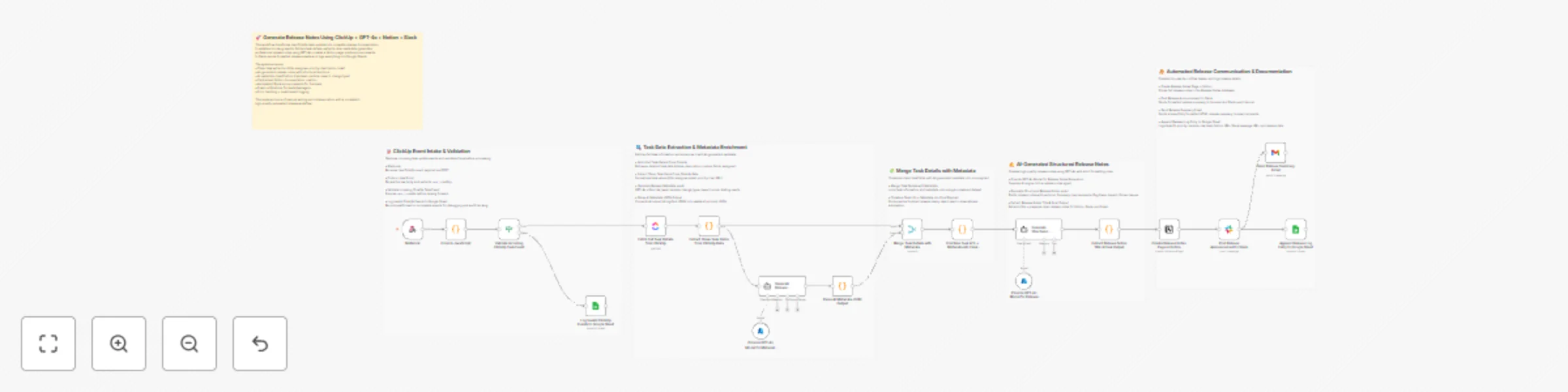
Workflow preview


 Early Deal
DISCOUNT 20%

Important notice
This workflow is provided as-is. Please review and test before using in production.
Overview
This workflow converts raw ClickUp task updates—received directly through a webhook—into fully automated release documentation. It validates incoming payloads, fetches and cleans task details, enriches them with AI-generated metadata, produces structured release notes using GPT-4o, publishes them to Notion, notifies stakeholders on Slack, emails a formatted summary, and logs the release into Google Sheets. The system handles malformed events gracefully by logging invalid payloads and continues only when a valid task_id is present. It extracts structured fields (title, description, links, priority, assignee), then augments them with AI-driven classifications such as risk level, change type, module, and impact score. GPT-4o generates polished release notes following a strict template. Finally, the workflow distributes the release across multiple channels while maintaining an auditable, centralized history.
⚙️ What This Workflow Does (Step-by-Step)
🟢 Webhook — Receive ClickUp Task Update Captures incoming events from ClickUp via POST and forwards the raw body for parsing.
🧹 Code in JavaScript — Extract task_id Parses the raw webhook body and safely extracts task_id. Invalid JSON → forwarded to error logging.
🔍 Validate Incoming ClickUp Task Event Checks if task_id exists. Valid → continue workflow Invalid → log error to Google Sheets
📄 Fetch Full Task Details from ClickUp Retrieves full task metadata: title, description, status, priority, links, assignee details, and due date.
🧩 Extract Clean Task Fields from ClickUp Data Normalizes and structures the task fields into a clean, usable JSON object.
🧠 Provide GPT-4o Model for Metadata Extraction Loads the language model for metadata generation.
🔍 Generate Release Metadata via AI AI generates structured metadata including: • risk_level • change_type • module • impact_score • requires_testing
🧹 Parse AI Metadata JSON Output Parses stringified JSON from the AI node into valid structured JSON. Malformed metadata → returned as an error object.
🔀 Merge Task Details with Metadata Combines clean task fields with AI-generated metadata into a complete release-ready object.
🧠 Provide GPT-4o Model for Release Notes Supplies the language model needed to generate formal release notes.
✍️ Generate Structured Release Notes via AI Produces uniform release notes containing: • Summary • Improvements & Features • Bug Fixes • Impact Analysis • Known Issues
📝 Extract Release Notes Title & Final Output Extracts title from markdown and prepares final content for publishing.
📘 Create Release Notes Page in Notion Saves the release notes as a new page in the Notion Release Notes database.
💬 Post Release Announcement to Slack Sends formatted release notes + Notion link to the specified Slack user/channel.
📧 Send Release Summary Email Sends a structured HTML email with the release summary, full notes, and Notion link.
📊 Append Release Log Entry to Google Sheet Writes a complete release log entry including: • task ID • title • priority • module • risk level • Notion URL • Slack message URL • release date
🛑 Log Invalid ClickUp Events to Google Sheet Stores any invalid or incomplete webhook payload for debugging and auditing.
🧩 Prerequisites
• ClickUp API token • Public webhook endpoint in n8n • Azure OpenAI GPT-4o credentials • Notion API integration • Slack API token • Google Sheets OAuth • Gmail OAuth
💡 Key Benefits
✔ Converts ClickUp updates directly into finished release documentation ✔ AI-powered metadata ensures consistent classification ✔ Instant multi-channel dissemination: Slack + Email + Notion ✔ Automatic logging for audit, QA, and release governance ✔ Eliminates manual writing, formatting, and cross-platform updates
👥 Perfect For
- Product teams running constant sprints
- Engineering teams needing reliable release documentation
- Teams using ClickUp as their primary task manager
- Organizations with multi-channel release communication needs