
Generate AI prompts with Google Gemini and store them in Airtable

Workflow preview
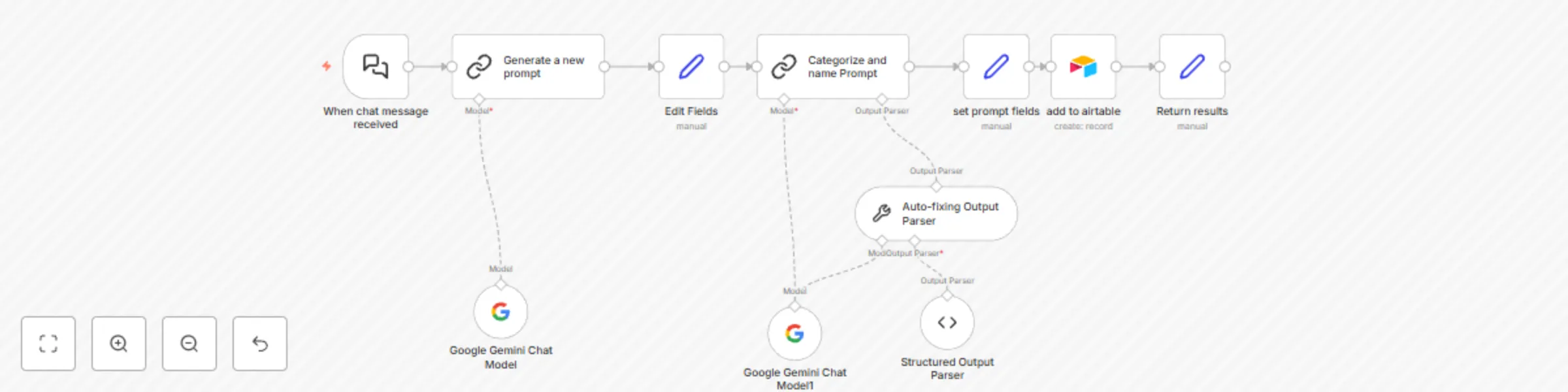
Workflow preview
100%
Generate AI prompts with Google Gemini and store them in Airtable preview
Open on n8n.io

Important notice

This workflow is provided as-is. Please review and test before using in production.

1. Workflow Overview

This workflow is designed to generate prompts for AI agents and store them in Airtable. It starts by receiving a chat message, processes it to create a structured prompt, categorizes the prompt, an...

Best for

  • Engineering automation workflows
  • Multimodal AI automation workflows
  • intermediate n8n builders looking for reusable templates

Tools used

@n8n/n8n-nodes-langchain.chattrigger, @n8n/n8n-nodes-langchain.lmchatgooglegemini, @n8n/n8n-nodes-langchain.outputparserautofixing, @n8n/n8n-nodes-langchain.outputparserstructured, n8n-nodes-base.set, @n8n/n8n-nodes-langchain.chainllm, n8n-nodes-base.airtable

Source and attribution

This workflow is cataloged by N8N Workflows and links back to its original n8n.io source page by Zacharia Kimotho.

Original n8n.io source

1.1 Workflow description

Title
Generate AI prompts with Google Gemini and store them in Airtable
Workflow name
Generate AI prompts with Google Gemini and store them in Airtable

This workflow is designed to generate prompts for AI agents and store them in Airtable.

It starts by receiving a chat message, processes it to create a structured prompt, categorizes the prompt, and finally stores it in Airtable.

2. Setup Instructions

Prerequisites

  • AI model eg Gemini, openAI etc
  • Airtable base and table or other storage tool

Step-by-Step Guide

  1. Clone the Workflow
  • Copy the provided workflow JSON and import it into your n8n instance.
  1. Configure Credentials
  • Set up the Google Gemini(PaLM) API account credentials.
  • Set up the Airtable Personal Access Token account credentials.
  1. Map Airtable Base and Table
  • Create a copy of the Prompt Library in Airtable.
  • Map the Airtable base and table in the Airtable node.
  1. Customize Prompt Template
  • Edit the 'Create prompt' node to customize the prompt template as needed.

Configuration Options

  • Prompt Template: Customize the prompt template in the 'Create prompt' node to fit your specific use case.
  • Airtable Mapping: Ensure the Airtable base and table are correctly mapped in the Airtable node.

4. Running and Troubleshooting

Running the Workflow

  1. Trigger the Workflow: Send a chat message to trigger the workflow.
  2. Monitor Execution: Use the n8n interface to monitor the workflow execution.
  3. Check Completion: Verify that the prompt is stored in Airtable and check the chat interface for the result.

Troubleshooting Tips

  • API Issues: Ensure that the APIs and Airtable credentials are correctly configured.
  • Data Mapping: Verify that the Airtable base and table are correctly mapped.
  • Prompt Template: Check the prompt template for any errors or inconsistencies.
  1. Use Case Examples

This workflow is particularly useful in scenarios where you want to automate the generation and management of AI agent prompts.

Here are some examples:

Rapid Prototyping of AI Agents:

Quickly generate and test different prompts for AI agents in various applications.

  • Content Creation: Generate prompts for AI models that create blog posts, articles, or social media content.
  • Customer Service Automation: Develop prompts for AI-powered chatbots to handle customer inquiries and support requests.
  • Educational Tools: Create prompts for AI tutors or learning assistants.

Industries/Professionals:

  • Software Development: Developers building AI-powered applications.

  • Marketing: Marketers automating content creation and social media management.

  • Customer Service: Customer service managers implementing AI-driven chatbots.

  • Education: Educators creating AI-based learning tools.

Practical Value:

  • Time Savings: Automates the prompt generation process, saving significant time and effort.

  • Improved Prompt Quality: Leverages Google Gemini and structured prompt engineering principles to generate more effective prompts.

  • Centralized Prompt Management: Stores prompts in Airtable for easy access, organization, and reuse.

4. Running and Troubleshooting

  • Running the Workflow:
  1. Activate the workflow in n8n.
  2. Send a chat message to the webhook URL configured in the "When chat message received" node.
  3. Monitor the workflow execution in the n8n editor.
  • Monitoring Execution:

  • Check the execution log in n8n to see the data flowing through each node and identify any errors.

  • Checking for Successful Completion:

  • Verify that a new record is created in your Airtable base with the generated prompt, name, and category.

  • Confirm that the "Return results" node sends back confirmation of the prompt in the chat interface.

  • Troubleshooting Tips:

  • Error: 400: Bad Request in the Google Gemini nodes:

  • Cause: Invalid API key or insufficient permissions.

  • Solution: Double-check your Google Gemini API key and ensure that the API is enabled for your project.

  • Error: Airtable node fails to create a record:

  • Cause: Invalid Airtable credentials, incorrect Base ID or Table ID, or mismatched column names.

  • Solution: Verify your Airtable API key, Base ID, Table ID, and column names. Ensure that the data types in n8n match the data types in your Airtable columns.

Follow me on Linkedin for more

1.2 Logical Blocks

This catalog entry is organized from the workflow JSON. The node-level section below shows the executable blocks available for review before importing the template.

2. Block-by-Block Analysis

Block 1 - When chat message received

Type / Role
@n8n/n8n-nodes-langchain.chatTrigger - chatTrigger
Config choices
Version 1.1

Block 2 - Google Gemini Chat Model

Type / Role
@n8n/n8n-nodes-langchain.lmChatGoogleGemini - lmChatGoogleGemini
Config choices
Version 1

Block 3 - Auto-fixing Output Parser

Type / Role
@n8n/n8n-nodes-langchain.outputParserAutofixing - outputParserAutofixing
Config choices
Version 1

Block 4 - Structured Output Parser

Type / Role
@n8n/n8n-nodes-langchain.outputParserStructured - outputParserStructured
Config choices
Version 1.2

Block 5 - Edit Fields

Type / Role
n8n-nodes-base.set - set
Config choices
Version 3.4

Block 6 - Google Gemini Chat Model1

Type / Role
@n8n/n8n-nodes-langchain.lmChatGoogleGemini - lmChatGoogleGemini
Config choices
Version 1

Block 7 - Return results

Type / Role
n8n-nodes-base.set - set
Config choices
Version 3.4

Block 8 - Categorize and name Prompt

Type / Role
@n8n/n8n-nodes-langchain.chainLlm - chainLlm
Config choices
Version 1.5

Block 9 - set prompt fields

Type / Role
n8n-nodes-base.set - set
Config choices
Version 3.4

Block 10 - add to airtable

Type / Role
n8n-nodes-base.airtable - airtable
Config choices
Version 2.1

Block 11 - Generate a new prompt

Type / Role
@n8n/n8n-nodes-langchain.chainLlm - chainLlm
Config choices
Version 1.5

3. Summary Table

Workflow Generate AI prompts with Google Gemini and store them in Airtable
Complexity intermediate
Nodes 11
Categories Engineering, Multimodal AI
Author Zacharia Kimotho
Published 27 Feb 2025

4. Reproducing the Workflow from Scratch

  1. 1. Download the workflow JSON

    Use the JSON export at /data/workflows/3027/3027.json as the source template for this automation.

  2. 2. Import the template into n8n

    Open n8n, import the downloaded JSON, and review each node before activating the workflow.

  3. 3. Configure credentials and variables

    Replace placeholder credentials, API keys, webhook URLs, account IDs, and environment-specific values with your own settings.

  4. 4. Test with sample data

    Run the workflow manually or in a staging workspace, inspect node output, and confirm downstream systems receive the expected data.

  5. 5. Activate and monitor

    Enable the workflow only after testing, then monitor executions, errors, and rate limits during the first production runs.

5. General Notes & Resources

Review imported nodes carefully before activation. This catalog entry is intended to help you inspect the workflow structure, understand required services, and find related templates faster.

Node names, credentials, schedules, webhook paths, and external service limits may need adjustment for your workspace.

Frequently asked questions

What does Generate AI prompts with Google Gemini and store them in Airtable do?

This workflow is designed to generate prompts for AI agents and store them in Airtable. It starts by receiving a chat message, processes it to create a structured prompt, categorizes the prompt, an...

What do I need before importing this workflow?

Review the workflow JSON, configure any required credentials in n8n, and test the automation in a safe workspace before using it in production.

Can I customize this workflow?

Yes. Use the block-by-block analysis and the downloadable JSON to inspect each node, then adjust credentials, prompts, schedules, filters, or destinations for your Engineering, Multimodal AI use case.



