Generate a legal website accessibility statement with AI and WAVE
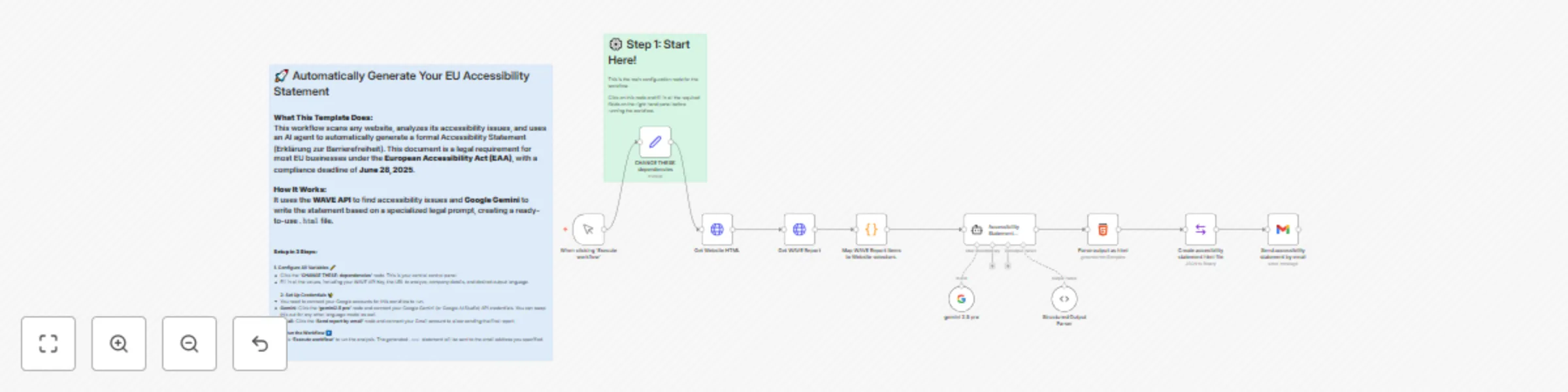
Workflow preview


 Early Deal
DISCOUNT 20%

Important notice
This workflow is provided as-is. Please review and test before using in production.
Overview
Who is this for?
This template is for any website owner, digital agency, or compliance officer operating within the European Union. It's designed for users who need to comply with the upcoming European Accessibility Act (EAA) but may not have deep technical or legal expertise.
Disclaimer
This workflow uses an npm package called "cheerio" to work with the specified URLs HTML code. Installing packages is only possible in self hosting.
What problem is this workflow solving? / Use Case
Starting June 28, 2025, the European Accessibility Act (EAA) mandates that most websites offering products or services in the EU must be accessible and publish a formal Accessibility Statement. Manually creating this legal document is complex, requiring both a technical site analysis and knowledge of specific legal requirements. This workflow automates the generation of a compliant first draft, saving significant time and effort.
What this workflow does
After you input your details (like website URL and API key) in a central configuration node, this workflow automatically:
- Scans your live website for accessibility issues using the powerful WAVE API.
- Processes the scan results to identify the main problem areas.
- Instructs a Google Gemini AI agent with a specialized legal prompt based on the European Accessibility Act.
- Generates a formal Accessibility Statement in your desired language.
- Saves the statement as an
.htmlfile and sends it to you as an email attachment.
Setup
This workflow is designed for a quick setup:
- Configure All Variables: Click the 'CHANGE THESE: dependencies' node. This is your central control panel. Fill in all the values, including your WAVE API Key, the URL to analyze, company details, and desired output language.
- Set Up Credentials: You will need to connect your Google accounts for the workflow to run.
- Gemini: Click the 'gemini 2.5 pro' node, click the gear icon (⚙️) next to the "Credential" field, and connect your Google Gemini API credentials.
- Gmail: Click the 'Send report by email' node and connect your Gmail account to allow sending the final report.
- Activate & Execute: Make sure the workflow is active in the top-right corner, then click 'Execute Workflow' to run your first analysis.
How to customize this workflow to your needs
This template is a great starting point for any EU country. Here's how to adapt it:
- Localize for Your Country (Important!): The generated statement contains a placeholder for the "Enforcement Procedure". You must edit the prompt in the 'Accessibility Statement Generator' node to replace this placeholder with the name and link to your specific country's official enforcement body.
- Change the AI: Swap the Google Gemini node for any other AI model, like OpenAI or Anthropic Claude, by replacing the node and connecting it to the agent.
- Change the Trigger: Replace the 'When clicking ‘Execute workflow’' node with a Form Trigger or Webhook Trigger to run this workflow based on external inputs, for example, to offer this analysis as a service to your clients.