
Find the best favicon from multiple sources with GPT-4 vision analysis

Workflow preview
Workflow preview
100%
Find the best favicon from multiple sources with GPT-4 vision analysis preview
Open on n8n.io

Important notice

This workflow is provided as-is. Please review and test before using in production.

1. Workflow Overview

Who's it for This workflow is perfect for directory site creators, content managers, and developers who need to automatically find and select the highest quality favicon or logo for websites they'r...

Best for

  • Document Extraction automation workflows
  • AI Summarization automation workflows
  • advanced n8n builders looking for reusable templates

Tools used

n8n-nodes-base.executeworkflowtrigger, n8n-nodes-base.httprequest, n8n-nodes-base.merge, @n8n/n8n-nodes-langchain.openai, @n8n/n8n-nodes-langchain.informationextractor, n8n-nodes-base.filter, n8n-nodes-base.set, n8n-nodes-base.code

Source and attribution

This workflow is cataloged by N8N Workflows and links back to its original n8n.io source page by Lucas Walter.

Original n8n.io source

1.1 Workflow description

Title
Find the best favicon from multiple sources with GPT-4 vision analysis
Workflow name
Find the best favicon from multiple sources with GPT-4 vision analysis

Who's it for

This workflow is perfect for directory site creators, content managers, and developers who need to automatically find and select the highest quality favicon or logo for websites they're showcasing. Instead of manually hunting down brand assets or settling for blurry default icons, this workflow does the heavy lifting by fetching multiple options and using AI to pick the best one.

How it works

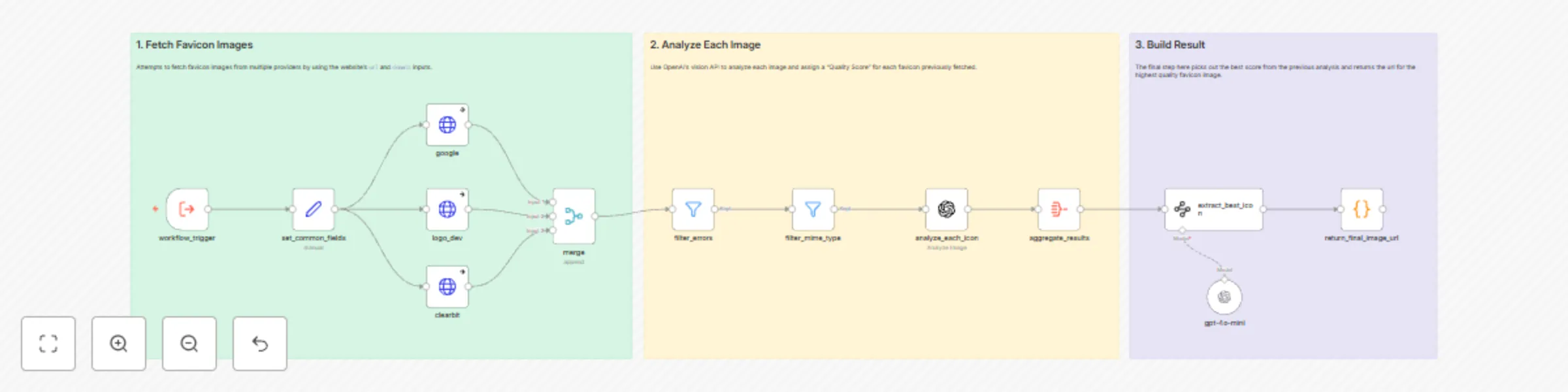
The workflow takes a website URL and domain as input, then intelligently fetches favicon images from three different sources:

  1. Google's Favicon API - Gets the site's actual favicon
  2. Logo.dev - Provides high-quality brand logos
  3. Clearbit - Alternative logo source for business websites

Once all images are collected, the workflow uses OpenAI's vision model to analyze each icon based on:

  • Image quality and resolution (minimum 256x256)
  • Brand authenticity (avoiding generic framework icons)
  • Visual clarity without artifacts or blur
  • Professional presentation suitable for directory listings

The AI assigns quality scores from 0.0 to 1.0, and the workflow automatically returns the URL of the highest-scoring favicon.

Requirements

  • OpenAI API key (for image analysis)
  • Logo.dev API key (free tier available)

How to set up

  1. Configure API credentials:

    • Add your OpenAI API key to n8n credentials
    • Sign up for Logo.dev and add your API token
    • The Clearbit and Google APIs require no authentication
  2. Test the workflow:

    • Use the pinned test data (Fyxer AI example) or replace with your own
    • Ensure all HTTP nodes can successfully fetch images
    • Verify the AI analysis is working by checking the quality scores
  3. Customize input format:

    • Modify the workflow trigger to accept your preferred input format
    • Adjust the domain extraction logic if needed for your use case

How to customize the workflow

For different quality criteria:

  • Edit the AI prompt in the "analyze_each_icon" node to emphasize different aspects (transparency, size, style preferences)

For additional favicon sources:

  • Add more HTTP Request nodes pointing to other favicon/logo APIs
  • Update the merge node to handle additional inputs
  • Modify the final URL construction logic to handle new sources

For batch processing:

  • Wrap this workflow in a loop to process multiple websites at once
  • Add error handling for failed requests or AI analysis timeouts

The workflow is designed to be reliable and handles errors gracefully - if one favicon source fails, it continues with the available options and still provides the best result possible.

1.2 Logical Blocks

This catalog entry is organized from the workflow JSON. The node-level section below shows the executable blocks available for review before importing the template.

2. Block-by-Block Analysis

Block 1 - workflow_trigger

Type / Role
n8n-nodes-base.executeWorkflowTrigger - executeWorkflowTrigger
Config choices
Version 1.1

Block 2 - logo_dev

Type / Role
n8n-nodes-base.httpRequest - httpRequest
Config choices
Version 4.2

Block 3 - google

Type / Role
n8n-nodes-base.httpRequest - httpRequest
Config choices
Version 4.2

Block 4 - merge

Type / Role
n8n-nodes-base.merge - merge
Config choices
Version 3

Block 5 - analyze_each_icon

Type / Role
@n8n/n8n-nodes-langchain.openAi - openAi
Config choices
Version 1.8

Block 6 - extract_best_icon

Type / Role
@n8n/n8n-nodes-langchain.informationExtractor - informationExtractor
Config choices
Version 1

Block 7 - clearbit

Type / Role
n8n-nodes-base.httpRequest - httpRequest
Config choices
Version 4.2

Block 8 - filter_errors

Type / Role
n8n-nodes-base.filter - filter
Config choices
Version 2.2

Block 9 - set_common_fields

Type / Role
n8n-nodes-base.set - set
Config choices
Version 3.4

Block 10 - filter_mime_type

Type / Role
n8n-nodes-base.filter - filter
Config choices
Version 2.2

Block 11 - return_final_image_url

Type / Role
n8n-nodes-base.code - code
Config choices
Version 2

Block 12 - gpt-4o-mini

Type / Role
@n8n/n8n-nodes-langchain.lmChatOpenAi - lmChatOpenAi
Config choices
Version 1.2

Block 13 - Sticky Note

Type / Role
n8n-nodes-base.stickyNote - stickyNote
Config choices
Version 1

Block 14 - Sticky Note1

Type / Role
n8n-nodes-base.stickyNote - stickyNote
Config choices
Version 1

Block 15 - aggregate_results

Type / Role
n8n-nodes-base.aggregate - aggregate
Config choices
Version 1

Block 16 - Sticky Note2

Type / Role
n8n-nodes-base.stickyNote - stickyNote
Config choices
Version 1

3. Summary Table

Workflow Find the best favicon from multiple sources with GPT-4 vision analysis
Complexity advanced
Nodes 16
Categories Document Extraction, AI Summarization
Author Lucas Walter
Published 02 Jul 2025

4. Reproducing the Workflow from Scratch

  1. 1. Download the workflow JSON

    Use the JSON export at /data/workflows/5599/5599.json as the source template for this automation.

  2. 2. Import the template into n8n

    Open n8n, import the downloaded JSON, and review each node before activating the workflow.

  3. 3. Configure credentials and variables

    Replace placeholder credentials, API keys, webhook URLs, account IDs, and environment-specific values with your own settings.

  4. 4. Test with sample data

    Run the workflow manually or in a staging workspace, inspect node output, and confirm downstream systems receive the expected data.

  5. 5. Activate and monitor

    Enable the workflow only after testing, then monitor executions, errors, and rate limits during the first production runs.

5. General Notes & Resources

Review imported nodes carefully before activation. This catalog entry is intended to help you inspect the workflow structure, understand required services, and find related templates faster.

Node names, credentials, schedules, webhook paths, and external service limits may need adjustment for your workspace.

Frequently asked questions

What does Find the best favicon from multiple sources with GPT-4 vision analysis do?

Who's it for This workflow is perfect for directory site creators, content managers, and developers who need to automatically find and select the highest quality favicon or logo for websites they'r...

What do I need before importing this workflow?

Review the workflow JSON, configure any required credentials in n8n, and test the automation in a safe workspace before using it in production.

Can I customize this workflow?

Yes. Use the block-by-block analysis and the downloadable JSON to inspect each node, then adjust credentials, prompts, schedules, filters, or destinations for your Document Extraction, AI Summarization use case.



