Block 1 - Sticky Note
- Type / Role
- n8n-nodes-base.stickyNote - stickyNote
- Config choices
- Version 1
This workflow is provided as-is. Please review and test before using in production.
Jamf Policies Export to Slack Quickly export and review your entire Jamf policy configuration—including triggers, frequencies, and scope—directly in Slack. This enables IT and security teams to ...
n8n-nodes-base.stickynote, n8n-nodes-base.manualtrigger, n8n-nodes-base.splitinbatches, n8n-nodes-base.set, n8n-nodes-base.xml, n8n-nodes-base.webhook, n8n-nodes-base.splitout, n8n-nodes-base.httprequest
This workflow is cataloged by N8N Workflows and links back to its original n8n.io source page by Jean-Marie Rizkallah .
Original n8n.io sourceQuickly export and review your entire Jamf policy configuration—including triggers, frequencies, and scope—directly in Slack. This enables IT and security teams to audit policy setups without logging into Jamf or generating reports manually.
Jamf Pro lacks a straightforward way to quickly review or share a list of all configured policies, including key attributes like frequency, scope, or triggers. Security teams often need this for audit or compliance reviews, but navigating Jamf’s UI or exporting via the API is time-consuming.
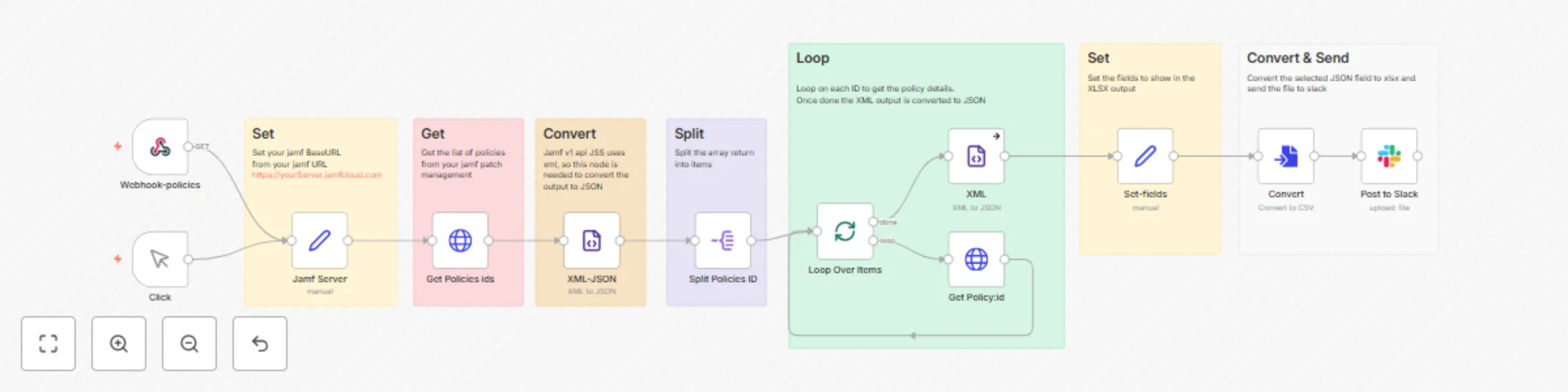
This workflow fetches all policies, extracts the most relevant fields, compiles them into a csv file, and posts that readble file into a designated Slack channel—automatically or on demand.
• A Jamf Pro API key (OAuth2) with read access to policies • A Slack app with permission to post files into your chosen channel
• Manually trigger or use the webhook to initiate the flow • Retrieve all policies from Jamf via the XML API • Convert the XML response into JSON • Split and loop through each policy ID • Retrieve detailed data for each policy • Format relevant fields (ID, name, trigger, scope, etc.) • Convert the final data set into an .csv file • Upload the file to your Slack channel
• Takes ~10 minutes to configure • Set the Jamf BaseURL in the “Jamf Server” node • Configure Jamf OAuth2 credentials in the HTTP Request nodes • Adjust the fields for export in the “Set-fields” node • Set your Slack credentials and target channel in the “Post to Slack” node • Optional: Customize the exported fields or filename
Schedule this flow daily/weekly, or tie it to change events to keep your team informed.
This catalog entry is organized from the workflow JSON. The node-level section below shows the executable blocks available for review before importing the template.
| Workflow | Export Jamf policies to Slack as CSV for instant auditing |
|---|---|
| Complexity | advanced |
| Nodes | 19 |
| Categories | SecOps |
| Author | Jean-Marie Rizkallah |
| Published | 25 Jul 2025 |
Use the JSON export at /data/workflows/6440/6440.json as the source template for this automation.
Open n8n, import the downloaded JSON, and review each node before activating the workflow.
Replace placeholder credentials, API keys, webhook URLs, account IDs, and environment-specific values with your own settings.
Run the workflow manually or in a staging workspace, inspect node output, and confirm downstream systems receive the expected data.
Enable the workflow only after testing, then monitor executions, errors, and rate limits during the first production runs.
Review imported nodes carefully before activation. This catalog entry is intended to help you inspect the workflow structure, understand required services, and find related templates faster.
Node names, credentials, schedules, webhook paths, and external service limits may need adjustment for your workspace.
Jamf Policies Export to Slack Quickly export and review your entire Jamf policy configuration—including triggers, frequencies, and scope—directly in Slack. This enables IT and security teams to ...
Review the workflow JSON, configure any required credentials in n8n, and test the automation in a safe workspace before using it in production.
Yes. Use the block-by-block analysis and the downloadable JSON to inspect each node, then adjust credentials, prompts, schedules, filters, or destinations for your SecOps use case.