
Evaluate tool usage accuracy in multi-agent AI workflows using evaluation nodes

Workflow preview
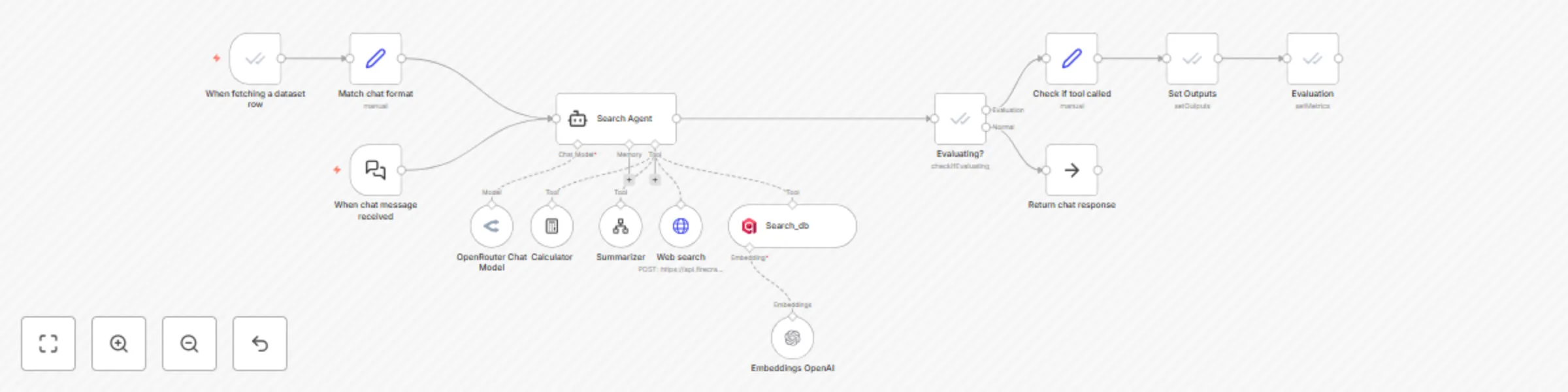
Workflow preview
100%
Evaluate tool usage accuracy in multi-agent AI workflows using evaluation nodes preview
Open on n8n.io

Important notice

This workflow is provided as-is. Please review and test before using in production.

1. Workflow Overview

Who's it for This workflow is ideal for AI developers running multi agent systems in n8n who need to quantitatively evaluate tool usage behavior. If you're building autonomous agents and want to ve...

Best for

  • Engineering automation workflows
  • AI Summarization automation workflows
  • advanced n8n builders looking for reusable templates

Tools used

@n8n/n8n-nodes-langchain.toolcalculator, n8n-nodes-base.set, @n8n/n8n-nodes-langchain.chattrigger, n8n-nodes-base.noop, n8n-nodes-base.evaluationtrigger, n8n-nodes-base.evaluation, @n8n/n8n-nodes-langchain.agent, @n8n/n8n-nodes-langchain.toolworkflow

Source and attribution

This workflow is cataloged by N8N Workflows and links back to its original n8n.io source page by Angel Menendez.

Original n8n.io source

1.1 Workflow description

Title
Evaluate tool usage accuracy in multi-agent AI workflows using evaluation nodes
Workflow name
Evaluate tool usage accuracy in multi-agent AI workflows using evaluation nodes

Who's it for

This workflow is ideal for AI developers running multi-agent systems in n8n who need to quantitatively evaluate tool usage behavior. If you're building autonomous agents and want to verify their decisions against ground-truth expectations, this workflow gives you plug-and-play observability.

What it does

This template uses n8n's built-in Evaluation Trigger and Evaluation nodes to assess whether an AI agent correctly used all the expected tools. It supports:

  • Dataset-driven testing of agent behavior

  • Logging actual tools to compare them with the expected tools

  • Assigning performance metrics (tool_called = true/false)

  • Persisting output back to Google Sheets for further debugging

The workflow can be triggered by either the chat input or the dataset row evaluation. It routes through a multi-tool agent node powered by the best LLMs. The agent has access to tools such as web search, calculator, vector search, and summarizer tools. The workflow then aims to validate tool use decisions by extracting the intermediate steps from the agent (i.e., action + observation) and comparing the tools that were called with the expected tools. If the tools that were called during the workflow execution match, then it's a pass; otherwise, it's documented as a fail. The evaluation nodes take care of that process. 

How to set it up

  1. Connect your Google Sheets OAuth2 credential. Replace the document with your own test dataset.

  2. Set your desired models and configure the different agent tools, such as the summarizer and vector store. The default vector store used is Qdrant, so the user must create this vector store with a few samples of queries + web search results.

  3. Run from either the chat trigger or the evaluation trigger to test.

Requirements

  • Google Sheets OAuth2 credential

  • OpenRouter / OpenAI credentials for AI agents and embeddings

  • Firecrawl and Qdrant credentials for web + vector search

How to customize

  • Edit the Search Agent system message to define tool selection behavior

  • Add more metric columns in the Evaluation node for complex scoring

  • Add new tool nodes and link them to the agent block

  • Swap in your own summarizer

1.2 Logical Blocks

This catalog entry is organized from the workflow JSON. The node-level section below shows the executable blocks available for review before importing the template.

2. Block-by-Block Analysis

Block 1 - Calculator

Type / Role
@n8n/n8n-nodes-langchain.toolCalculator - toolCalculator
Config choices
Version 1

Block 2 - Check if tool called

Type / Role
n8n-nodes-base.set - set
Config choices
Version 3.4

Block 3 - When chat message received

Type / Role
@n8n/n8n-nodes-langchain.chatTrigger - chatTrigger
Config choices
Version 1.1

Block 4 - Match chat format

Type / Role
n8n-nodes-base.set - set
Config choices
Version 3.4

Block 5 - Return chat response

Type / Role
n8n-nodes-base.noOp - noOp
Config choices
Version 1

Block 6 - When fetching a dataset row

Type / Role
n8n-nodes-base.evaluationTrigger - evaluationTrigger
Config choices
Version 4.6

Block 7 - Evaluation

Type / Role
n8n-nodes-base.evaluation - evaluation
Config choices
Version 4.6

Block 8 - Evaluating?

Type / Role
n8n-nodes-base.evaluation - evaluation
Config choices
Version 4.6

Block 9 - Set Outputs

Type / Role
n8n-nodes-base.evaluation - evaluation
Config choices
Version 4.6

Block 10 - Search Agent

Type / Role
@n8n/n8n-nodes-langchain.agent - agent
Config choices
Version 1.9

Block 11 - Summarizer

Type / Role
@n8n/n8n-nodes-langchain.toolWorkflow - toolWorkflow
Config choices
Version 2.2

Block 12 - Web search

Type / Role
n8n-nodes-base.httpRequestTool - httpRequestTool
Config choices
Version 4.2

Block 13 - OpenRouter Chat Model

Type / Role
@n8n/n8n-nodes-langchain.lmChatOpenRouter - lmChatOpenRouter
Config choices
Version 1

Block 14 - Embeddings OpenAI

Type / Role
@n8n/n8n-nodes-langchain.embeddingsOpenAi - embeddingsOpenAi
Config choices
Version 1.2

Block 15 - Search_db

Type / Role
@n8n/n8n-nodes-langchain.vectorStoreQdrant - vectorStoreQdrant
Config choices
Version 1.3

3. Summary Table

Workflow Evaluate tool usage accuracy in multi-agent AI workflows using evaluation nodes
Complexity advanced
Nodes 15
Categories Engineering, AI Summarization
Author Angel Menendez
Published 01 Jul 2025

4. Reproducing the Workflow from Scratch

  1. 1. Download the workflow JSON

    Use the JSON export at /data/workflows/5523/5523.json as the source template for this automation.

  2. 2. Import the template into n8n

    Open n8n, import the downloaded JSON, and review each node before activating the workflow.

  3. 3. Configure credentials and variables

    Replace placeholder credentials, API keys, webhook URLs, account IDs, and environment-specific values with your own settings.

  4. 4. Test with sample data

    Run the workflow manually or in a staging workspace, inspect node output, and confirm downstream systems receive the expected data.

  5. 5. Activate and monitor

    Enable the workflow only after testing, then monitor executions, errors, and rate limits during the first production runs.

5. General Notes & Resources

Review imported nodes carefully before activation. This catalog entry is intended to help you inspect the workflow structure, understand required services, and find related templates faster.

Node names, credentials, schedules, webhook paths, and external service limits may need adjustment for your workspace.

Frequently asked questions

What does Evaluate tool usage accuracy in multi-agent AI workflows using evaluation nodes do?

Who's it for This workflow is ideal for AI developers running multi agent systems in n8n who need to quantitatively evaluate tool usage behavior. If you're building autonomous agents and want to ve...

What do I need before importing this workflow?

Review the workflow JSON, configure any required credentials in n8n, and test the automation in a safe workspace before using it in production.

Can I customize this workflow?

Yes. Use the block-by-block analysis and the downloadable JSON to inspect each node, then adjust credentials, prompts, schedules, filters, or destinations for your Engineering, AI Summarization use case.



