Escalate product UAT critical bugs with OpenAI, Jira and Slack
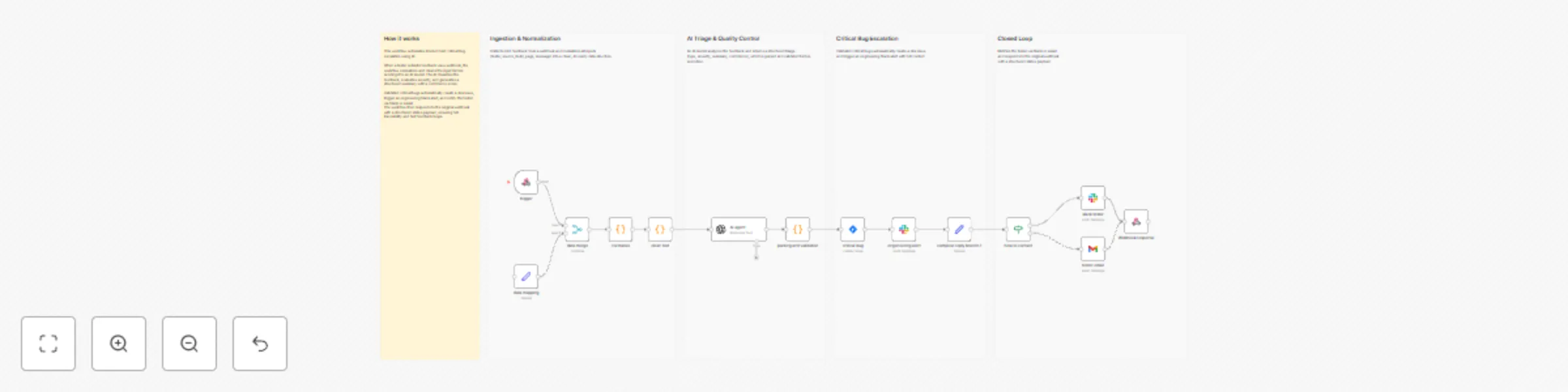
Workflow preview


 Early Deal
DISCOUNT 20%

Important notice
This workflow is provided as-is. Please review and test before using in production.
Overview
Description
Automatically detect and escalate Product UAT critical bugs using AI, create Jira issues, notify engineering teams, and close the feedback loop with testers.
This workflow analyzes raw UAT feedback submitted via a webhook, classifies it with an AI model, validates severity, and automatically escalates confirmed critical bugs to Jira and Slack. Testers are notified, and the original webhook receives a structured response for full traceability.
It is designed for teams that want fast, reliable critical bug handling during UAT without manual triage.
Context
During Product UAT and beta testing, critical bugs are often buried in unstructured feedback coming from forms, Slack, or internal tools.
Missing or delaying these issues can block releases and create friction between Product and Engineering.
This workflow ensures:
Faster detection of critical bugs
Immediate escalation to engineering
Clear ownership and visibility
Consistent communication with testers
It combines AI-based classification with deterministic routing to keep UAT feedback actionable and production-ready.
Who is this for?
Product Managers running UAT or beta programs
Project Managers coordinating QA and release readiness
Engineering teams who need fast, clean bug escalation
Product Ops teams standardizing feedback workflows
Any team handling high-volume UAT feedback
Perfect for teams that want speed, clarity, and traceability during UAT.
Requirements
Webhook trigger (form, Slack integration, internal tool, etc.)
OpenAI account (for AI triage)
Jira (critical bug tracking)
Slack (engineering alerts)
Gmail or Slack (tester notifications)
How it works
Trigger The workflow starts when UAT feedback is submitted via a webhook.
Normalize & Clean Incoming data is normalized (tester, build, page, message) and cleaned to ensure a consistent, AI-ready structure.
AI Triage & Validation An AI model analyzes the feedback and returns a structured triage result (type, severity, summary, confidence), which is parsed and validated.
Critical Bug Escalation Validated critical bugs automatically:
create a Jira issue with full context
trigger an engineering Slack alert
Closed Loop The tester is notified via Slack or email, and the workflow responds to the original webhook with a structured status payload.
What you get
Automated critical bug detection during UAT
Instant Jira ticket creation
Real-time engineering alerts in Slack
Automatic tester communication
Full traceability via structured webhook responses
About me :
I’m Yassin a Product Manager Scaling tech products with a data-driven mindset. 📬 Feel free to connect with me on Linkedin