Email reports on expiring Microsoft Entra ID app secrets and certificates with Microsoft Graph
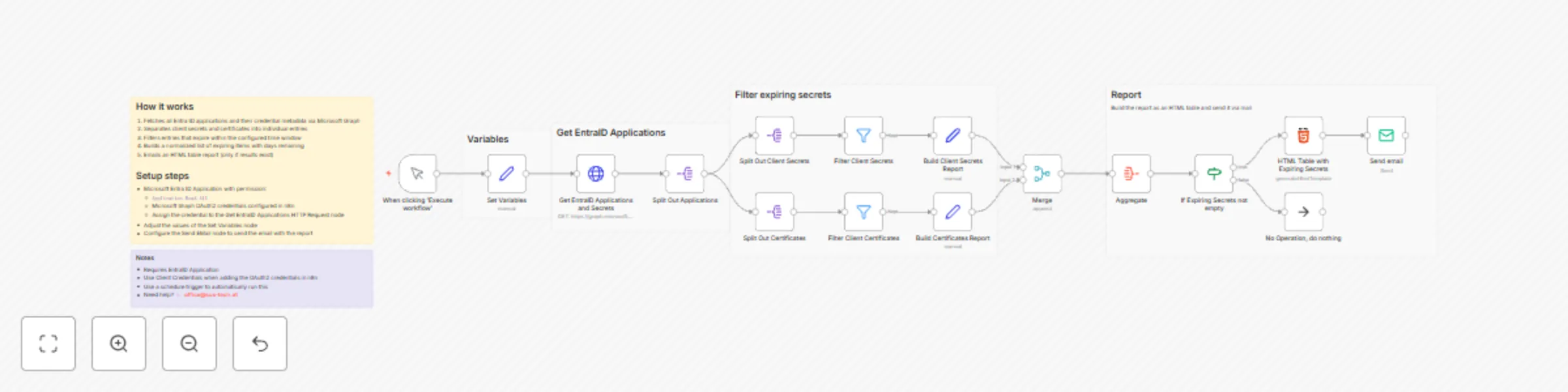
Workflow preview


 Early Deal
DISCOUNT 20%

Important notice
This workflow is provided as-is. Please review and test before using in production.
Overview
Monitor expiring EntraID application secrets and notify responsible
Stay ahead of credential expirations by automatically detecting Entra ID application client secrets and certificates that are about to expire, and sending a neatly formatted email report.
What this workflow solves
Expired client secrets and certificates are a common cause of unexpected outages and failed integrations. Manually checking expiration dates across many Entra ID applications is tedious and easy to miss. This workflow automates the discovery and reporting of credentials that will expire within a configurable time window.
Key features
Fetches all Microsoft Entra ID applications along with:
Client secrets (
passwordCredentials)Certificates (
keyCredentials)
Splits credentials into individual entries for easier processing
Filters credentials expiring within the next N days (configurable)
Normalizes results into a consistent structure including:
Application name
App ID
Credential type (Client Secret / Certificate)
Credential name + ID
Days remaining until expiration
Generates an HTML table report, sorted by application name
Sends an email only when expiring items are found (otherwise does nothing)
How it works
- Fetches all Entra ID applications and their credential metadata via Microsoft Graph
- Separates client secrets and certificates into individual entries
- Filters entries that expire within the configured time window
- Builds a normalized list of expiring items with days remaining
- Emails an HTML table report (only if results exist)
Setup requirements
Microsoft Entra ID app registration with Microsoft Graph Application permissions:
Application.Read.All
In n8n:
Create Microsoft Graph OAuth2 credentials (Client Credentials flow recommended)
Assign those credentials to the Get EntraID Applications and Secrets HTTP Request node
Update the Set Variables node:
notificationEmail: where to send the reportdaysBeforeExpiry: alert window in days (e.g., 14)
Notes
The email table highlights soon-to-expire credentials more prominently (based on remaining days).
For automation, replace the manual trigger with a Schedule Trigger (e.g., daily/weekly).
The workflow accesses metadata only (names/IDs/expiry), not secret values.